the other day I wanted to make my first project „wireless“ by powering it via Battery. I found online, the the Arduino can handle quite an amount of current without me regulating it.
Since I wanted to power the Arduino UNO (original) and a Servo Motor (5V) I chose to use 2x 18650 batteries in serial. According to my multimeter this lead to a current of 8V. But all I earned was white smoke coming from my Arduino, but it survived.
Then I tried the 9V block battery - it powered the Arduino, but being only on the battery the Arduino failed to power the servo - at least the servo did not move.
This lead me to my (nooby) conclusion, that it has to do something with power. And in deed 9V blocks seem to have something between 0.6 and 1.2A while my 18650s seem to have 6.5A each.
Until now I believed a battery delivers only as much amps as needed, so frying a device with too much amps should be impossible, afaik.
Now my questions:
is my assumption correct that the issues (smoke/ inoperable Servo) are related to too much/ too few power?
why was that the case and what was wrong with my assumption that a device only gets as much amps as required?
how do I prevent this? How can I operate my projects on 18650 batteries (especially with each 18650 having potentially a different max A)?
The 18650 battery has a voltage of 3.6v and has between 2600mAh and 3500mAh (mili-amp-hours).
Placing two of them fully charged results in a 7.2 volt battery with a current rating of between 2600mAh and 3500mAh (mili-amp-hours). This is in series not serial.
The unit of electro motive force is the volt. The unit of current in simple terms is the amp.
A source will have a Voltage and a Current capacity. A car battery may be able to source 100 amps (just as an example) and if I place a 1.0 amp load on it the load will only draw its rated current assuming a 12 volt battery and 12 volt load.
Since you did not describe or link to your servo I have no idea. The 5.0 Vout on for example on an Arduino board is not an infinite current source.
That assumption is correct.
You may want to check your wiring and please show a schematic in your post. I can appreciate English is likely not your first language but terminology is important.
Welcome. I recommend against the 9V smoke alarm batteries as they do not last nor as you noted do not supply much current. I do not know how you wired this thing but it sounds like you connected the batteries to the 5V pin, this will fry things it must be 5V. There is another input labeled Vin which will comfortable work with 8V. An important rule is that the Arduino a Power Supply it is NOT! You can save some money by first posting an annotated schematic that we will check and make suggestions. This can save you from destroying many components. Many of us do not like fritzing as it is a wiring thing, not a schematic. There are many full blown CAD packages available for free or as a trial at no charge. I use KiCad, it works great for me. Also if you do not have any experiance with CAD it will be not be a few evening learning experience. I use it for schematic capture through Gerber files to make my PCBs (Printed Circuit Boards).
Without knowing how you connected the equipment we would only be guessing - so we need a schematic.
You will learn a lot of simple electronics by doing schematics, and also save a lot of mistakes.
The 18650 battery has a voltage of 3.6v and has between 2600mAh and 3500mAh (mili-amp-hours).
In theory, yes. But if it is fully charged it can reach up to 4V. Mabe that's because they where quite cheap, but it's possible for mine.
You may want to check your wiring and please show a schematic in your post. I can appreciate English is likely not your first language but terminology is important.
Yes, I mixed up some terminology, I'm very sorry. Unfortunately, I cannot edit my initial text anymore. When I said current I meant voltage (2nd paragraph), when I said power I meant current
I used Vin on the Arduino to connect the batteries to. Luckily, the Arduino survived, despite smoking like a lokomotive. I think there was much luck involved.
Some time ago I tried KiCAD, but switched to Fritzing since it is way more accessible to beginners like me. You can basically copy & paste your breadboard from your desk into the software and create a schematic from it. I even once created a PCB from it. It might not have the most accurate elecronics symbols, I hope it is understandable enough, though.
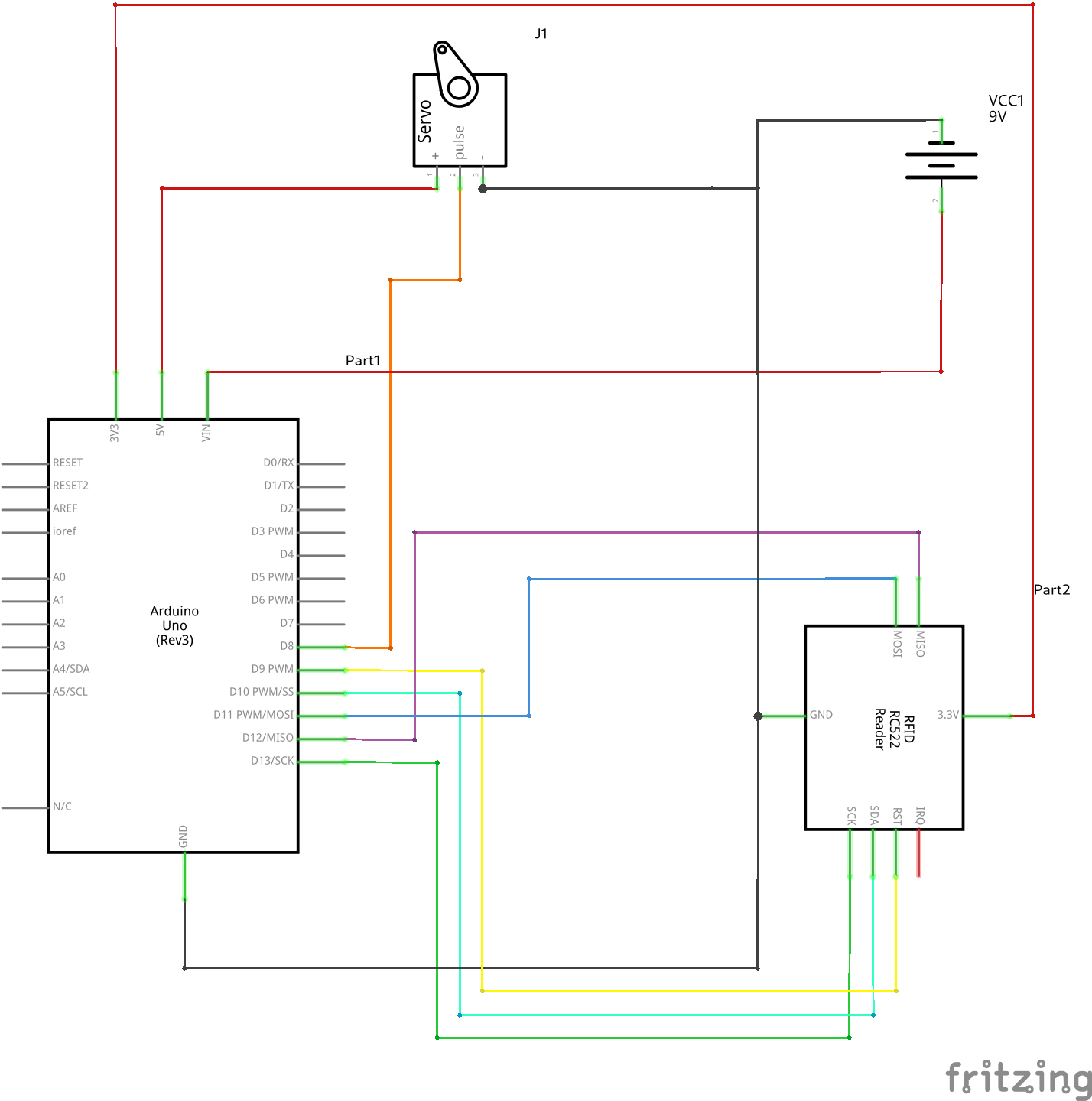
I added my schematic file (made in Fritzing, unfortunately) to display my wiring:
Ah, I also added the RFID Card Reader to the schematic. I did not mention it previously, sorry. I was not sure if it is mentionable for the question why the Arduino started smoking. Also: You can replace the 9V with two 18650 in series, back then I just did that, I pulled the wires of the 9V battery out of the breadboard and sticked the 18650 back in.
Supplying the servo with 5V that is from the MCU regulator will not work out well for the project and could be a source of smoke. And if the MCU smoked like a train, it its broken and what is broke is just not known yet.
As has been mentioned several times, the Uno is not a power supply, especially for motors.
If you seen smoke then something is damaged. It's not a good idea to continue with that board. Buy a new one.
You should not power the servo from the arduino 5V output. Even the small ones can have a stall currents over 500mA. That may fry the 5V regulator. What you should do is use the two 18650 batteries in series but use a buck regulator to step that down to 5V for the servo and the arduino.
thank you very much for your help. So what I understood is, that the Servo might have pulled more amps through the Vin than the Arduino can handle and somewhere between Vin and the 5V output to the servo something gave up and started to smoke.
So next time I’ll power only “lightweight” devices through the Arduino (if any), but would prefer to power everything through an external supply.