Hello Community,
I'm building a code that takes input from several sensors and the result to display on my sign that has about 100 WS2812 LEDs. I have problems with the code. So here is the situation so far.
I have a DHT11 sensor and a LDR. humidity and HeatIndex values are taken and mapped to a certain color so that its reflected on my sign. And brightness is changed according to the values from the LDR. For these changes in color and brightness I used the map() function but, for a smooth fade used the idea from "Hans Jørgen" (Natural-Nerd/sound_reactive.ino at master · hansjny/Natural-Nerd · GitHub) and managed to play around with the values. the code is 270+ lines. so here is my code:
#include "DHT.h"
#include "FastLED.h"
#include <math.h>

#define DHTPIN 8
#define DHTTYPE DHT11   // DHT 11

#define NUM_LEDS_1 60
#define LED_PIN 10
#define NUM_LEDS_2 21
#define LED_PIN_2 11
#define UPDATES_PER_SECOND 100

int old_temp_color = 0;
int old_humd_color = 0;
int old_brightness = 200;

DHT dht(DHTPIN, DHTTYPE);
CRGB leds_1[NUM_LEDS_1];
CRGB leds_2[NUM_LEDS_2];

/*for sound sensor*/
const int sampleWindow = 50; //sample window width in ms(50ms =20Hz)
unsigned int sample;


/*values for temperature and fade*/
int i;
void fade_between_temp(int a, int b, CRGB leds_1[NUM_LEDS_1], int del, int bright);
void set_definite_temp(int a, CRGB leds_1[NUM_LEDS_1], int bright);

/*values for humidity fade*/
int k;
void fade_between_humd(int e, int f, CRGB leds_2[NUM_LEDS_2], int del, int bright);
void set_definite_humd(int e, CRGB leds_2[NUM_LEDS_2], int bright);

/*values and functions for brightness fade*/
int j;
void fade_between_brightness(int c, int d, CRGB leds_1[NUM_LEDS_1], CRGB leds_2[NUM_LEDS_2], int del, int color1, int color2);
void set_definite_brightness(int c, CRGB leds_1[NUM_LEDS_1], CRGB leds_2[NUM_LEDS_2], int color1, int color2);


/*for LDR*/
int ldr = A0;//Set A0(Analog Input) for LDR.
int ldr_raw = 0;

/*for motion sensor*/
int PIR = 2;
unsigned long myTime;
unsigned long finish;


void setup() {
  Serial.begin(9600);
  Serial.println("starting the system");
  FastLED.addLeds<WS2812, LED_PIN, GRB>(leds_1, NUM_LEDS_1);
  FastLED.addLeds<WS2812, LED_PIN_2, GRB>(leds_2, NUM_LEDS_2);

  for (int x = 0, y = 0; (x < NUM_LEDS_1) && (y < NUM_LEDS_2); x++, y++) {
    leds_1[x] = CHSV(255, 0, old_brightness);
    leds_2[y] = CHSV(255, 0, old_brightness);
  }
  FastLED.show();
  delay(2000);
  /*temperature and humidity sensor*/
  dht.begin();

  //  /*PIR sensor*/
  //  pinMode(PIR, INPUT);    // initialize sensor as an input
  //
}

void loop() {
  // Wait a few seconds between measurements.
  delay(2000);
  // Reading temperature or humidity takes about 250 milliseconds!
  // Sensor readings may also be up to 2 seconds 'old' (its a very slow sensor)
  float h = dht.readHumidity();
  float t = dht.readTemperature();
  float f = dht.readTemperature(true);

  // Check if any reads failed and exit early (to try again).
  if (isnan(h) || isnan(t) || isnan(f)) {
    Serial.println(F("Failed to read from DHT sensor!"));
    return;
  }
  // Compute heat index in Celsius (isFahreheit = false)
  float hic = dht.computeHeatIndex(t, h, false);

  Serial.print(F("Humidity: "));
  Serial.println(h);
  Serial.print(F("%  Temperature: "));
  Serial.println(t);
  Serial.println(F("°C "));
  Serial.println(f);
  Serial.print(F("°F  Heat index: "));
  Serial.println(hic);
  Serial.println(F("°C "));

  if (hic < 18) {
    hic = 18;
  }
  if (hic > 35) {
    hic = 35;
  }
  int new_temp_color = map(hic, 18, 35, 95, 0);
  Serial.print(" new_temp_color = ");
  Serial.println(new_temp_color);
  Serial.print(" old_temp_color = ");
  Serial.println(old_temp_color);

  if (new_temp_color < 0) {
    new_temp_color = 0;
  }
  if (new_temp_color > 95) {
    new_temp_color = 95;
  }
  fade_between_temp(old_temp_color, new_temp_color, leds_1, 100, old_brightness );
  delay(1000);
  old_temp_color = new_temp_color;


  if (h < 10) {
    hic = 1;
  }
  if (h > 85) {
    hic = 85;
  }
  int new_humd_color = map(h, 10, 85, 135, 165);
  Serial.print(" new_humd_color = ");
  Serial.println(new_humd_color);
  Serial.print(" old_humd_color = ");
  Serial.println(old_humd_color);

  if (new_humd_color < 135) {
    new_humd_color = 135;
  }
  if (new_humd_color > 165) {
    new_humd_color = 165;
  }
  fade_between_humd(old_humd_color, new_humd_color, leds_2, 100, old_brightness );
  delay(1000);
  old_humd_color = new_humd_color;

  /*LDR sensor*/
  // Wait a few seconds between measurements.
  delay(1000);
  ldr_raw = analogRead(ldr);//Reads the Value of LDR(light).
  int new_brightness = map(ldr_raw, 0, 1000, 255, 50);
  Serial.print(" new brightness = ");
  Serial.println(new_brightness);
  Serial.print(" old brightness = ");
  Serial.println(old_brightness);

  fade_between_brightness(old_brightness, new_brightness, leds_1, leds_2, 100, new_temp_color, new_humd_color);
  delay(1000);
  old_brightness = new_brightness;

  //  /*pir sensor*/
  //  delay(500);
  //   Serial.println("HIHI");
  //  //Wait a few seconds between measurements
  //  int val = digitalRead(PIR);   // read sensor value
  //  if (val == HIGH) {           // check if the sensor is HIGH
  //
  //    Serial.println("motion detected");
  //    myTime = millis();
  //    finish = myTime + 10000;
  //
  //    rainbow();
  //
  //    while (millis() != finish) /* spin your wheels */ ;


}


/*for temp color fade*/
void fade_between_temp(int a, int b, CRGB leds_1[NUM_LEDS_1], int del, int bright) {
  int i, j, steps = 100;
  double dsteps = 100.0;
  double s1, tmp1;
  s1 = double((b - a)) / dsteps;
  tmp1 = a;

  for (i = 0; i < steps; i++) {
    tmp1 += s1;
    for (j = 0; j < NUM_LEDS_1; j++)
      leds_1[j] = CHSV((int)round(tmp1), 255, bright);
    FastLED.show();
    delay(del);
  }
  set_definite_temp(b, leds_1, bright);
}

void set_definite_temp(int a, CRGB leds_1[NUM_LEDS_1], int bright) {
  int i;
  for (i = 0; i < NUM_LEDS_1; i++)
    leds_1[i] = CHSV(a, 255, bright);

  FastLED.show();
}

/*for humd color fade*/
void fade_between_humd(int e, int f, CRGB leds_2[NUM_LEDS_2], int del, int bright) {
  int i, j, steps = 100;
  double dsteps = 100.0;
  double s1, humd1;
  s1 = double((f - e)) / dsteps;
  humd1 = e;

  for (i = 0; i < steps; i++) {
    humd1 += s1;
    for (j = 0; j < NUM_LEDS_2; j++)
      leds_2[j] = CHSV((int)round(humd1), 255, bright);
    FastLED.show();
    delay(del);
  }
  set_definite_humd(f, leds_2, bright);
}

void set_definite_humd(int e, CRGB leds_2[NUM_LEDS_2], int bright) {
  int i;
  for (i = 0; i < NUM_LEDS_2; i++)
    leds_2[i] = CHSV(e, 255, bright);

  FastLED.show();
}


/*for brightness fade*/
void fade_between_brightness(int c, int d, CRGB leds_1[NUM_LEDS_1], CRGB leds_2[NUM_LEDS_2], int del, int color1, int color2) {
  int j, k, l, steps = 100;
  double dsteps = 100.0;
  double s1, bright1;
  s1 = double((d - c)) / dsteps;
  bright1 = c;

  for (j = 0; j < steps; j++) {
    bright1 += s1;
    for (k = 0, l = 0; (k < NUM_LEDS_1) && (l < NUM_LEDS_2); k++, l++)
      leds_1[k] = CHSV(color1, 255, (int)round(bright1));
    leds_2[l] = CHSV(color2, 255, (int)round(bright1));
    FastLED.show();
    delay(del);
  }
  set_definite_brightness(d, leds_1, leds_2, color1, color2);
}

void set_definite_brightness(int c, CRGB leds_1[NUM_LEDS_1], CRGB leds_2[NUM_LEDS_2], int color1, int color2) {
  int j, k;
  for (j = 0, k = 0; (j < NUM_LEDS_1) && (k < NUM_LEDS_2); j++, k++)
    leds_1[j] = CHSV(color1, 255, c);
  leds_2[k] = CHSV(color2, 255, c);

  FastLED.show();
}


/*patterns if motion is detected*/
void rainbow() {
  for (int i = 0; i < NUM_LEDS_1; i++) {
    fill_rainbow(leds_1, i, 0, 255 / NUM_LEDS_1);
    FastLED.show();
    delay(50);
  }
  FastLED.clear();
}
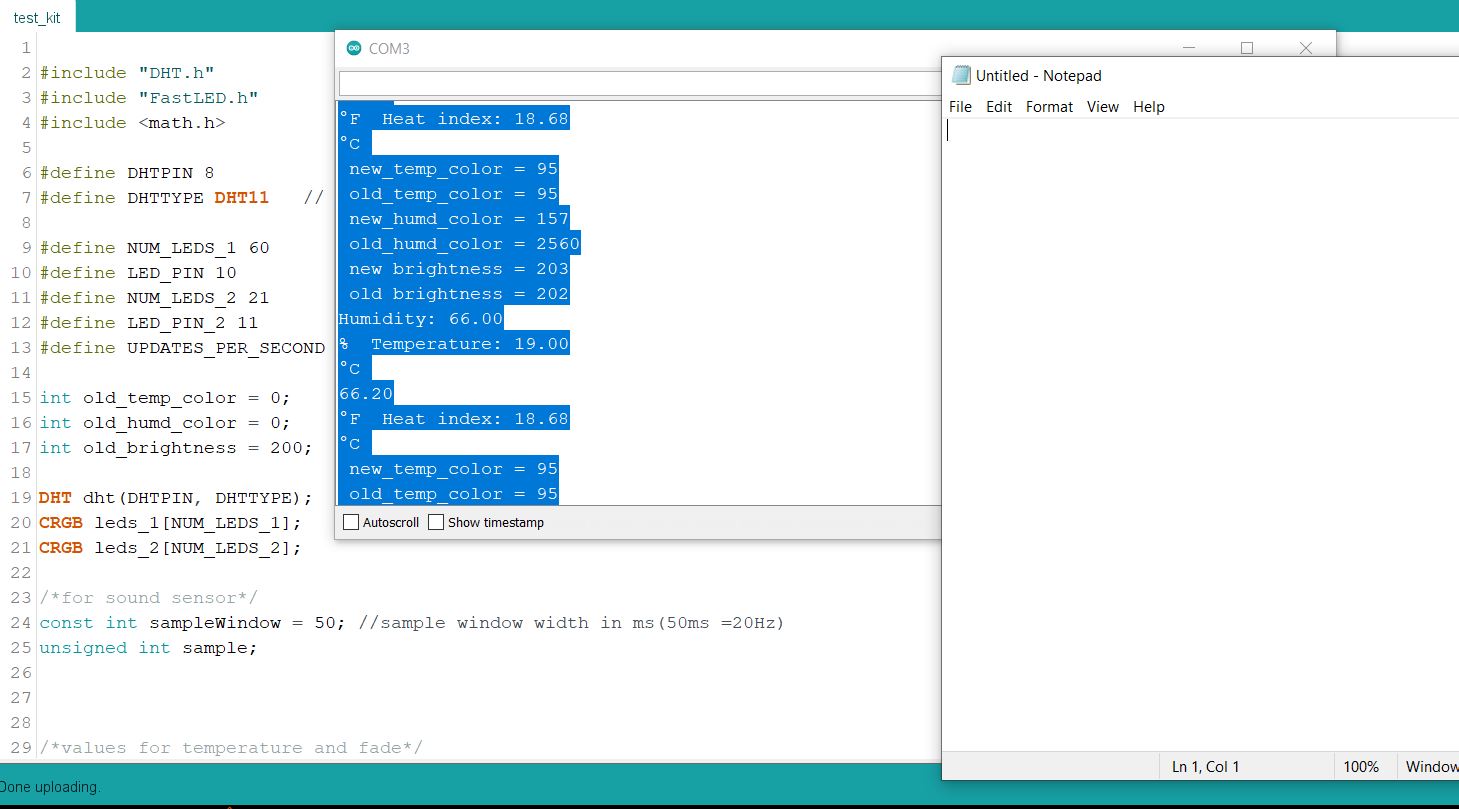
The problem now: Everything works fine except the humidity_fade function, where the old_humidity value keeps changing abruptly which disturb the colour fading function that's related to humidity. I don't know where these values are coming from. If you see my code, the error is somewhere between 132-146 lines.
Could somebody please help me solve this issue?
 Thank you!