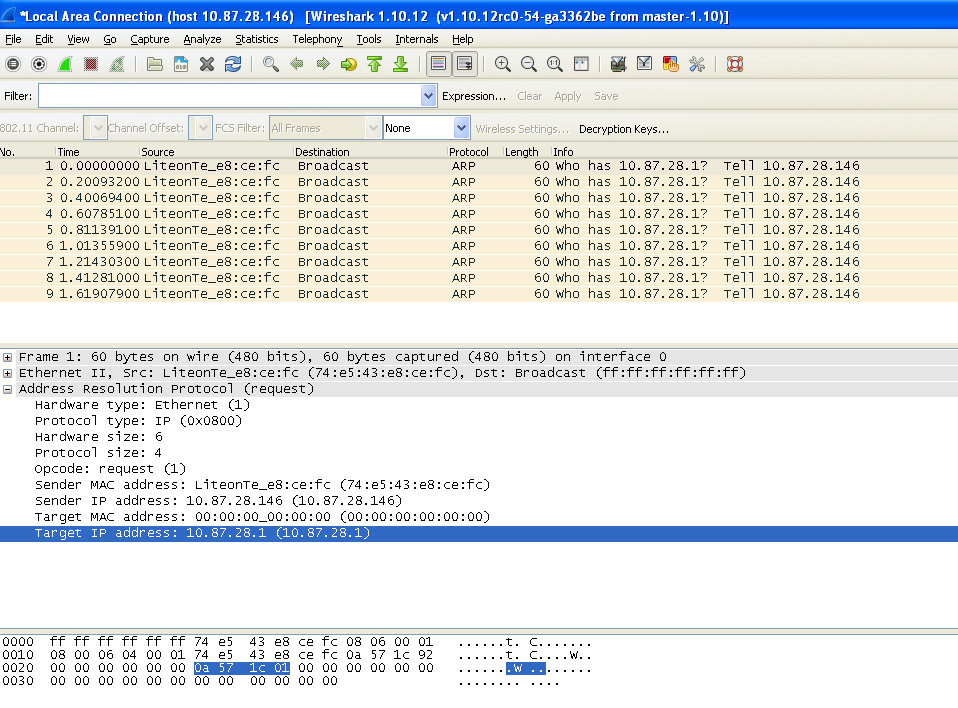
I have been attempting to get this fake DNS server to function within my Hamnet mesh network to point to my NTP server. For days I thought it was the NTP server failing to respond until I finally did some packet sniffing with WireShark. The problem appears to be that the return address for the NTP server from the DNS server is being truncated as it is the last part of the returned packet to a DNS request.

This is using an UNO R3 with an Arduino ethernet shield. When I debug print the responseBuffer after ending the UDP write, everything is there! So maybe someone has some idea why the sent responseBuffer truncates the IP address.
Thanks
#include <SPI.h>
#include <Ethernet.h>
#include <EthernetUdp.h>

// setting for EthernetShield
byte mac[] = {
  0x74, 0xE5, 0x43, 0xE8, 0xCE, 0xFC};
byte ip[] = { // IP of DNS Server
  10, 87, 28, 146};

byte resIp[] = { // IP response
  10, 87, 28, 147};

unsigned int listenPort = 53;
IPAddress remoteIp;
unsigned int remotePort;
EthernetUDP Udp; // An Ethernet UDP instance
#define PACKET_MAX_SIZE 512

char requestBuffer[PACKET_MAX_SIZE];
char responseBuffer[PACKET_MAX_SIZE];
String readString;

void setup() {
  Ethernet.begin(mac, ip);
  Udp.begin(listenPort);
  Serial.begin(19200);
}

void loop() {
  int requestSize = Udp.parsePacket();
  if(requestSize) {
    Udp.read(requestBuffer, PACKET_MAX_SIZE);
    remoteIp = Udp.remoteIP();
    remotePort = Udp.remotePort();

    int type = (requestBuffer[2] >> 3) & 15;
    if(type == 0) { // Standard Query
      readString = "";
      int ini = 12;
      int lon = requestBuffer[ini];
      char domain[64];
      int i = 0;
      while(lon != 0) {
        for(int j = 0; j < lon; j++) {
          domain[i++] = requestBuffer[ini + j + 1];
          readString += requestBuffer[ini + j + 1];
        }
        domain[i++] = '.';
        ini += lon + 1;
        lon = requestBuffer[ini];
      }
      domain[i] = '\0';
      if(readString.indexOf('us pool ntp') > 0) { // NTP request exists
        Serial.print(remoteIp);
        Serial.print("  ");
        Serial.println(domain);
        int resIndex = 0;
        for(int k = 0; k < 2; k++) { // identification
          responseBuffer[resIndex++] = requestBuffer[k];
        }
        responseBuffer[resIndex++] = '\x81'; // response
        // recursion desired
        responseBuffer[resIndex++] = '\x80'; // recursive
        // no error
        for(int k = 4; k < 6; k++) { // question
          responseBuffer[resIndex++] = requestBuffer[k];
        }
        for(int k = 4; k < 6; k++) { // answer
          responseBuffer[resIndex++] = requestBuffer[k];
        }
        for(int k = 0; k < 4; k++) { // authority, addition
          responseBuffer[resIndex++] = '\x00';
        }
        for(int k = 12; k < requestSize - 8; k++) { // question
          responseBuffer[resIndex++] = requestBuffer[k];
        }
        responseBuffer[resIndex++] = '\xc0'; // Offset to domain name
        responseBuffer[resIndex++] = '\x0c';
        responseBuffer[resIndex++] = '\x00'; // type
        responseBuffer[resIndex++] = '\x01';
        responseBuffer[resIndex++] = '\x00'; // class
        responseBuffer[resIndex++] = '\x01';
        responseBuffer[resIndex++] = '\x00'; // ttl
        responseBuffer[resIndex++] = '\x00';
        responseBuffer[resIndex++] = '\x00';
        responseBuffer[resIndex++] = '\x3c';
        responseBuffer[resIndex++] = '\x00'; // ip length
        responseBuffer[resIndex++] = '\x04';
        responseBuffer[resIndex++] = resIp[0]; // ip
        responseBuffer[resIndex++] = resIp[1];
        responseBuffer[resIndex++] = resIp[2];
        responseBuffer[resIndex++] = resIp[3];
        responseBuffer[resIndex++] = '\x00'; // end
        Udp.beginPacket(remoteIp, remotePort);
        Udp.write((uint8_t *)responseBuffer, (uint8_t)(resIndex-1));
        Udp.endPacket();
      }
    }
  }
  // delay(10);
}