Compare it to a Raspberry Pi 5 and I thinki you will agree the UNO Q is a bargain and you get an UNO as well.
1 Like
Take a close look at the pin spacing on a Uno board. It would make sense if it were on a 0.1 inch matrix in both directions so that you could use perf board for a shield.
However, due to a mistake in the original Uno pin layout, one of the gaps between pins in the same row is not 0.1 inch so all shields that plug into it have to have custom pin spacing
1 Like
Well, that's just weird news. I had to make sure it wasn't April Fool's Day. 
1 Like
This might be a turning point, like major.
For the good or for the bad, mixed feelings here.
Arduino really got me into programming ‘low level‘, understanding how chips work and how to tame them. How will this work out for newbies from now on? What route will Qualcomm take?
I have a weird, anxious underbelly feeling about this….
Big tech taking over has never been ‘good‘.
So it is still called a Uno. I've lost count of the number of completely incompatible processors which are mounted on boards called "Uno". I, for one, will probably not be getting one simply because I don't want to have to get familiar with yet another great stack of MCU datasheets to do important things which are not generally supported by existing libraries such as low power modes, special timer configuration, advanced control of peripherals such as the ADC etc. etc.
4 Likes
And learn a new developer software program.
Because this is new hardware, there is also a new developer environment, App Lab.
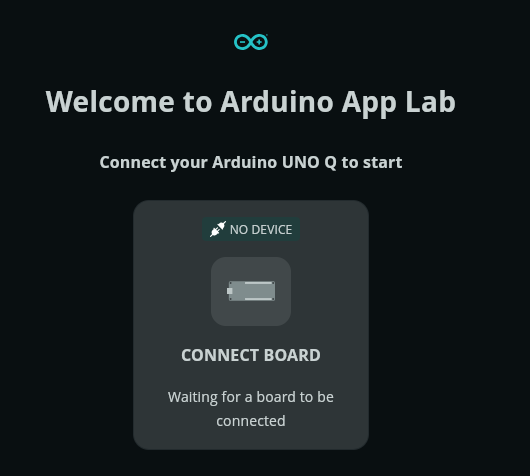
Will the Uno Q be as poorly documented and as poorly supported with examples and device libraries as many of the other recently introduced, and presumably now orphaned Arduino products?
I experimented for a bit with an STM32 board and decided that the entire effort was a complete waste of time, partly because of the many errors and omissions in the (now abandoned) Arduino core support.
That is not meant to diminish Roger Clark's heroic efforts to maintain it, but one person alone cannot hold back the rising tide.
5 Likes
Ah! Another Weasley Uno?
I don't expect something new from a new Uno.
Another overly complicated board for rare, isolated users, like the OPTA or GIGA. And then the unfortunate few who bought it are left wandering around forums where no one can help them.
Linux in a microcontroller is nothing new. Raspberry has reaped the harvest. I think the future lies with boards with integrated FPGAs, where the user can design their own microcontroller.
3 Likes
How is that different from today especially for Cloud apps?
How will the free dev environment add support for a new Qualcomm designed board with a Qualcomm ARM SOC and no datasheet? For that you’ll need the official IDE. It will likely start out being free and maybe remain open source for a while. The usual corporate enshittification will change that over time.
I don't want to go too far off topic here, but has the STM32 been abandoned again ? After Roger Clark quit the scene, ST Microelectronics began to maintain an Arduino core for all of their boards. Now I look on their web site and it looks very bare: https://www.stm32duino.com/ , however, the github repository at GitHub - stm32duino/Arduino_Core_STM32: STM32 core support for Arduino seems to be maintained with an impressively low number of open issues.
EDIT
Maybe it isn't so off topic after all. The Uno Q has a ST Microelectronics STM32U585 processor, together with the Qualcomm Dragonwing QRB2210 microprocessor on the board. The STM32U585 is also supported by the STMDUINO Arduino core. I'd be curious to know if the STMDUINO core is included in the development system for Uno Q or if another core has been written to handle it.
EDIT 2
The STM32U585 uses the core below and not the ST microelectronics core:
There are two different cores. The STM core is not a successor of the Clark's one.
I think Clark's is better. By the way Clark's repository is not archived and still maintained.
I prefer this package for my STM32 projects and even sometimes make PRs to the repo.
I gave up on STM32 several years ago, and at the time I had the impression that Roger Clark had stopped maintaining his core. I see now that updates were made a few months ago.
As for a modular linux based MCU, I have trouble imagining that the Uno Q could even begin to compete with, for example, the RPi Zero W or W2, which have a rock solid OS, supported by over a decade of development in device, machine vision, scientific computing and AI libraries and applications, as well as active participation by a community much larger and with a great deal more expertise than that centered around Arduino.
1 Like
I didn't expect it to be free. I'm the last guy to expect anything for free and I'm grateful that the IDE is.
I paid for the cloud thing for a year. it didn't do what I wanted: Cloud Serial data transfer.
Further looking at the available information:
Arduino seem to be continuing their trend of 10 pounds of ... stuff... in a 5 pound bag. Both sides of the board are well populated.
I think the elimination of the barrel connector for the 7-24V Vin is a shortcoming.
No SD card slot seems like a mistake.
There are 2 60-pin expansion connectors so that is good.
Seems to have the Arduino Bridge for interprocessor communication.
I need to finish reading the data sheet.
1 Like
The big question is: why would Qualcomm buy Arduino. There can only be one answer: money.
The next biggest question is: how do they plan to make the money…?
The rest about families and making things greater together is pure marketing and tries to play on your emotions. Sure there will be some benefits, but those are only the means to financial ends.
There is one guarantee though that it will not be good for Arduino and it’s community. It never is.
Time will tell.
2 Likes
Yeah. I would be happier if Arduino maintained a focus on the smaller and more minimal microcontrollers, and the "less than $30" price point.
But the performance per dollar in that space sort of sucks, and I see the attraction of more power... I don't think I need a Giga, Portenta, a Q, or even an ESP32, for nearly anything I want to do with an Arduino, but I see a lot of people in the fora getting told "get a more powerful board, for the application you're attempting."
Still... Give me Picos and Xiao/QT Oy...
Or an ebbing tide - PoV.
(-:
I'm not sure about Arduino's having always being open source . . . .
I'm not sure if they will continue that. . . .
Welp, I love the Uno, Nano, and Uno so there will always be clones of them.
1 Like