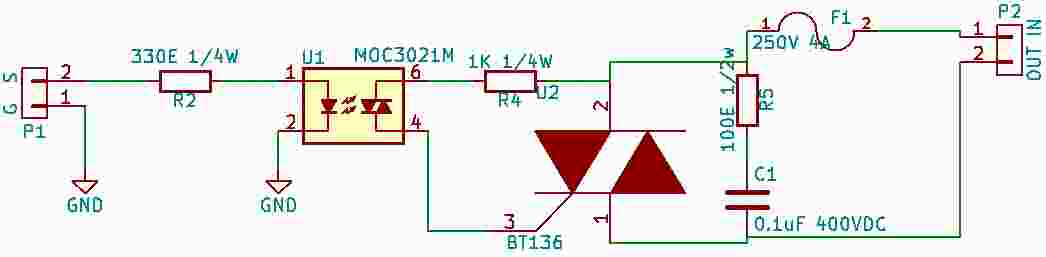
Can someone please help me to find the resistor watts required for R4 in the attached schematic.
I want to control my PANASONIC NA-127VB3 washing machine from arduino. Resistor R4 which is 1K 1/4W is burned, The schematic works for lights without any issue
Energy consumption by washing machine is 0.80kWh/cycle, What should be the watts of the resistor (R4) in this case?
I suspect the original calculation for R4 was correct (it limits the drive to the gate of the TRIAC), however, if it is burned, I suspect you will find the associated components are bad - either the TRIAC (BT136) and/or the opto-coupler ( MOC3021 ) are also bad. The fact that R4 is burned indicates it exceeded the design limits - that often happens when something else fails.
The same circuit I tested with a bulb and then I installed it for the washing machine and MOC and TRIAC are new bought from DigiKey just 2 or 3 months back.
I'm still suspicious there is another issue there - in looking at the data sheet for the BT136, it is only rated for 4A rms which seems small for controlling something in a washing machine. If the resistor is just running a bit too hot, but things are functioning as expected, put in a 1/2 watt or even a 1 watt resistor, but if it has turned black and exploded (as resistors do when WAY over their limit), you have other issues. I would check the triac if things are not working and see if it is still good. Your schematic does not show what that triac is controlling, but if it is something like the motor, that seems pretty small for the control triac.
This was the data sheet I was looking at for the triac: BT136 data sheet
Yeah... The 1/4W resistor should be fine (until the TRIAC burns-up).
BT136 TRIAC is rated at 4 Amps maximum. And it probably needs a heatsink.
800 Watts at 120V is: 800/120 = 6.7 Amps. At 240V, it's half that.
You've probably got at least twice the rated current when the motor starts-up and normally it's a good idea to "derate" components. So, I'd look for a TRIAC rated for 4 or 5 times the expected/calculated current.
Sorry I did not mentioned about the A/C rating, here in UAE it is 240V which come to 3.3 Amps. So the traic rating should be fine.
@gpsmikey, yes you were right, Initially when I test the circuit with a light bulb it was fine, I am not sure what went wrong after that. The triac was faulty. I got continuity on T1 and T2 of triac. Replaced the traic and working fine for last 1 hour, I will wait for some more time to see if there is any other issue.
You should not be using a 4A triac for a 3.3A load, especially a motor - that's begging for premature failure. You've hardly got any headroom there, and the headline specs for a device are always sorta optimistic (though reputable manufacturers will tell you the conditions under which those numbers are valid if you read the footnotes in the datasheet)
I agree with DrAzzy - I would never design a circuit (especially motor control) with a triac that close to the running current of the motor. In a design like that the triac will operate in one of two modes - going to fail and has failed Motors are notorious for high starting current - especially if under load (like a big load of wet laundry).
That is more in the range of what I would choose (I would have picked something in the 15-20 amp range typically). You will need to look at the differences between the two - I notice this one says the gate is less sensitive to minimize noise immunity. That could mean a lower value of R4 but make sure the opto coupler can handle the gate current. It also says it only triggers in 3 quadrants - I'm not sure all the ramifications there - if it is being just used for motor control (on or off) then that should not be an issue. You also need to consider a heat sink. It indicates it has 2500 volt isolation between any terminal and the tab, so the tab can be mounted on a heat sink without it having to be electrically "hot" (many devices have one leg common to the mounting tab).
gpsmikey:
It also says it only triggers in 3 quadrants - I'm not sure all the ramifications there
That's OK - it only needs to trigger in two, and generally those either both correspond to a positive gate voltage, or a gate voltage matching T2 - as in this case.
R4 is effectively a fusible resistor. It only ever dissipates any significant power when the BT136 fails so conversely, it tells you this has happened.
DVDdoug:
You've probably got at least twice the rated current when the motor starts-up and normally it's a good idea to "derate" components. So, I'd look for a TRIAC rated for 4 or 5 times the expected/calculated current.
Good advice if it is your own machine. But this is a commercial product. Remember Henry Ford's apocryphal dictum.
I would think that should work OK although I don't know what you have in the way of a heat sink - watch the temperature of the TRIAC with a full load and see how hot it gets. My preference is to run things at close to room temperature and NOT just below the melting point of solder
DVDdoug:
Yeah... The 1/4W resistor should be fine (until the TRIAC burns-up).
BT136 TRIAC is rated at 4 Amps maximum. And it probably needs a heatsink.
800 Watts at 120V is: 800/120 = 6.7 Amps. At 240V, it's half that.
You've probably got at least twice the rated current when the motor starts-up and normally it's a good idea to "derate" components. So, I'd look for a TRIAC rated for 4 or 5 times the expected/calculated current.
And, use a heatsink.
Modern energy efficient washing machines are much more complex than you think, the motor
control is all digital and there's ilkely no "inrush" or overloading to worry about, the machine will shut down with a
fault code.
However there seems to have been no attempt to find out what this particular machine needs
in the way of current, nor how inductive a load it is, so the circuit is quite possibly unsuitable.
Triac circuits are not suitable for a highly inductive load.
 Motors are notorious for high starting current - especially if under load (like a big load of wet laundry).
