Hello I bought some stepper motors off Amazon for my Arduino they run from 5 to 12 volts. They don't turn on at 5 volts or even show any lights or indication of life so I want to step up the Arduino vcc output to something higher I hear you can use an npn transistor but all circuit diagrams instead are way too complex I am not an electrical engineer just a programmer so this is very hard for some reason but it sounds so simple. Does anyone have a simple circuit that they use for this ordering little parts like voltage step up and down takes days by then I will have found an alternative. Hope someone understands my frustrations. And tips would be most appreciated.
What you need to do is to use the Arduino output to control an existing external 12V supply rather than trying to step up the output to 12V because the Arduino cannot supply enough current to drive a stepper motor
Have you considered using a stepper motor driver such as SparkFun Motor Driver - Dual TB6612FNG (1A) - SparkFun Motor Driver - Unsoldered Header
Hi, @johnboyman
What lights?
Can you please post a link to specs/data of the steppers?
Can you post some images of your steppers?
Thanks.. Tom.. 


I read somewhere that my Arduino can't handle the amperage is this true can I use a mega 2560?
This is the tutorial that i followed.
Arduino Tutorials for Testers: Stepper Motor - Qxf2 BLOG
its wired exactly. the lights on the stepper never even blink. I open the serial monitor. I set the rpm it says it rotating. I feel retarted. This is such a simple task. Please help.

You can use it, but not as a power supply
Discarded power bricks from various items, like laptops and monitors are easy to find at thrift shops, flea markets and computer recycling places. They work fine for stepper motors.
Amazon link corrected: https://www.amazon.ca/Longruner-Geared-Stepper-Uln2003-arduino/dp/B015RQ97W8
Ah yes, the ever-popular 28byj-48 stepper - 5 Volt version (not the 12) - with the rubbish ULN2003 board. 
You are apparently rather confused - but I must say, that is not surprising given the total rubbish found in the Internet - and even the Arduino site proper! 
An Arduino has nothing to do with any sort of "Amperage".
It is you see, not a power supply, does not in any meaningful way resemble a power supply. The UNO and various other older versions do rather confusingly include a series regulator chip connected to a pin called "Vin" and on some of them a "barrel jack". This is confusing as it is a most unfortunate hangover from the "early days" when "9V" power packs were common and this was a practical way to power a lone Arduino board for initial demonstration purposes with a few simple LEDs connected but almost nothing else (because there was not much else to connect  ). And even then it was limited because an unloaded 9 V transformer-rectifier-capacitor supply would generally provide over 12 V which the regulator could barely handle.
Nowadays, 5 V regulated switchmode packs are arguably the most readily available in the form of "Phone chargers" and switchmode "buck" regulators to regulate down from 12 V or other available voltages are cheap on eBay or Aliexpress so these can be fed into the USB connector or (more appropriately) 5 V pin to provide adequate power for most applications. Unfortunately, many tutorials or "instructables" are seriously outdated or misleading and have not been updated to reflect the contemporary situation.
You can, but in terms of powering, it is identical to the UNO.
Since your picture indicates you have it connected via USB, presumably to a PC or laptop, I must suspect that the USB port is not capable of supplying enough current when the stepper is connected.
Maybe I'm missing it but, I don't see a ground wire between UNO and driver board.
Hi,
Can you please post a circuit diagram?
A drawing of your schematic will be fine, as long as you include component names and pin labels along with power supplies and connections.
Thanks.. Tom...

That breadboard is used for bread !

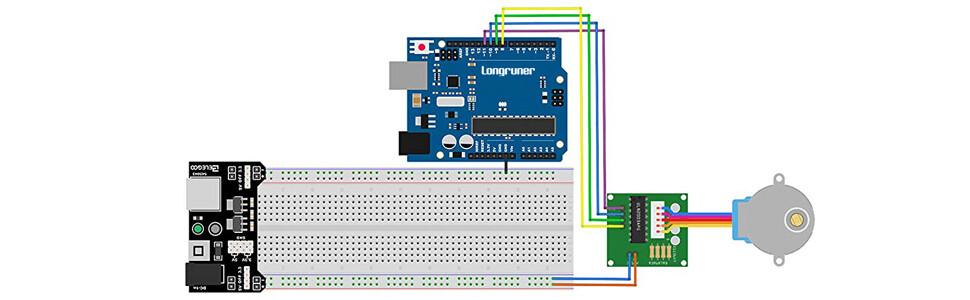
I believe that you are simply missing the proper power connections. As mentioned above, the Arduino in not capable of providing the power you need. Referring to the image (from Amazon) you can see the power lines at the bottom of the breadboard connected to the stepper motor controller.
Adding this should be simple and also resolve your issue.
I believe that the stepper power supply and the Arduino power supply should share a ground connection. If I'm incorrect I hope someone will correct me ASAP.
By the same token, neither is the "MB102 Breadboard Power Supply" indicated in that Fritzing!
Well, unless it is powered through the USB connector from a USB "Phone charger" - and since it is a "type A" socket rather than a plug, you need a male-male adapter cable.
Most versions of this have the diode but not the polyswitch so as long as the diode is adequately rated, can pass up to an Amp of 5 V directly from the USB connector to the selected 5 V output pins. Which apart from the 3.3 V output, is about the only use of the adapter.

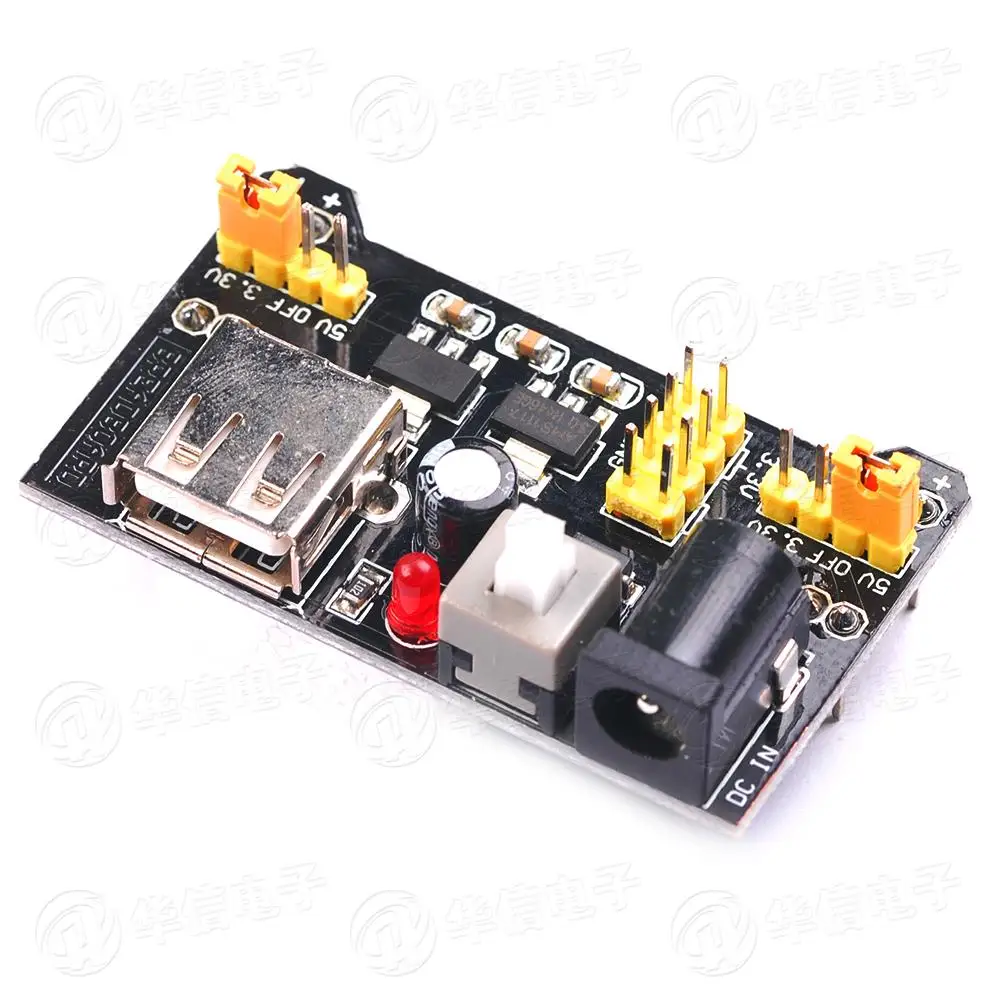
I observe the "5--12V" notation on the PCB. The ULN2003 operates on either 5 v (poorly) or 12 V.
The motors come in 5 or 12 V versions. You have the more common 5 V version so it runs on 5 V, and not 12. Someone (on the fora) here has suggested that if you use a proper driver that actually provides 5 V to the stepper and do that continuously, it tends to overheat!  (100 + 100 mA at 5 V - 1 Watt.)