Hello guys, I’m trying to build a PID boost controller for turbocharged cars. The code works as it should, but the pressure oscilates around the target pressure more than I’d want it and I’m afraid it’s not because of not-good-enough values of P,I and D (sTune library sets the values automatically and I have also tried setting them myself with the best results being close to the sTune results.)
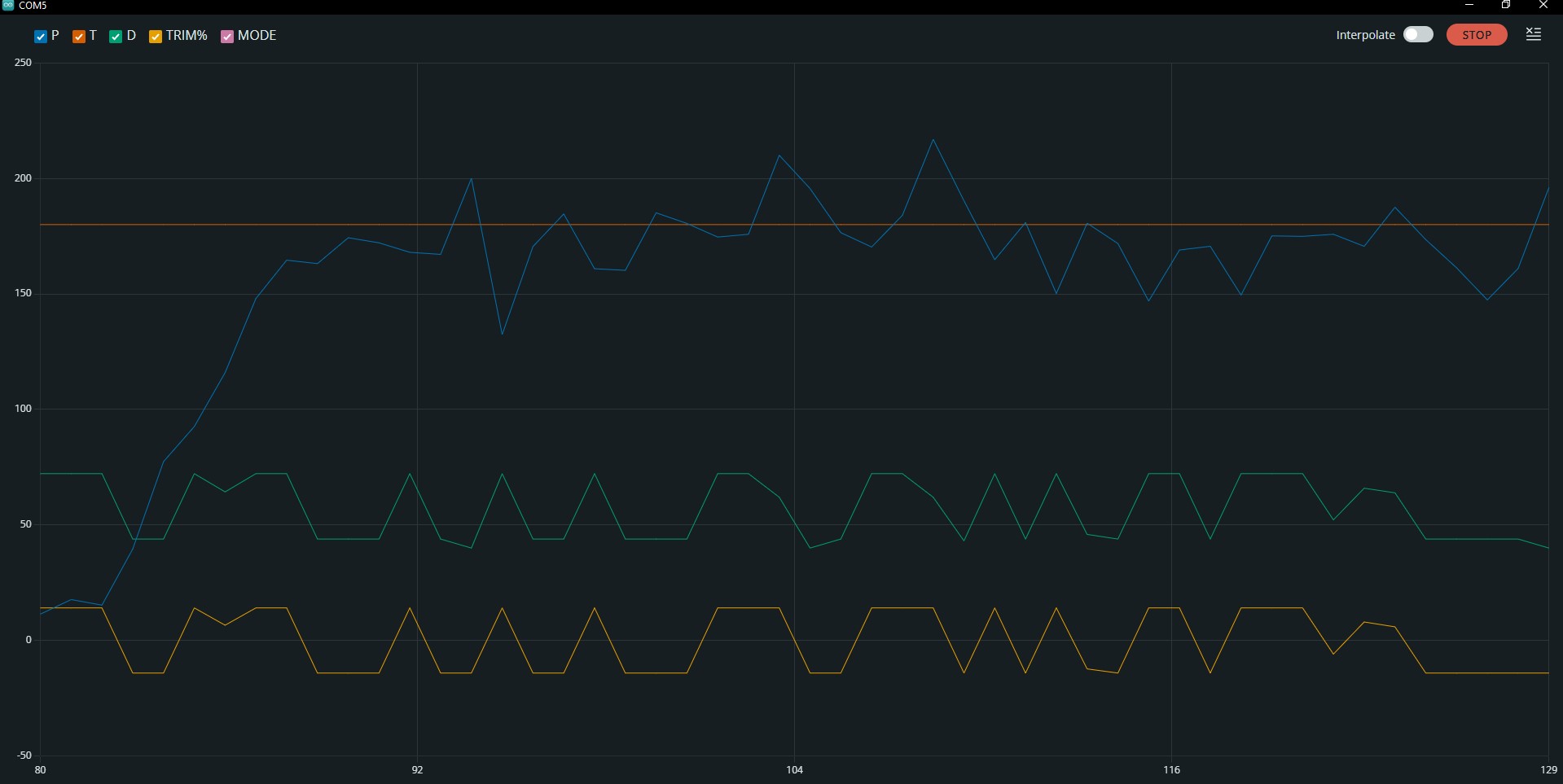
The picture below is from the code I attached below but the blue line oscilates around the 180 kPa target by more than ±10 kPa. An acceptable oscilation would be ± 10 kPa or less

Hardware:
- Arduino UNO
- MAC valve DDBA 12Volt DC (35A-AAA-DDBA-1BA)
- MPX 5500DP pressure sensor
- 16x2 LCD screen
- 1N4001 diode
- IRFZ44 Mosfet
- LM2596 Buck converter
- cables, resistors, a button, a capacitor to filter the sensor’s input…and that’s all pretty much
Code:
```cpp
#include <Wire.h>
#include <LiquidCrystal_I2C.h>
#include <PID_v1.h>
#include "sTune.h"
#include <math.h>

// ================== USER SETTINGS ==================
static const double setpoint_kPa_init = 180.0;  // target boost
static double setpoint_kPa = setpoint_kPa_init;

// Air source (battery inflator) soft limit (it cuts ~250 kPa)
static const double SUPPLY_MAX_KPA = 245.0;   // safety headroom for guard
static const double OVERSHOOT_MARGIN = 10.0;  // start backing off above SP + margin

// PID gains for TRIM (15 ms sample time, feed-forward enabled)
static double Kp = 2.2, Ki = 0.34, Kd = 0.32;

// Feed-forward base and trim ranges
static const double BASE_DUTY_FRAC = 0.58;   // 60% base duty
static const double MAX_BASE_BACKOFF = 0.1;  // up to -10% base when guarding
static const double TRIM_FRAC = 0.14;        // PID trims ±14% around base

// Keep the valve in its linear band (final duty clamp)
static const uint8_t DUTY_CLAMP_MIN = 102;  // 40% of 255
static const uint8_t DUTY_CLAMP_MAX = 204;  // 80% of 255

// Pressure filtering
static const uint8_t FILTER_SAMPLES = 5;
static const unsigned FILTER_US_DELAY = 300;  // µs between ADC reads

// Integral zone (don’t integrate when far from target)
static const double I_ZONE_KPA = 15.0;

// Logging / LCD periods
static const unsigned LOG_MS = 80;   // ~12.5 Hz serial log
static const unsigned LCD_MS = 500;  // 2 Hz LCD
// =====================================================

LiquidCrystal_I2C lcd(0x3F, 16, 2);

const int pressurePin = A0;  // MPX sensor
const int solenoidPin = 11;  // OC2A (Timer2 PWM @ ~31 Hz)
const int buttonPin = 7;     // Autotune trigger button (to GND)

double PV_kPa, OUT_trim;
PID boostPID(&PV_kPa, &OUT_trim, &setpoint_kPa, Kp, Ki, Kd, DIRECT);

unsigned long lastLCD = 0, lastLog = 0;
uint8_t lastDuty = 0;
bool buttonPrevPressed = false;

// ---------- sTune integration ----------
enum Mode : uint8_t { MODE_NORMAL = 0,
                      MODE_AUTOTUNE = 1,
                      MODE_APPLY = 2 };
static Mode runMode = MODE_NORMAL;

// sTune input/output variables
static float tuneInput = 0.0f;   // mirrors PV
static float tuneOutput = 0.0f;  // raw duty during tuning

// construct tuner ONCE globally (no assignment!)
sTune tuner(&tuneInput, &tuneOutput,
            sTune::DampedOsc_PID,
            sTune::directIP,
            sTune::printSUMMARY);

// plant setup constants
static const float STUNE_INPUT_SPAN = 500.0f;    // kPa full span (MPX5500)
static const float STUNE_OUTPUT_SPAN = 255.0f;   // PWM 8-bit span
static const float STUNE_OUTPUT_START = 130.0f;  // ~51%
static const float STUNE_OUTPUT_STEP = 165.0f;   // ~65%
static const uint32_t STUNE_TEST_SEC = 3;
static const uint32_t STUNE_SETTLE_SEC = 1;
static const uint16_t STUNE_SAMPLES = 250;

// ---------- simple serial command parser ----------
static char _lineBuf[64];
static uint8_t _lineLen = 0;

void printHelp() {
  Serial.println(F("Cmds:"));
  Serial.println(F("  P=#  I=#  D=#          (set individual gains)"));
  Serial.println(F("  PID kp ki kd           (set all three)"));
  Serial.println(F("  GET                    (print current PID gains)"));
  Serial.println(F("  ATSTART                (start sTune autotune)"));
  Serial.println(F("  ATSTOP                 (abort autotune and return to normal)"));
  Serial.println(F("  ATAPPLY                (re-apply last found sTune gains)"));
  Serial.println(F("  SET TGT=###            (set setpoint kPa)"));
}

void handleSerial() {
  while (Serial.available()) {
    char c = Serial.read();
    if (c == '\r') continue;
    if (c == '\n') {
      _lineBuf[_lineLen] = '\0';
      if (_lineLen > 0) {
        char* s = _lineBuf;
        while (*s == ' ') s++;

        if ((s[0] == 'P' || s[0] == 'p') && s[1] == '=') {
          double v = atof(s + 2);
          Kp = v;
          boostPID.SetTunings(Kp, Ki, Kd);
          Serial.print(F("Kp="));
          Serial.println(Kp, 6);
        } else if ((s[0] == 'I' || s[0] == 'i') && s[1] == '=') {
          double v = atof(s + 2);
          Ki = v;
          boostPID.SetTunings(Kp, Ki, Kd);
          Serial.print(F("Ki="));
          Serial.println(Ki, 6);
        } else if ((s[0] == 'D' || s[0] == 'd') && s[1] == '=') {
          double v = atof(s + 2);
          Kd = v;
          boostPID.SetTunings(Kp, Ki, Kd);
          Serial.print(F("Kd="));
          Serial.println(Kd, 6);
        } else if ((s[0] == 'P' || s[0] == 'p') && (s[1] == 'I' || s[1] == 'i') && (s[2] == 'D' || s[2] == 'd')) {
          double nkp = Kp, nki = Ki, nkd = Kd;
          char* p = s + 3;
          while (*p == ' ') p++;
          if (*p) { nkp = atof(p); }
          while (*p && *p != ' ') p++;
          while (*p == ' ') p++;
          if (*p) { nki = atof(p); }
          while (*p && *p != ' ') p++;
          while (*p == ' ') p++;
          if (*p) { nkd = atof(p); }
          Kp = nkp;
          Ki = nki;
          Kd = nkd;
          boostPID.SetTunings(Kp, Ki, Kd);
          Serial.print(F("PID set -> Kp="));
          Serial.print(Kp, 6);
          Serial.print(F(", Ki="));
          Serial.print(Ki, 6);
          Serial.print(F(", Kd="));
          Serial.println(Kd, 6);
        } else if (strncasecmp(s, "GET", 3) == 0) {
          Serial.print(F("Kp="));
          Serial.print(Kp, 6);
          Serial.print(F(" Ki="));
          Serial.print(Ki, 6);
          Serial.print(F(" Kd="));
          Serial.println(Kd, 6);
        } else if (strncasecmp(s, "SET TGT=", 8) == 0) {
          double v = atof(s + 8);
          setpoint_kPa = v;
          Serial.print(F("Setpoint_kPa="));
          Serial.println(setpoint_kPa, 1);
        } else if (strncasecmp(s, "ATSTART", 7) == 0) {
          startAutotune();
        } else if (strncasecmp(s, "ATSTOP", 6) == 0) {
          abortAutotune();
        } else if (strncasecmp(s, "ATAPPLY", 7) == 0) {
          applyLastTunings(true);
        } else {
          printHelp();
        }
      }
      _lineLen = 0;
    } else {
      if (_lineLen < sizeof(_lineBuf) - 1) _lineBuf[_lineLen++] = c;
    }
  }
}

// ---------- Pressure read ----------
float getFilteredPressure_kPa() {
  long sum = 0;
  for (uint8_t i = 0; i < FILTER_SAMPLES; i++) {
    sum += analogRead(pressurePin);
    delayMicroseconds(FILTER_US_DELAY);
  }
  const float avg = sum / (float)FILTER_SAMPLES;

  const float voltage = avg * (5.0f / 1023.0f);
  const float V0 = 0.20f;
  const float spanV = 4.70f;
  float kPa = (voltage - V0) * (500.0f / spanV);

  if (kPa < -50) kPa = -50;
  if (kPa > 550) kPa = 550;
  return kPa;
}

// ---------- Timer2 ~31 Hz PWM ----------
void setupTimer2_31Hz() {
  pinMode(solenoidPin, OUTPUT);
  TCCR2A = 0;
  TCCR2B = 0;
  TCCR2A |= _BV(WGM20);
  TCCR2A |= _BV(COM2A1);
  TCCR2B |= _BV(CS22) | _BV(CS21) | _BV(CS20);
  OCR2A = 0;
}
inline void pwmWrite31Hz(uint8_t duty) {
  OCR2A = duty;
}

// ---------- sTune helpers ----------
void startAutotune() {
  if (runMode == MODE_AUTOTUNE) {
    Serial.println(F("Autotune already running."));
    return;
  }

  tuneInput = (float)PV_kPa;
  tuneOutput = STUNE_OUTPUT_START;

  tuner.Configure(STUNE_INPUT_SPAN, STUNE_OUTPUT_SPAN,
                  STUNE_OUTPUT_START, STUNE_OUTPUT_STEP,
                  STUNE_TEST_SEC, STUNE_SETTLE_SEC, STUNE_SAMPLES);

  tuner.SetEmergencyStop((float)SUPPLY_MAX_KPA);

  runMode = MODE_AUTOTUNE;
  boostPID.SetMode(MANUAL);
  Serial.println(F("\n=== sTune: starting autotune (open-loop step test) ==="));
}

void abortAutotune() {
  if (runMode != MODE_AUTOTUNE) {
    Serial.println(F("Autotune not running."));
    return;
  }
  runMode = MODE_NORMAL;
  boostPID.SetMode(AUTOMATIC);
  Serial.println(F("sTune: aborted. Back to normal PID."));
}

void applyLastTunings(bool announce) {
  float kp_s, kii, kdd;
  tuner.GetAutoTunings(&kp_s, &kii, &kdd);

  double newKp = kp_s;
  double newKi = kp_s * kii;
  double newKd = (kdd > 0.0f) ? (kp_s / kdd) : 0.0;

  if (isfinite(newKp) && isfinite(newKi) && isfinite(newKd) && newKp > 0) {
    Kp = newKp;
    Ki = newKi;
    Kd = newKd;
    boostPID.SetTunings(Kp, Ki, Kd);
    if (announce) {
      Serial.print(F("sTune applied -> Kp="));
      Serial.print(Kp, 6);
      Serial.print(F(", Ki="));
      Serial.print(Ki, 6);
      Serial.print(F(", Kd="));
      Serial.println(Kd, 6);
    }
  } else {
    Serial.println(F("sTune: invalid tunings; keeping old gains."));
  }
}

// ---------- setup ----------
void setup() {
  setupTimer2_31Hz();
  lcd.init();
  lcd.backlight();
  Serial.begin(115200);

  pinMode(buttonPin, INPUT_PULLUP);  // button to GND, active LOW

  const int TRIM_MAX = (int)(TRIM_FRAC * 255.0 + 0.5);
  boostPID.SetOutputLimits(-TRIM_MAX, +TRIM_MAX);
  boostPID.SetSampleTime(15);
  boostPID.SetMode(AUTOMATIC);

  printHelp();
  Serial.println(F("PID serial ready."));
}

// ---------- loop ----------
void loop() {
  handleSerial();

  PV_kPa = getFilteredPressure_kPa();
  tuneInput = (float)PV_kPa;

  // Read button (active LOW)
  bool buttonNowPressed = (digitalRead(buttonPin) == LOW);

  // On rising edge of button (user presses), start autotune
  if (buttonNowPressed && !buttonPrevPressed && runMode == MODE_NORMAL) {
    startAutotune();
  }
  buttonPrevPressed = buttonNowPressed;

  if (PV_kPa >= SUPPLY_MAX_KPA) {
    pwmWrite31Hz(DUTY_CLAMP_MIN);
  }

  if (runMode == MODE_AUTOTUNE) {
    // Only run autotune while the button is held down
    if (buttonNowPressed) {
      uint8_t duty = (uint8_t)constrain((int)roundf(tuneOutput), DUTY_CLAMP_MIN, DUTY_CLAMP_MAX);
      pwmWrite31Hz(duty);
      lastDuty = duty;

      uint8_t st = tuner.Run();

      if (st == sTune::tunings) {
        applyLastTunings(true);
        runMode = MODE_APPLY;
      }
    } else {
      // Button released during autotune -> abort and return to normal
      abortAutotune();
    }
  } else {
    if (runMode == MODE_APPLY) {
      boostPID.SetMode(AUTOMATIC);
      runMode = MODE_NORMAL;
      Serial.println(F("sTune: switching to NORMAL with new gains."));
    }

    double baseFrac = BASE_DUTY_FRAC;
    double backoff = 0.0;
    if (PV_kPa > setpoint_kPa + OVERSHOOT_MARGIN) {
      backoff += (PV_kPa - (setpoint_kPa + OVERSHOOT_MARGIN)) / 40.0;
    }
    if (PV_kPa > SUPPLY_MAX_KPA - 8.0) {
      backoff += (PV_kPa - (SUPPLY_MAX_KPA - 8.0)) / 16.0;
    }
    if (backoff > MAX_BASE_BACKOFF) backoff = MAX_BASE_BACKOFF;
    baseFrac -= backoff;
    if (baseFrac < 0.40) baseFrac = 0.40;

    double e = setpoint_kPa - PV_kPa;
    double Ki_eff = Ki;
    if ((lastDuty >= DUTY_CLAMP_MAX && e > 0) || (lastDuty <= DUTY_CLAMP_MIN && e < 0)) {
      Ki_eff = 0;
    }
    if (fabs(e) > I_ZONE_KPA) {
      Ki_eff = 0;
    }
    boostPID.SetTunings(Kp, Ki_eff, Kd);
    boostPID.Compute();
    boostPID.SetTunings(Kp, Ki, Kd);

    const int baseDuty = (int)(baseFrac * 255.0 + 0.5);
    int duty = baseDuty + (int)OUT_trim;
    if (duty < DUTY_CLAMP_MIN) duty = DUTY_CLAMP_MIN;
    if (duty > DUTY_CLAMP_MAX) duty = DUTY_CLAMP_MAX;
    pwmWrite31Hz((uint8_t)duty);
    lastDuty = (uint8_t)duty;
  }

  const unsigned long now = millis();
  if (now - lastLog >= LOG_MS) {
    lastLog = now;
    const float dutyPct = lastDuty * 100.0f / 255.0f;
    const float trimPct = OUT_trim * 100.0f / 255.0f;
    Serial.print("P:");
    Serial.print(PV_kPa, 1);
    Serial.print("\tT:");
    Serial.print(setpoint_kPa, 0);
    Serial.print("\tD:");
    Serial.print(dutyPct, 1);
    Serial.print("\tTRIM%:");
    Serial.print(trimPct, 1);
    Serial.print("\tMODE:");
    Serial.print(runMode == MODE_NORMAL ? "N" : (runMode == MODE_AUTOTUNE ? "AT" : "AP"));
    Serial.println();
  }

  if (now - lastLCD >= LCD_MS) {
    lastLCD = now;
    const int dutyPctRounded = (int)(lastDuty * 100.0f / 255.0f + 0.5f);

    lcd.setCursor(0, 0);
    lcd.print("P:        kPa ");
    lcd.setCursor(3, 0);
    lcd.print(PV_kPa, 1);

    lcd.setCursor(0, 1);
    if (runMode == MODE_AUTOTUNE) {
      lcd.print("AT RUN  D:");
      lcd.setCursor(10, 1);
      lcd.print(dutyPctRounded);
    } else {
      lcd.print("T:      D:   ");
      lcd.setCursor(3, 1);
      lcd.print(setpoint_kPa, 0);
      lcd.setCursor(10, 1);
      lcd.print(dutyPctRounded);
    }
  }
}

```
So, do you think it might be because I’m using a breadboard instead of soldered wires ? Or something with the frequency of the solenoid valve ? What do you suggest trying in order to reduce the oscilation range ?
Thanks in advance guys !


