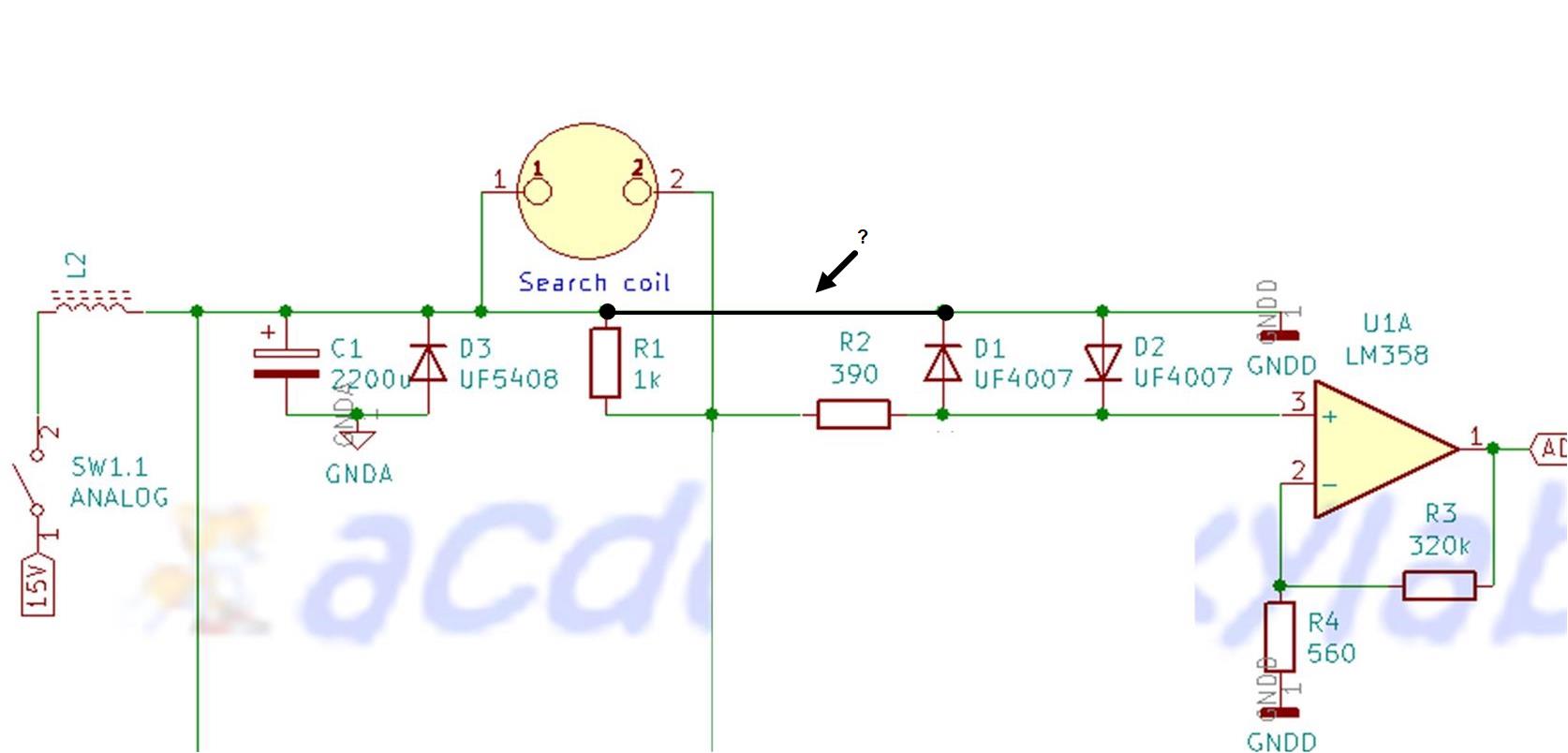
Meteorite?
If "yes"...
https://www.google.com/search?q=meteorite+for+sale
Meteorite?
If "yes"...
https://www.google.com/search?q=meteorite+for+sale
I have drawn FoxyPI v3 schematic in KiCad (click the thumbnail for zoom):
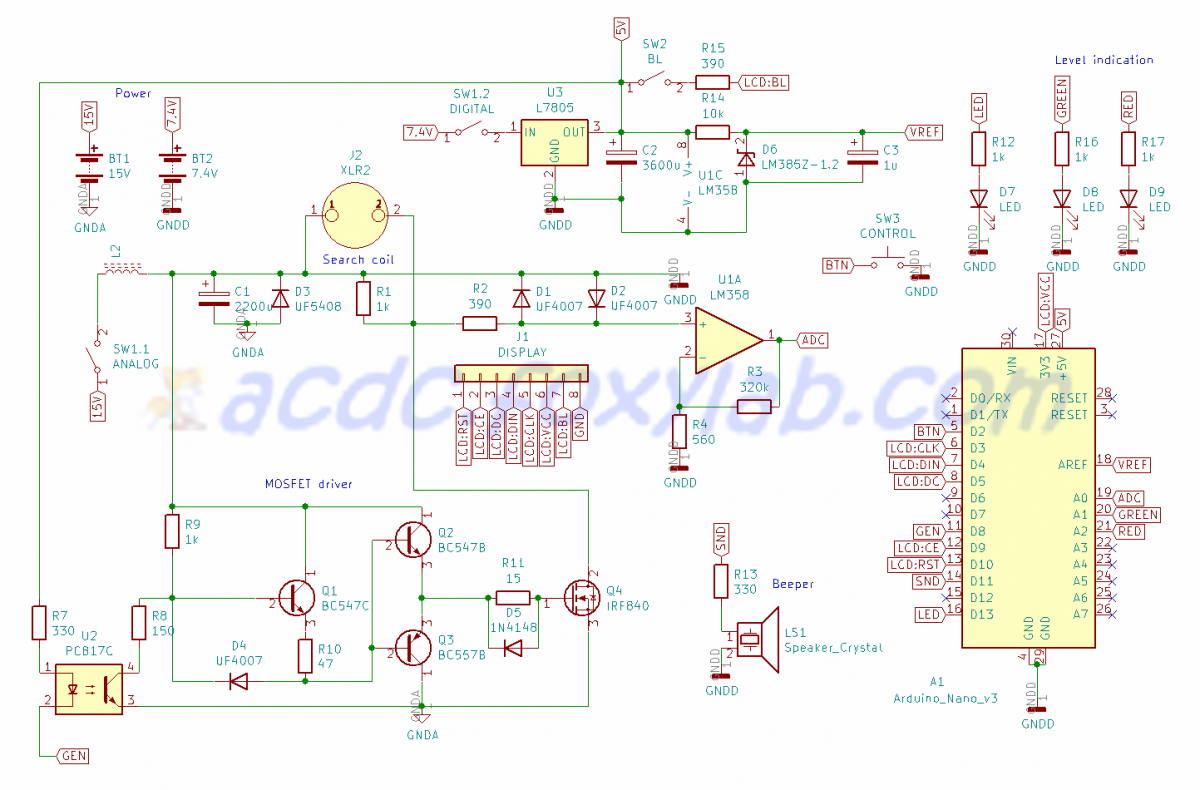
I built a model of the entire power part of my metal detector for LTspice XVII:
FoxyPI_v3_tran.asc
You can play with the parameters and watch, for example, the voltage on the search coil (1), on the opamp input (2), the current in the coil (3):

I know this is an old post, but that looks more like welding slag.
ChrisTenone:
I know this is an old post, but that looks more like welding slag.
Probably it is.
The final firmware version 3.4 is ready - FoxyPIv3_4.ino.eightanaloginputs.hex
What's new:

And here is how the interference from a nearby LCD TV appears:

Some finds in garden with FoxyPI

Video illustration of metal detector starting procedures:

The FoxyPI firmware version 3.5 is ready - FoxyPIv3_5.ino.eightanaloginputs.hex
What's new:
added the ability to adjust the display contrast using the CONTRAST item in the service menu
An example is small/normal/excessive contrast:

I know this is an old post, but that looks more like welding slag.
tap it with a metal object. if it's a meteorite it will ring like a bell.
Thanks, its slag.
The second riddle for me is a forged handle of an unusual shape from some object (in center on this photo - Arduino metal detector? - #127 by FoxyLab - Project Guidance - Arduino Forum)
Bonsoir je voudrais savoir le capteur détecteur de mouvement pouvant détecter un individu jusqu'à une distance de 100m suivant une ligne ?
En Angais !
Good evening I would like to know the sensor motion sensor that can detect an individual up to a distance of 100m following a line?
Jacques97:
Bonsoir je voudrais savoir le capteur détecteur de mouvement pouvant détecter un individu jusqu'à une distance de 100m suivant une ligne ?
En Angais !Good evening I would like to know the sensor motion sensor that can detect an individual up to a distance of 100m following a line?
Bonsoir Dans cette rubrique, vous pouvez discuter de la découverte du bûcheron à partir du conte de la ville émeraude  Le détecteur de métal ne détecte pas les personnes "ordinaires".
Good evening! In this topic, you can discuss the discovery of the Lumberjack from the tale of the emerald city The metal detector does not detect "ordinary" people.
I decided to numerically evaluate the stability of my metal detector - it turned out to be quite satisfactory: after 15 minutes of operation, the detection range of targets decreases by less than 4%.
I am very interested in your PI metal detector, study the design and follow your efforts. Your website is pleasant to read, informative and been educational. Thank you for all the information. I understand that the detector basically uses two circuits - analog and digital - with their own voltages and grounding. I actually started to build the analog part and look forward to experiment with it. However, my knowledge to program the specific functions of the Arduino is still insufficient, which is of course fun to do. It would greatly help me if you could refer me to some basic information to get started. Please do not misunderstand me, I am not asking for the source code because I understand and respect that you want to keep it; I am very grateful for the compiled file, but possibly you may know where to find educational information about the instructions for the Arduino with respect to pulse induction (pulse generation, timing, decay measurements, ADC). I am deeply impressed and will continue to follow your work. I enjoy it immensely.
RodionAU:
I am very interested in your PI metal detector, study the design and follow your efforts. Your website is pleasant to read, informative and been educational. Thank you for all the information.
Thank you for such a flattering assessment of my creation!
RodionAU:
I am very interested in your PI metal detector, study the design and follow your efforts. Your website is pleasant to read, informative and been educational. Thank you for all the information. I understand that the detector basically uses two circuits - analog and digital - with their own voltages and grounding.
Yes!
RodionAU:
I actually started to build the analog part and look forward to experiment with it. However, my knowledge to program the specific functions of the Arduino is still insufficient, which is of course fun to do. It would greatly help me if you could refer me to some basic information to get started. Please do not misunderstand me, I am not asking for the source code because I understand and respect that you want to keep it; I am very grateful for the compiled file, but possibly you may know where to find educational information about the instructions for the Arduino with respect to pulse induction (pulse generation, timing, decay measurements, ADC). I am deeply impressed and will continue to follow your work. I enjoy it immensely.
The basics are no secret. But there are some nuances in signal processing that allow my device to work with satisfactory stability and reliability with such mediocre electronic components in terms of characteristics.
I’ll probably add some programmatic details to the site. But now you may be interested in these no less interesting open source projects than mine:
https://create.arduino.cc/projecthub/mircemk/diy-arduino-based-pulse-induction-metal-detector-c6f244
Thank you,
I built the analog part and study at the moment a document by Jorbi who, in my humble opinion, may get everything out of an Arduino that is in it for a decent PI metal detector.
Jorbi uses timer0 to generate the pulse to feed the search coil. This pulse consists of 0.32 ms ON (4) to provide current to the coil and 4.672 ms OFF (72, the time of the collapse of the magnetic field and the decay. I have no idea how to set the pulse for my testcoil, which is approximately 427 uH with an internal resistance of approx. 0.65 ohms.
I found the articles you refer to, and certainly will go through them. I am not a great programmer but I can handle code. At the moment I am waiting for some parts for the digital part of your detector. Sincerely,
Dear sir,
I would like to start with the digital part of your metal detector circuit, but I don't have all the components required. First you use 2 x 18650 Li-ion batteries (UltraFire 4200 mAh) with nominal 7.4 V. Although I see the advantage of rechargeable batteries, I do not understand why you need them so powerful. Li-ion batteries are also expensive. I think I also buy such a pair of 18650 batteries with battery holder, but for the moment I would like to try 4 x Alkaline AA batteries with a nominal 6 V to feed the components of the digital part and the Arduino Nano. A note is that the UltraFire batteries that you use, may be fake regarding such a capacity. A few years ago I bought UltraFire batteries of 7800 mAh each as well for my oscilloscope. I suppose a few of those are enough to drive a Tesla up a mountain at maximum speed. My question: can I replace the 2 x 18650 batteries (7.4 V) with 4 x AA batteries (6 V) with of course a L7805 voltage regulator to 5 V? A second question I would like to ask is whether I can use an Arduino Uno instead of the Nano for the time being. The Nano is on order and I could load your compiled HEX file on my Uno to test the detector. Does this cause problems? Thanks in advance for your attention and best regards,
Hello FoxyPi,
Another question: in the circuit the ground of the 'digital' part is connected to the 15V input of the analog part. This seems odd to me and it seems a mistake in the drawing of the diagram. I enjoy building the circuit and it would be my first 'real' metal detector, apart from some very simple ones with Arduino.
Greetings, Rodion