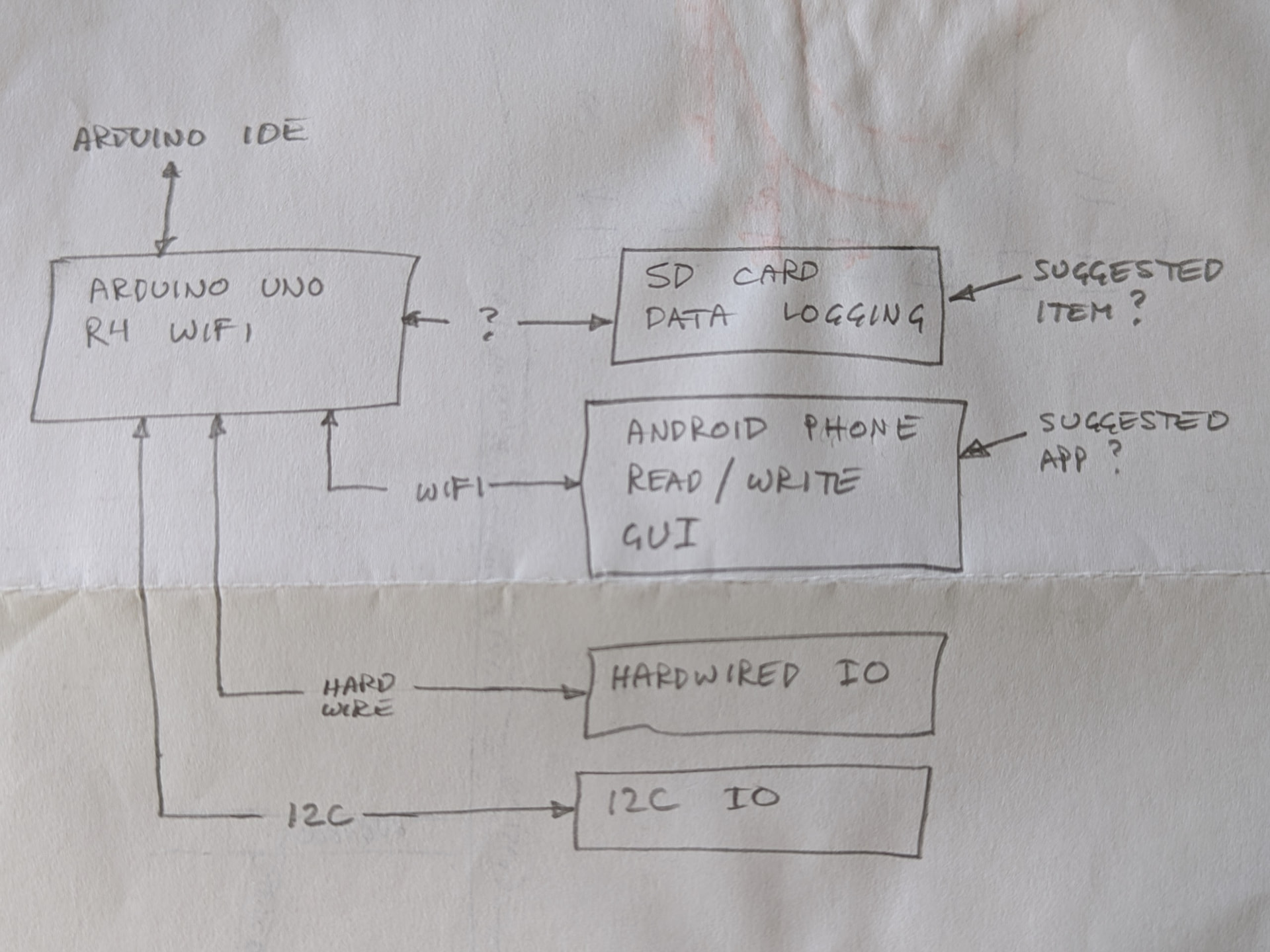
New project underway that requires extensive data logging and frequent manual verification. Looking for seasoned users to point me in the right direction (see photo).
Preamble: Not skilled with Rasberry Pi (or Python) hence not super stoked about moving onto such a platform (Arduino Uno Q or similar). But if seasoned folks on here strongly recommend it, I'll go there.
Project:
Question 1 - recommendation on hardware and communications to use for SD card datalogger ?
Question 2 - recommendation on software app to use for android based GUI ?
When I did this sort of thing I used an esp8266 as a web server and then ran a browser as the interface. Anything that supported a browser (PC, cell phone, tablet) could be used as the interface.
Today I would probably use an esp32 since it is about the same price and has more function.
You're way ahead of me OC (like all the way up into the 21st century!)
For the GUI - that makes all kinds of sense now that you've blown my doors open.
For the datalogger - what would you?
Here is the link to a project I did years ago. It is a bit dated - there are better ways to do parts of it now. It will give you some idea of what is involved.
You do have to learn a bit of HTML. There are a lot of tutorials and examples on the web.
have a look at record-and-replay-can-communication-in-vehicle for a ESP32 based Canbus to SD data logger
although a 4 inch Freenove_ESP32_Display was used for the data logger the TFT was not used - it could be used to support a datalogger + GUI
the ESP32 has onboard BLE so could transmit data to an Android app
That's some nice coding!
Lots of learnings in there for me - thanks.
I was amused by the conversion to fahrenheit. As a retired Canadian engineer, I've always had to be familiar with both Metric System and US Customary System. Even the Brits switched to Metric from their Imperial System (only USA, Liberia and Myanmar remain)!
Will study this and apply to my project.
Thank you,
Ray
Oh yeah... Took me a bit to understand what you're putting down.
Now I get it. I like it!
Will investigate further.
Thanks for opening my mind to such an approach.
this should lead to a list of hardware and software requirements which can be used to select microcontrollers, sensors, IO controllers, communications, etc
the selected devices can then be tested in individual programs to check for suitability and easy of use, e.g. documentation and support libraries
a prototype can then be implemented to check that the various hardware and software components work together and meet the requirements specification
things often don't work out like that, e.g.
end users do not know what they want
end users specify the hardware they want to use - sometimes unsuitable
one is given a built PCB and told to implement the software to meet the requirements - sometimes not possible
when a prototype is implemented the end user starts adding requirements, e.g. WiFi, Bluetooth, LoRa, etc - prototypes can go thru several revisions
e.g. how much data are you planning to sample?
8bit, 16bit, 32bit data?
how often - every millisecond, second, 10minutes
etc etc
It certainly does - and is probably as gross an overkill as its price suggests. While you may be a few points too close to the wind with a Uno, a Mega is probably more than adequate for your declared intent.
See post #14
I agree that the capabilities of the UNO Q might well be surplus to requirements, but I don't follow your logic on price. The price of an Arduino UNO Q is 13% less than the price of an Arduino Mega 2560.
The low end of that is for cheap derivative boards, so not exactly an "apples to apples" comparison against the official Arduino UNO Q. You are correct that the price of the official Arduino Mega 2560 is $50 USD (or to be precise, $49.90).
 :
