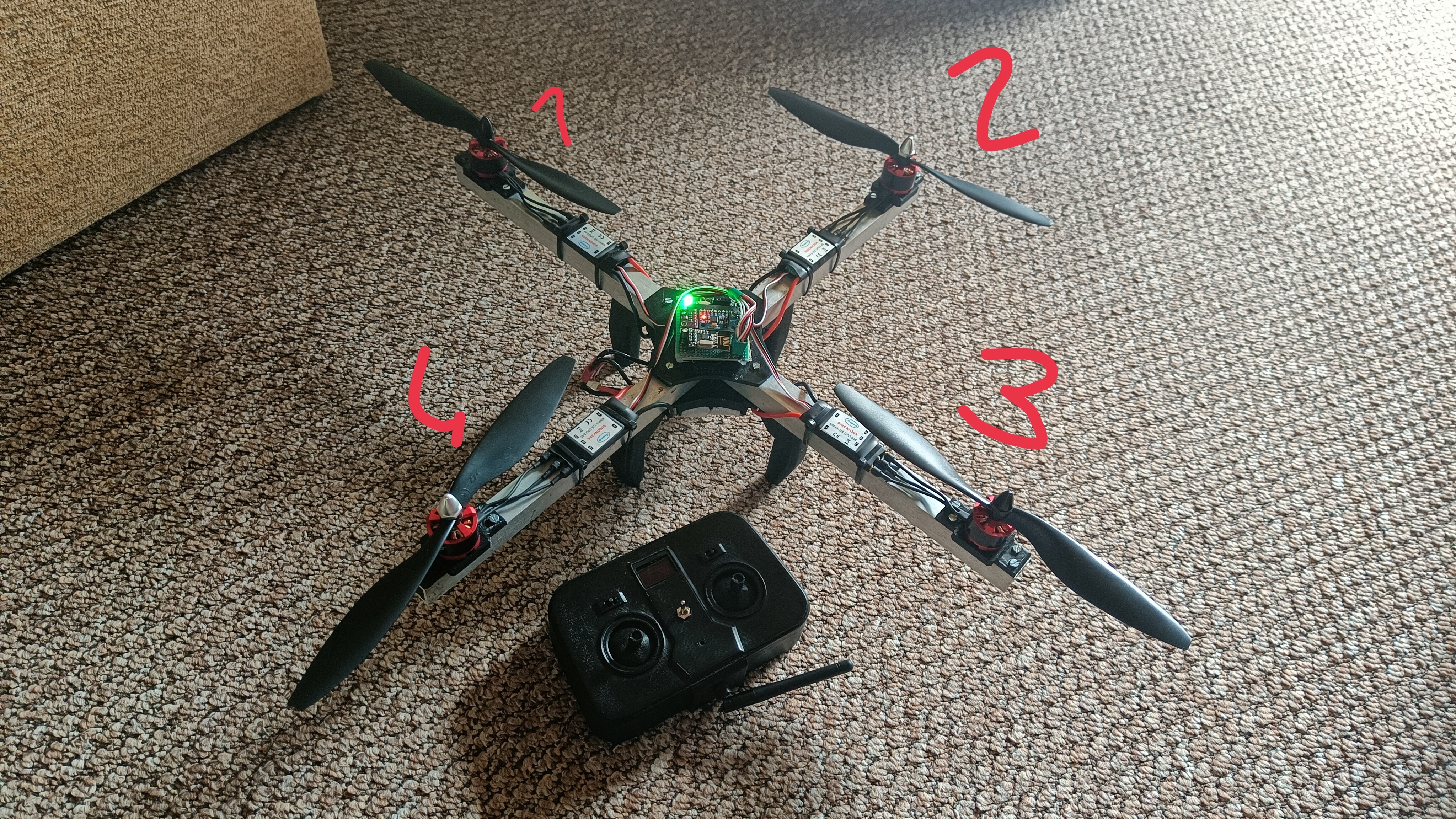
Prop spin directions incorrect. A CW proper in a CCW spot.
Prop over tightened or loose on the spindle.
Prop spin directions incorrect. A CW proper in a CCW spot.
Prop over tightened or loose on the spindle.
Yeah, going blind squinting at the photo, so @crownous please confirm that you have the right propellers on there.
Nothing is more satisfying than seeing the best flyer bring out a build and have it flip over immediately and start trying to fly to the center of the Earth.
Which is to say, it happens to everyone.
A "hop test" should always be performed, even if you know the propellers are on the correct motors and you know they are on there good.
Because until you know, you don't know.
Starting from scratch with an untuned quadcopter is bound to involve a certain amount of excitement… with care it does not necessarily have to involve damages to the equipment or personal injury.
Which is why anything that can be done with no propellers shoukd be done with no propellers.
Please elaborate. I don't know the implications of over tightening props - been using the same approach as when doing bike repair, where the physical torques necessary are a good match to what a human can provide, so with the right tool in an experienced hand, things get tightened just right. A few of those are basically as tight as you can, and they don't mean by getting out a breaker bar and wailing on it.
a7
I've not encountered any issues with putting on the props very tightly. It was a mention of a guess of a possibility. Yes, a slim chance.
Are you spinning the props inward, good for newbies but sucks in leaves or outward good for blowing away small leaves of trees.
Where is the front of the drone? At the remote control?

which one is prop 1?
prop 1 CW
prop 2 CCW
prop 3 CW
prop4 CCW
From the photo with the remote controller as a reference. Prop1 is the lower right hand prop, prop 2 is the upper right hand prop, prop 3 is the upper left hand prop, prop 4 is the lower right hand prop.
It is highly probable that prop3 and prop4 are in the wrong positions.
Remember just letting the drone sit on the ground with spun up motors may cause the drone to bounce around from all the air flow.
There does appear to be no standard, but until I looked I thought there was. All the resources I exploit trying to keep stuff in the air uses

with, as you point out, the biggest choice being between props in and props out.
No reason to fly upwind!
Besides, you have two lower right hand props and no lower left…
I fly everything from toys with no way, or no easy way to go props different. Also I have demonstrated ability to screw things up - having half a fleet in each camp would be a recipe for that kind of excitement no one wants.
a7
So I changed directions of motors. Now I have:
Motor 1 CW
Motor 2 CCW
Motor 3 CW
Motor 4 CCW
What happens between 0 and 70%?
You might like to lash your quadcopter to a birck - leave just enough slack so the quad can visibly tilt in both pitch and roll axes, enough so it can twist a bit for yaw.
Brivk heavy enough so it can't be lifted.
Eventually you will be able to fire it up and gently see that your aileron control makes it roll left and right, your elevator makes it pitch forward and back, and you rudder makes it yaw CW and CCW.
The throttle should just look like it is trying to lift the brick.
This is the hardest part of a build: shaking out stupid errors, and tuning. Of course if there is something deeply flawed with you control algorithm, there will be just that much more... fun.
You do you, but there is no reason not to (and some good reasons to) just go along with numbering the motors according to the picture I posted. Which is as far as I can tell how a huge fraction of quadcopter builders do it. Kinda like using red wire for V+ and black for GND.
You haven't yet told us which end is forward, nor whether you are planning for props-in or props out.
a7
Motor speed is increasing.
That's exactly what I plan to do.
Okay, I will change it.
Forward is motor 1 and 2, backward is 3 and 4.
I am not sure, if I understand it correctly. From what I read online, the difference is in spinning directions. I changed them according to the picture you posted earlier, what should be props in? So before I had props out (motor 1ccw, motor2 cw, motor3 ccw, motor4 cw).
The front pair of props should rotate in opposite directions such that the props turn towards the centre axis of the quid (props in) or away from it (props out)
The rear pair of props should do the same but should match the props in or props out configuration of the front pair
Props in or props out is a choice you must make, and the choice will need to be accounted for in the control software.
I use open source flight control software which allows for setting up the choice with a configuration tool. As long as you don't lie to it about where you CW motors are and where your CCW motors are, it will just work.
Of course the motors on the diagonal must match and there have to be two of each.
If you wrote this software, you shoukd know what to do. If you did not write it, do what the original author did. If you want to change it, that can come later. You can certainly fly either way.
Since yaw isn't accomplished aerodynamically, the CW rotation will be effected by an RPM increase of the CCW motors and a corresponding reduction in the RPM of the CW motors, ideally leaving lift unchanged.
a7
I wrote this code, but I didn't even know that something like props-in and props-out existed, so my code doesn't mention it. Why is it so important to account for the placement of cw or ccw in the code? I read on the internet that props-out is more stable for a drone like mine, what would you recommend?
pick one and go with it. I'm a learn with props blowing in for more stability and props out for more maneuverability. Being more maneuverable means less stable. What size props are being used? What size motors are being used? Props should be matched to the motors. Those motors in the image look like CineLifters, lower RPM's and bigger props. A CineLifter may warrant 3 bladed props.
Because... at least to yaw CCW, you have to increase the speed of the CW motors.
Not knowing which those were would make doing that difficult.
And I do not know for sure, but the implications of getting that wrong might mean more than your rudder input needing to be reversed…
a7
The motors I use are ReadyToSky 920kv 2212 and propellers are 10x4.5 inch Link.
920Kv and sized 2212 clearly shows the motors are for a CineLifter. 920Kv means low RPM's for torque over speed. I'd use 5 to 10 inch props, depending upon the motor spacing. 3 to 5 blades props.
Okay, I think the best thing to do now is to build a test stand and see the full behavior of the drone. When that's done, I hope I'll understand how to implement it in the code.
My build should be similar to the dji f450, which also uses 2 blade propellers, so hopefully mine will work with them too.
I replaced ATmega328P with ESP32. Then problems with radio communication appeared. I use two-way communication in the code - currently only the drone transmitter and the controller receiver work correctly (I display the drone's altitude). When the controller is supposed to transmit, I get strange values on the drone side. Two different values are "merged" into one, and when the button is pressed, a double is stored in the camera variable instead of a bool.
Values in Serial monitor:
altitudeSetpoint65491.00
pitchSetpoint0.00
rollSetpoint65536.00
yawSetpoint8650752.00
camera0
It looks like someone forgot to print a space between the two prints.
Don't worry. If the camera variable is a bool, the double will get converted to bool when stored.
as you are coming close to really lift off the ground
I highly recommend to mount some kind of protection cage around everything
so that the cage is protecting the props against touching from all directions