Hi Everybody,
I have a real strange phenomen with a ESP32 running ESPUI and sending UDP-messages.
After some time the website build with the ESPUI-library is no longer reachable.
Browser says "website did not answer"
using ping results in
C:\Users\choic>ping 192.168.1.234

Ping wird ausgeführt für 192.168.1.234 mit 32 Bytes Daten:
Zeitüberschreitung der Anforderung.
Antwort von 192.168.1.73: Zielhost nicht erreichbar.
Zeitüberschreitung der Anforderung.
Zeitüberschreitung der Anforderung.

Ping-Statistik für 192.168.1.234:
    Pakete: Gesendet = 4, Empfangen = 1, Verloren = 3
    (75% Verlust),

C:\Users\choic>
but sending UDP-messags from this ESP32 still works ! ?? Hu???
I am very sure that sending the UDP-messages works because I have a computer running a python-script that receives the UDP-messages
2024.03.31; 22: 43: 24 ; 192.168.1.234 ; 2024.03.31; 22: 43: 24 ; reconnectCnt: 0 ; UDP_Msg - Cnt: 616 ; BoardType: ESP32-OLD-CP210x_COM3
2024.03.31; 22: 43: 29 ; 192.168.1.234 ; 2024.03.31; 22: 43: 29 ; reconnectCnt: 0 ; UDP_Msg - Cnt: 617 ; BoardType: ESP32-OLD-CP210x_COM3
If I lookup the WiFi-router the router shows ESP32 is present with IP-Adress 192.168.1.234
full signal-strength (ESPs are 1 m away from the router)
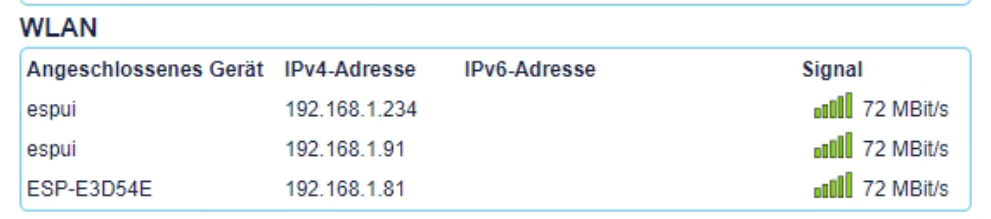
Now what could make an ESP32 sending UDP-messages but beeing unreachable for pings and website-requests?
What keeps the ESP32 connected is if I use auto-refresh of the website once every two minutes
I have another ESP32-S3 connected to the same router which shows the same phenomen:
refreshing the website every two minutes connecting stays
no refreshing connection gets lost
Then there is another ESP8266 running ESP-DASH which stays connected all the time without doing anything.
and ping-time of this ESP8266 is a single millisecond
C:\Users\choic>ping 192.168.1.81

Ping wird ausgeführt für 192.168.1.81 mit 32 Bytes Daten:
Antwort von 192.168.1.81: Bytes=32 Zeit=1ms TTL=255
Antwort von 192.168.1.81: Bytes=32 Zeit=1ms TTL=255
Antwort von 192.168.1.81: Bytes=32 Zeit=1ms TTL=255
Antwort von 192.168.1.81: Bytes=32 Zeit=1ms TTL=255

Ping-Statistik für 192.168.1.81:
    Pakete: Gesendet = 4, Empfangen = 4, Verloren = 0
    (0% Verlust),
Ca. Zeitangaben in Millisek.:
    Minimum = 1ms, Maximum = 1ms, Mittelwert = 1ms
while ping of the ESP32-S3 is aound 200 milliseconds for a local network with microcontroller with full signal-strength and 72 MBit speed
C:\Users\choic>ping 192.168.1.91

Ping wird ausgeführt für 192.168.1.91 mit 32 Bytes Daten:
Antwort von 192.168.1.91: Bytes=32 Zeit=189ms TTL=255
Antwort von 192.168.1.91: Bytes=32 Zeit=206ms TTL=255
Antwort von 192.168.1.91: Bytes=32 Zeit=208ms TTL=255
Antwort von 192.168.1.91: Bytes=32 Zeit=205ms TTL=255

Ping-Statistik für 192.168.1.91:
    Pakete: Gesendet = 4, Empfangen = 4, Verloren = 0
    (0% Verlust),
Ca. Zeitangaben in Millisek.:
    Minimum = 189ms, Maximum = 208ms, Mittelwert = 202ms
Oh oops and with code a much more detailed analysis is possible
#define BOARD_ID "ESP32-OLD-CP210x_COM3"

// MACRO-START * MACRO-START * MACRO-START * MACRO-START * MACRO-START * MACRO-START *
// a detailed explanation how these macros work is given in this tutorial
// https://forum.arduino.cc/t/comfortable-serial-debug-output-short-to-write-fixed-text-name-and-content-of-any-variable-code-example/888298

#define dbg(myFixedText, variableName) \
  Serial.print( F(#myFixedText " "  #variableName"=") ); \
  Serial.println(variableName);

#define dbgi(myFixedText, variableName,timeInterval) \
  { \
    static unsigned long intervalStartTime; \
    if ( millis() - intervalStartTime >= timeInterval ){ \
      intervalStartTime = millis(); \
      Serial.print( F(#myFixedText " "  #variableName"=") ); \
      Serial.println(variableName); \
    } \
  }

#define dbgc(myFixedText, variableName) \
  { \
    static long lastState; \
    if ( lastState != variableName ){ \
      Serial.print( F(#myFixedText " "  #variableName" changed from ") ); \
      Serial.print(lastState); \
      Serial.print( F(" to ") ); \
      Serial.println(variableName); \
      lastState = variableName; \
    } \
  }

#define dbgcf(myFixedText, variableName) \
  { \
    static float lastState; \
    if ( lastState != variableName ){ \
      Serial.print( F(#myFixedText " "  #variableName" changed from ") ); \
      Serial.print(lastState); \
      Serial.print( F(" to ") ); \
      Serial.println(variableName); \
      lastState = variableName; \
    } \
  }
// MACRO-END * MACRO-END * MACRO-END * MACRO-END * MACRO-END * MACRO-END * MACRO-END *

#include <Preferences.h>     // see https://github.com/espressif/arduino-esp32/tree/master/libraries/Preferences
Preferences myPrefInstance;  // create an instance of the object
#include <DNSServer.h>
DNSServer dnsServer;

#include <SafeString.h> // https://github.com/PowerBroker2/SafeString
#if defined(ESP8266)
#include <ESP8266WiFi.h>
#include <ESPAsyncTCP.h>
#elif defined(ESP32)
#include <WiFi.h>
#include <AsyncTCP.h>
#endif
#include <ESPAsyncWebServer.h>
#include <ESPUI.h> // see https://github.com/s00500/ESPUI

#include <time.h>                   // time() ctime()

#define MaxMsgLength 1024
createSafeString(UDP_Msg_SS, MaxMsgLength);

#define MaxHeaderLength 32
createSafeString(UdpHeader_SS, MaxHeaderLength);
createSafeString(Msg1_SS, 128);
createSafeString(Msg2_SS, 128);
createSafeString(Msg3_SS, 128);
createSafeString(Msg4_SS, 128);
createSafeString(Msg5_SS, 128);

createSafeString(MultiPurp_SS, 128);

#define MaxTimeStampLength 64
createSafeString(TimeStamp_SS, MaxTimeStampLength);

cSF(Date_SS, 32);

cSF(multiPurp_SS, 1024);
cSF(text1_SS, 128);
cSF(text2_SS, 128);
cSF(text3_SS, 128);
cSF(BoardType_SS, 128);

const byte DNS_PORT = 53;
IPAddress apIP(192, 168, 4, 1);

time_t now;                         // this is the epoch
tm myTimeInfo;                      // the structure tm holds time information in a more convient way

const char* ntpServer = "2.de.pool.ntp.org";
const long  gmtOffset_sec = 7200;
const int   daylightOffset_sec = 0;

IPAddress remoteIP(192, 168, 1, 255);     // receiver-IP
IPAddress broadCastIP(192, 168, 1, 255);  // receiver-IP

IPAddress remoteAPIP(192, 168, 4, 255);     // receiver-IP
IPAddress broadCastAPIP(192, 168, 4, 255);  // receiver-IP

int remotePort = 4210;  // receiver port to listen on must match the portnumber the receiver is listening to
IPAddress local_IP;
WiFiUDP Udp;
#define UDP_RcvBufLen 256
char UDP_RcvBuffer[UDP_RcvBufLen];
unsigned long reconnectCnt = 0;
unsigned long OnlineStart;


unsigned long UDP_SendTimer;
unsigned long WiFiDisCDetected;
unsigned long WiFiDisConnectedDone;
unsigned long WiFiReconnectDone;
unsigned long WiFiISreconected;

int myCounter = 0;

char HeaderDelimiter = '$'; // must match the delimiter defined in the python-code

unsigned long MyTestTimer = 0; // Timer-variables MUST be of type unsigned long
const byte    OnBoard_LED = 2;
unsigned long SwitchStateTimer = 0;

int myWiFiStatus;
int myLastWiFiStatus;

const char *home_ssid     = "SSID";     // your network SSID (name)
const char *home_password = "password"; // your network key

char ap_ssid[25];
const char* AP_password = "espui";
const char* AP_hostname = "espui";

uint16_t myTab1_ID;
uint16_t myTab2_ID;

uint16_t statusLabel_ID;

uint16_t text1_ID;
uint16_t text2_ID;
uint16_t text3_ID;

uint16_t buttonSave_ID;
uint16_t buttonSetDefault_ID;

#define myNameSpace "Texte"
const boolean ReadOnly  = true;
const boolean ReadWrite = !ReadOnly; // not-operator inverts the value

void PrintFileNameDateTime() {
  Serial.println( F("Code running comes from file ") );
  Serial.println( F(__FILE__) );
  Serial.print( F("  compiled ") );
  Serial.print( F(__DATE__) );
  Serial.print( F(" ") );
  Serial.println( F(__TIME__) );
}


// easy to use helper-function for non-blocking timing
boolean TimePeriodIsOver (unsigned long &startOfPeriod, unsigned long TimePeriod) {
  unsigned long currentMillis  = millis();
  if ( currentMillis - startOfPeriod >= TimePeriod ) {
    // more time than TimePeriod has elapsed since last time if-condition was true
    startOfPeriod = currentMillis; // a new period starts right here so set new starttime
    return true;
  }
  else return false;            // actual TimePeriod is NOT yet over
}


void BlinkHeartBeatLED(int IO_Pin, int BlinkPeriod) {
  static unsigned long MyBlinkTimer;
  pinMode(IO_Pin, OUTPUT);

  if ( TimePeriodIsOver(MyBlinkTimer, BlinkPeriod) ) {
    digitalWrite(IO_Pin, !digitalRead(IO_Pin) );
  }
}


void text1Callback(Control *sender, int eventType) {
  Serial.print("ID: ");
  Serial.print(sender->id);
  Serial.print(" ");
  Serial.println(sender->label);
  Serial.print("eventType:");
  Serial.println(eventType);

  if (eventType == T_VALUE) {
    multiPurp_SS  = "";
    multiPurp_SS += String(sender->label).c_str();
    multiPurp_SS += " changed to #";
    multiPurp_SS += String(sender->value).c_str();
    multiPurp_SS += "#";
    Serial.println(multiPurp_SS);

    if (sender->id == text1_ID) {
      text1_SS  = "";
      text1_SS += String(sender->value).c_str();
    }

    if (sender->id == text2_ID) {
      text2_SS  = "";
      text2_SS += String(sender->value).c_str();
    }

    if (sender->id == text3_ID) {
      text3_SS  = "";
      text3_SS += String(sender->value).c_str();
    }
  }
  Serial.println();

  ESPUI.updateLabel(statusLabel_ID, multiPurp_SS.c_str() ); //String(rndString1));
}


void buttonSetDefaultCallback(Control* sender, int eventType) {
  Serial.print("ID: ");
  Serial.print(sender->id);
  Serial.print(" ");
  Serial.println(sender->label);

  if (eventType == B_UP) {
    Serial.println("Set default values");
  }
}


void  buttonSaveCallback(Control* sender, int eventType) {
  Serial.print("ID: ");
  Serial.print(sender->id);
  Serial.print(" ");
  Serial.println(sender->label);
  if (eventType == B_UP) {
    SafePreferences();
  }
}


void ConnectToWiFi() {

  int myCount = 0;
#if defined(ESP32)
  WiFi.setHostname(AP_hostname);
#else
  WiFi.hostname(AP_hostname);
#endif

  // try to connect to existing network
  WiFi.begin(home_ssid, home_password);
  Serial.print("\n\nTry to connect to existing network");
  Serial.print(" named #");
  Serial.print(home_ssid);
  Serial.println("#");

  // Wait for connection
  while (WiFi.status() != WL_CONNECTED && myCount < 31) {
    yield(); // very important to execute yield to make it work
    BlinkHeartBeatLED(OnBoard_LED, 50); // blink LED fast during attempt to connect

    if ( TimePeriodIsOver(MyTestTimer, 500) ) { // once every 500 miliseconds
      Serial.print(".");                        // print a dot
      myCount++;

      if (myCount > 120) { // after 120 dots = 60 seconds
        Serial.println();
        Serial.print("not connected ");
      }
    }
  }

  if (WiFi.status() == WL_CONNECTED ) {
    Serial.println("");
    Serial.print("Connected to #");
    Serial.print(home_ssid);
    Serial.print("# IP address: ");
    Serial.println(WiFi.localIP());
  }
}


void printWiFiModeAndIP() {
  if (WiFi.getMode() == WIFI_AP) {
    Serial.print("ESP is its OWN accesspoint with SSID ");
    Serial.println(ap_ssid);
    Serial.print("IP address: ");
    Serial.println(WiFi.softAPIP() );
  }
  else {
    Serial.print("ESP connected to existing WLAN named ");
    Serial.println(home_ssid);
    Serial.print("IPAdress: ");
    Serial.println(WiFi.localIP() );
  }
}


void setup() {
  BoardType_SS = BOARD_ID;
  Serial.begin(115200);
  PrintFileNameDateTime();
  Serial.print("Board-type:");
  Serial.println(BoardType_SS);

#if defined(ESP32)
  WiFi.setHostname(AP_hostname);
#else
  WiFi.hostname(AP_hostname);
#endif

  ConnectToWiFi();
  synchroniseWith_NTP_Time();

  if (WiFi.status() != WL_CONNECTED) {
    Serial.println("not connected to WiFi");
  }

  printWiFiModeAndIP();
  dnsServer.start(DNS_PORT, "*", apIP);

  defineUI();
  ESPUI.begin(BOARD_ID);
  // LoadPreferences() must be called AFTER  ESPUI.begin() because it uses ESPUI-variables
  LoadPreferences();
}


void loop() {
  dnsServer.processNextRequest();

  BlinkHeartBeatLED(OnBoard_LED, 500);

  myWiFiStatus = WiFi.status();
  if (myLastWiFiStatus != myWiFiStatus) {
    Serial.print("WiFiStatus changed from ");
    printWiFiStatus(myLastWiFiStatus);
    Serial.print(" to ");
    printWiFiStatus(myWiFiStatus);
    myLastWiFiStatus = myWiFiStatus;
  }

  if ( TimePeriodIsOver(MyTestTimer, 5000) ) {
    multiPurp_SS = BOARD_ID;
    time(&now);                               // read the current time
    localtime_r(&now, &myTimeInfo);           // update the structure tm with the current time
    StoreTimeStampIntoSS(TimeStamp_SS, myTimeInfo);
    multiPurp_SS += " ";
    multiPurp_SS += TimeStamp_SS;
    ESPUI.updateLabel(statusLabel_ID, multiPurp_SS.c_str() ); //String(rndString1));
  }

  if (TimePeriodIsOver(UDP_SendTimer, 5000)) {
    myWiFiStatus = WiFi.status();
    printWiFiStatus(myWiFiStatus );

    if (myWiFiStatus  != WL_CONNECTED) {
      WiFiDisCDetected = micros();
      Serial.println("WiFi.status() != WL_CONNECTED");
      printWiFiStatus(myWiFiStatus );
      WiFi.disconnect();
      WiFiDisConnectedDone = micros();
      Serial.println("WiFi.disconnect() done");
      printWiFiStatus(WiFi.status());
      WiFi.reconnect();
      WiFiReconnectDone = micros();
      Serial.println("WiFi.reconnect() done ");
      printWiFiStatus(WiFi.status() );
      reconnectCnt++;
      OnlineStart = millis();
      unsigned long myWaitTimer = millis();
      while ( (millis() - myWaitTimer < 5000) ) {
        yield();
        if (WiFi.status() == WL_CONNECTED) {
          Serial.println("early reconnected");
          break;
        }
      }
      WiFiISreconected = micros();
      Serial.println("waiting done");

      Serial.print("DISC detected to WiFi.disconnect() done:");
      Serial.println( WiFiDisConnectedDone - WiFiDisCDetected);

      Serial.print("DISC detected to WiFi.reconnect() done:");
      Serial.println( WiFiReconnectDone - WiFiDisCDetected);

      Serial.print("DISC detected to reconnected:");
      Serial.println(WiFiISreconected - WiFiDisCDetected );

      printWiFiStatus(WiFi.status() );
      //dbgc("WiFi", WiFi.status() );
    }
    if (WiFi.status() == WL_CONNECTED) {
      SendUDP_Msg();
    }
    else {
      printWiFiStatus(WiFi.status() );
      Serial.println("no UDP - Message send");
      OnlineStart = millis();
    }
    Serial.println();
    Serial.println();
  }
}


void defineUI() {
  // shown above all tabs
  statusLabel_ID = ESPUI.addControl(ControlType::Label, "last action", "Last Action: none", ControlColor::Turquoise);
  dbg("dUI", statusLabel_ID);

  /*
    text1_ID = ESPUI.addControl(ControlType::Text, "Text 1", "", ControlColor::Alizarin,0, &text1Callback);
    text2_ID = ESPUI.addControl(ControlType::Text, "Text 2", "", ControlColor::Alizarin,0, &text1Callback);
    text3_ID = ESPUI.addControl(ControlType::Text, "Text 3", "", ControlColor::Alizarin,0, &text1Callback);
  */
  text1_ID = ESPUI.text("Text-Input 1", &text1Callback, ControlColor::Alizarin, "Text 1");
  text2_ID = ESPUI.text("Text-Input 2", &text1Callback, ControlColor::Alizarin, "Text 2");
  text3_ID = ESPUI.text("Text-Input 3", &text1Callback, ControlColor::Alizarin, "Text 3");

  dbg("dUI", text1_ID);
  dbg("dUI", text2_ID);
  dbg("dUI", text3_ID);

  // ESPUI.button("Push Button", &buttonCallback, ControlColor::Peterriver, "Press");
  buttonSave_ID       = ESPUI.button("Save to Flash ", &buttonSaveCallback,       ControlColor::Peterriver, "Save ");
  buttonSetDefault_ID = ESPUI.button("Set Default ",   &buttonSetDefaultCallback, ControlColor::Peterriver, "Default ");
  dbg("dUI", buttonSave_ID);
  dbg("dUI", buttonSetDefault_ID);
}


void LoadPreferences() {
  Serial.println("LoadPreferences");
  myPrefInstance.begin(myNameSpace, ReadOnly);
  //                                    ID       default value
  text1_SS = myPrefInstance.getString ("Text_1", "Text 1").c_str();
  text2_SS = myPrefInstance.getString ("Text_2", "Text 2").c_str();
  text3_SS = myPrefInstance.getString ("Text_3", "Text 3").c_str();

  dbg("LP", text1_SS);
  dbg("LP", text2_SS);
  dbg("LP", text3_SS);

  myPrefInstance.end();
  ESPUI.updateControlValue(text1_ID, text1_SS.c_str() );
  ESPUI.updateControlValue(text2_ID, text2_SS.c_str() );
  ESPUI.updateControlValue(text3_ID, text3_SS.c_str() );
}


void SafePreferences() {
  Serial.println("SafePreferences");

  myPrefInstance.begin(myNameSpace, ReadWrite);
  //myPrefInstance.clear();

  myPrefInstance.putString ("Text_1"     , text1_SS.c_str() );
  myPrefInstance.putString ("Text_2"     , text2_SS.c_str() );
  myPrefInstance.putString ("Text_3"     , text3_SS.c_str() );

  LoadPreferences();
}


void SendUDP_Msg() {

  Serial.print(F("Send Message to #"));
  Serial.print(remoteIP);
  Serial.print(F(": "));
  Serial.println(remotePort);

  Serial.print("reconnectCnt: ");
  Serial.println(reconnectCnt);

  UDP_Msg_SS  = "";
  UdpHeader_SS = BOARD_ID;
  UDP_Msg_SS = UdpHeader_SS;
  UDP_Msg_SS += HeaderDelimiter;

  StoreTimeStampIntoSS(TimeStamp_SS, myTimeInfo);

  UDP_Msg_SS += TimeStamp_SS;

  ipToSafeString(MultiPurp_SS, WiFi.localIP() );
  UDP_Msg_SS += " ; ";
  UDP_Msg_SS += MultiPurp_SS;

  time(&now);                       // read the current time
  localtime_r(&now, &myTimeInfo);   // update the structure tm with the current time
  StoreTimeStampIntoSS(TimeStamp_SS, myTimeInfo);
  UDP_Msg_SS += " ; ";
  UDP_Msg_SS += TimeStamp_SS;

  UDP_Msg_SS += " ; ";
  UDP_Msg_SS += "reconnectCnt: ";
  UDP_Msg_SS += reconnectCnt;

  UDP_Msg_SS += " ; UDP_Msg - Cnt: ";
  UDP_Msg_SS += myCounter++;

  UDP_Msg_SS += " ; BoardType: ";
  UDP_Msg_SS += BoardType_SS;

  //Serial.print("WiFi.status() = ");
  //Serial.println(WiFi.status() );
  Serial.print(F("Send UDP_Msg #"));
  Serial.print(UDP_Msg_SS);
  Serial.println("#");

  remoteIP = broadCastIP;

  Udp.beginPacket(remoteIP, remotePort);
  Udp.write((const uint8_t*)UDP_Msg_SS.c_str(), UDP_Msg_SS.length());
  Udp.endPacket();
}


// Message callback of WebSerial
/*
  void recvMsg(uint8_t *data, size_t len) {
  WebSerial.println("Received Data...");

  multiPurp_SS = "";
  for (int i = 0; i < len; i++) {
    multiPurp_SS += char(data[i]);
  }
  WebSerial.println(multiPurp_SS);
  Serial.print("Webserial receievd #");
  Serial.print(multiPurp_SS);
  Serial.println("#");
  }
*/

void ipToSafeString(SafeString & p_RefToSS, IPAddress ip) {
  p_RefToSS = ip[0];
  p_RefToSS += ".";
  p_RefToSS += ip[1];
  p_RefToSS += ".";
  p_RefToSS += ip[2];
  p_RefToSS += ".";
  p_RefToSS += ip[3];
}


void SetDateStr() {
  time(&now);                      // read the current time
  localtime_r(&now, &myTimeInfo);  // update the structure tm with the current time

  //if (myTimeInfo.tm_hour == 0 && myTimeInfo.tm_min == 0 && myTimeInfo.tm_sec <= 0) {
  Date_SS = " - ";
  Date_SS += myTimeInfo.tm_year + 1900;
  Date_SS += " - ";
  Date_SS += myTimeInfo.tm_mon + 1;
  Date_SS += " - ";
  Date_SS += myTimeInfo.tm_mday;
}

void StoreTimeStampIntoSS(SafeString & p_RefToSS, tm p_myTimeInfo) {

  time(&now);                               // read the current time
  localtime_r(&now, &myTimeInfo);           // update the structure tm with the current time

  //p_RefToSS = " ";
  p_RefToSS  = myTimeInfo.tm_year + 1900;
  p_RefToSS += ".";

  // month
  if (myTimeInfo.tm_mon + 1 < 10) {
    p_RefToSS += "0";
  }
  p_RefToSS += myTimeInfo.tm_mon + 1;

  p_RefToSS += ".";

  // day
  if (myTimeInfo.tm_mday + 1 < 10) {
    p_RefToSS += "0";
  }
  p_RefToSS += myTimeInfo.tm_mday;

  p_RefToSS += "; ";

  // hour
  if (myTimeInfo.tm_hour < 10) {
    p_RefToSS += "0";
  }
  p_RefToSS += myTimeInfo.tm_hour;
  p_RefToSS += ": ";

  // minute
  if (myTimeInfo.tm_min < 10) {
    p_RefToSS += "0";
  }
  p_RefToSS += myTimeInfo.tm_min;

  p_RefToSS += ": ";

  // second
  if (myTimeInfo.tm_sec < 10) {
    p_RefToSS += "0";
  }
  p_RefToSS += myTimeInfo.tm_sec;
  //p_RefToSS += ", ";
}

void synchroniseWith_NTP_Time() {
  Serial.print("configTime uses ntpServer ");
  Serial.println(ntpServer);
  configTime(gmtOffset_sec, daylightOffset_sec, ntpServer);
  Serial.print("synchronising time");
  int myCnt = 0;
  while (myTimeInfo.tm_year + 1900 < 2000 ) {
    time(&now);                       // read the current time
    localtime_r(&now, &myTimeInfo);
    BlinkHeartBeatLED(OnBoard_LED, 100);
    delay(100);
    Serial.print(".");
    myCnt++;
    if (myCnt > 600) {
      break;
    }
  }

  if (myCnt > 600) {
    Serial.println("not synchronised with NTP - server");
  }
  else {
    Serial.print("\n time synchronsized \n");
  }
}

void printWiFiStatus(uint8_t p_WiFiStatus) {

  Serial.print("WiFi - Status: ");
  switch (p_WiFiStatus) {

    case WL_IDLE_STATUS: // 0
      Serial.println("WL_IDLE_STATUS temporary status assigned when WiFi.begin() is called");
      break;

    case WL_NO_SSID_AVAIL: // 1
      Serial.println("WL_NO_SSID_AVAIL   when no SSID are available");
      break;

    case WL_SCAN_COMPLETED: // 2
      Serial.println("WL_SCAN_COMPLETED scan networks is completed");
      break;

    case WL_CONNECTED: // 3
      Serial.println("WL_CONNECTED");
      break;

    case WL_CONNECT_FAILED: // 4
      Serial.println("WL_CONNECT_FAILED");
      break;

    case WL_CONNECTION_LOST: // 5
      Serial.println("WL_CONNECTION_LOST");
      break;

    case WL_DISCONNECTED: // 6
      Serial.println("WL_DISCONNECTED");
      break;
  }
}