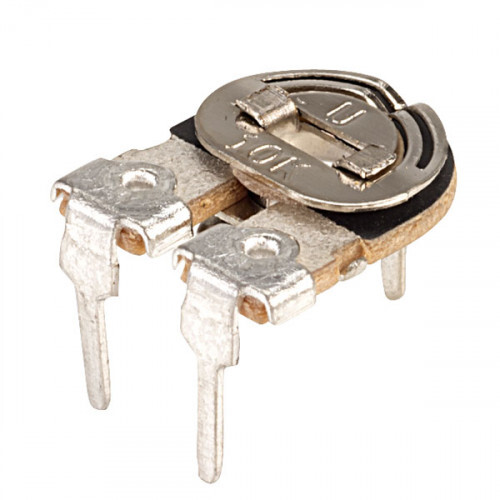
You have to know beforehand what the lower voltage will be, R6 will null out that voltage to zero
If it's 1V then apply a 1V voltage source to R17 and adjust R6 untill the voltage at test point T1 (output of U1) is zero. Remove the 1V voltage source and connect what you had connected to your analog read to R17.
You can later readjust R6 to give you whatever output range looks good.
I'm going to pick a nit here Jim.
With a single rail amp he can have R6 Way Off and still read 0V at T1. Should the instruction be something like "Adjust R6 until T1 just reaches 0V" or "Adjust R6 until T1 is as close to 0V as possible" and accept that little error?
Hi, I was testing this, built the whole circuit, then I smelled smoke and noticed my preset was sparking.
What I did? the preset has three pins, the single lonely pin I connected to the 5V and one of the two pins I connected to GND and the second of the two pins I connected to as shown. The preset is sparking when I turn it to the extreme end to reach zero volts at T1. Why?