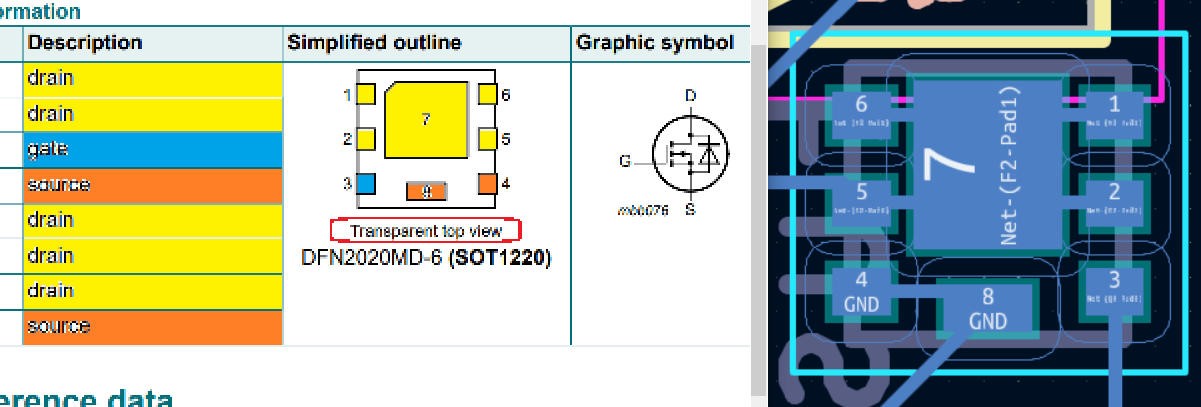
It was actually just a bad fet, i guess i overheated it when soldering it or something.
Usually is not always!
Not so sure about now but FETs used to be fragile to static!
Never use limit values as a reference. Look at the graph of on-State resistance versus gate voltage:

Here you can clearly see that the mosfet opens at about 2-2.5V

Those are eerily narrow traces for something that probably draws several amps.
In fact, all of your power traces are underdimensioned. Does that board directly power the igniters? I understand those igniters will easily draw >10A peak currents upon firing. Are you forcing that current through those flimsy traces running all over the place? Eeek!
That board looks like it'll be enormously noisy. I wouldn't be surprised if you ran into all kinds of arcane issues with it.
1 Like
The igniters that we use for what this is meant for only take about 0.5A to ignite. Yes the board is messy, i learned that messy traces make noise after i ordered the but they actually work fine.
Okay, 500mA isn't too bad; I don't expect much trouble if that's all it takes to ignite them. Many of those ignites easily draw an order of magnitude more than that, which is what made me worried. Power transients on your board might also have explained the demise of your MOSFETs, but with a modest 0.5A I wouldn't look in that direction.
1 Like
I just tested it with a 2 Amp ignitor and it worked, board not even warm.
2 Likes
Whhen I as a programmer watched EE's go for hairline traces on reject PCB's, they put 12V 5A linear PSU power across likely traces and chanted Go For SMOKE!, there was some before the hairline tracesdid smoke and light up, curling up off the board while epoxy fumed the room.
There is a time element in the smoke game.
In a book it states that Alfred Nobel demostrated lighting nitroglycerin and fire and striking that hith a hammer without making an explosion, but the author who wrote that also stated that Nobel did those things in certain ways thay Nobel knew were safe. The observing public didn't know the difference but did know that accidents with nitro often had deadly results.
How long an AVR pin can take 50mA and still work? Or 40mA?
Are those boards for one time use? I have made a lot rockets not intended to come back down in discrete pieces. I hate picking stuff up with a shovel and bucket, but that was long ago.
All model rockets nowadays are required to be recovered, so these boards are not single use.
1 Like
Little project for a rocket launch, send a rocket up that emits a frequency sound or ticks and get the movement from 3+ ground stations as doppler?
I worked with ground observing doppler in the 70's (Army) so I know it works but my clearances didn't lapse till after 2000. What to do with the rocket is subtract the received frequency from the sent frequency.
I am interested. I learned model rocketry starting 1968 in 5th grade.. back when Apollo was a chunk of science class (same as 1st grade through, Mercury to Apollo) and our teacher held mjodel rocket classes and events. His Estes Saturn 1B had lower rated B engines, took off slow and flew maybe 200 ft or so up so the whole event was clear and easy to see. With data, it would have been more complete -- with the things we have now, the wow should be more inspiring! I might not have devolved to pyrotechnics!
This topic was automatically closed 180 days after the last reply. New replies are no longer allowed.