Hi,
I'm working on expanding an existing project, which is a PID temperature controller for a home espresso machine.
I'm thinking of using one microcontroller to just run my PID code and drive the LCD, while I use another to run all of my menus, and control all the other functions, such as auto on/off based on the time, brewing shots/steaming milk, measuring beverage mass to calculate extraction ratios, etc...
Part of the reason I'm thinking of doing this is to effectively expand the amount of program space, since all the things I want to do will likely use it up pretty quickly.
Does this sound feasible / worthwhile? Are there other / better ways to accomplish this? Are there problems that I need to be aware of?
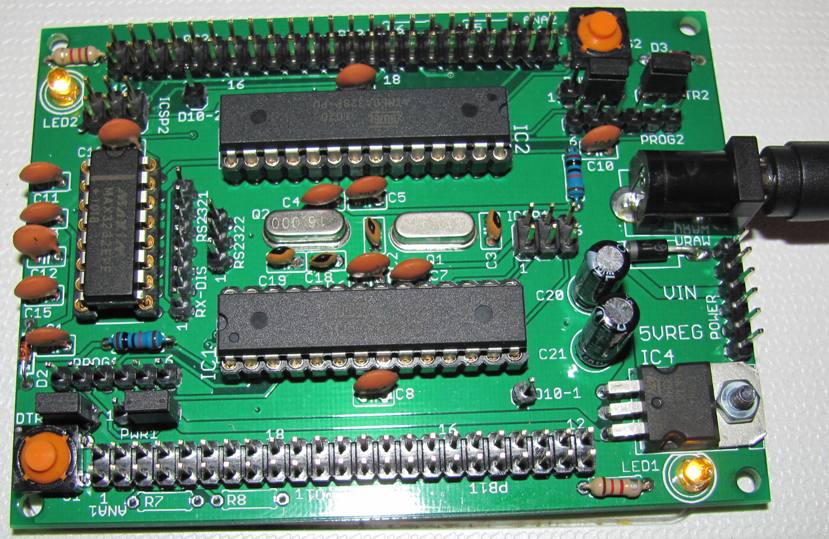
40 IO pins. Headers to connect USB/Serial adapter, ICSP, jumpers to connect MAX232 for Serial.
Add some jumper wires for chip-to-chip SPI, I2C, or UART-UART comm's. Bare boards $5 mailed to US locations. Kits, assembled boards, available upon request.
40 IO pins. Headers to connect USB/Serial adapter, ICSP, jumpers to connect MAX232 for Serial.
Add some jumper wires for chip-to-chip SPI, I2C, or UART-UART comm's. Bare boards $5 mailed to US locations. Kits, assembled boards, available upon request.
You can use chip-to-chip SPI, I2C, or UART-UART comm's.
rosscopicotrain:
Part of the reason I'm thinking of doing this is to effectively expand the amount of program space
You didn't say what microcontroller you're using but if that's the only reason then I would consider just using a Mega or ATmega1284P instead. 256K goes a long way. It just seems like unnecessary complexity to use 2 microcontrollers just for more program space.