Hi, I'm using the OPTA (wifi) main unit and EMR expansions to read analog voltage from a sensor outputing 1-5V. The reading is not accurate, I'm currently getting an offset of about 0.2V. For this specific issue I know it's not a problem to correct this offset but I'm worried that as I connect more sensors this offset would change. Can someone please explain why this happens and if it's possible that in the event I will be connecting more sensors to additional analog inputs, the offsets/scaling would change?
Well it would take a long time to explain it, but this is not uncommon that an internal A/D converter has an offset. It is basically what you get when you try and get an analogue device to operate in a closely coupled digital environment.
It should stay constant and will not change when you read more sensors. Providing of course that the sensors have an impedance range in the 10K to 50K region.
I'm not an Opta expert and I can't say with 100% certainty that there is no interaction between ADC channels, although I would be surprised if there was.
Hi to @dotan_qd-sol, @Grumpy_Mike , @jim-p ! the opta analog input stage features a very basic design and therefore, the input impedance is relatively low.
Interaction between ADC inputs is an undesirable but possible effect named 'crosstalk'. fine tuning of the analog RC inputs networks and ADC sampling time can solve it.
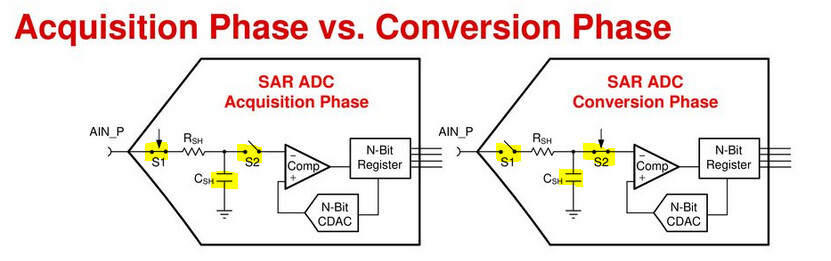
Crosstalk effect is the result of residual charge (between conversions) at the ADC internal Sample&Hold capacitor. That means the SH cap does not reach the voltage value of your analog input.
However, there is a very simple solution involving software:
If you need to connect two analog sensors, double every connection. The second input reading should be better than the first one, as it is more near the real value of your analog input.
A1=sensor 1 A2=sensor 1 << more precise
A3=sensor 2 A4=sensor 2 << more precise
To probe the crosstalk effect, the nightmare scenario is: