P channel MOSFET for Reverse polarity Protection

I was trying to understand the reverse polarity protection circuit using a P-channel MOSFET.

I understand the purpose of adding a Zener diode: for instance, if our supply voltage is 24V and we are using a specific P-channel MOSFET, we can add a Zener diode with a breakdown voltage of 12V. This Zener diode will limit the voltage at the gate-source junction of the MOSFET to 12V.

However, I’m confused. What happens if our load requires a voltage greater than 12V? How does the Zener diode allow the load to receive a voltage above 12V without cutting it off? Why does it only limit the voltage for the Vgs of the MOSFET?

The circuit is not a voltage regulator, it only is a diode with low forward voltage. For that purpose it's sufficient that Vgs is high enough to turn the MOSFET on. Then the body diode is bypassed by the low-resistance drain-source channel.

  • The MOSFET turns ON (low resistance) when the gate to source is sufficiently biased.
  • Let’s assume we are using an AO3401 P channel and V(bat) = 27v.
  • For this part number, Vds(max) is 30v, we are switching 27v,
  • For this device Vgs(max) is ±12V
  • A 10v zener will keep the MOSFET safe.
  • This MOSFET turns ON from Vgs = -2.5v to -10v
    The Vgs voltage has nothing to do with what the output voltage will be in your configuration.
    With MOSFETs, voltage controls current (Rds(on).
    At Vgs = -2.5v the Rds(on) is <60mΩ (at -10v <40mΩ).
    Initially 27v on the Drain gives ~26.7 at the source.
    The MOSFET turns ON since Vgs is -10v
    Let’s assume our load is 1 amp.
    Once the MOSFET is ON @1A and 40mΩ we have Vds = .04v hence output voltage on the source will be 27v - .04v = 26.96v.
    i.e. our output voltage is 26.96v

Because there will be 12V across the resistor.
24V minus the zener 12V = 12V across resistor.

12V across zener and 12V across resistor = 24V across load

This topic has been solved

Have a nice day!

@leansolution

  • Test time.
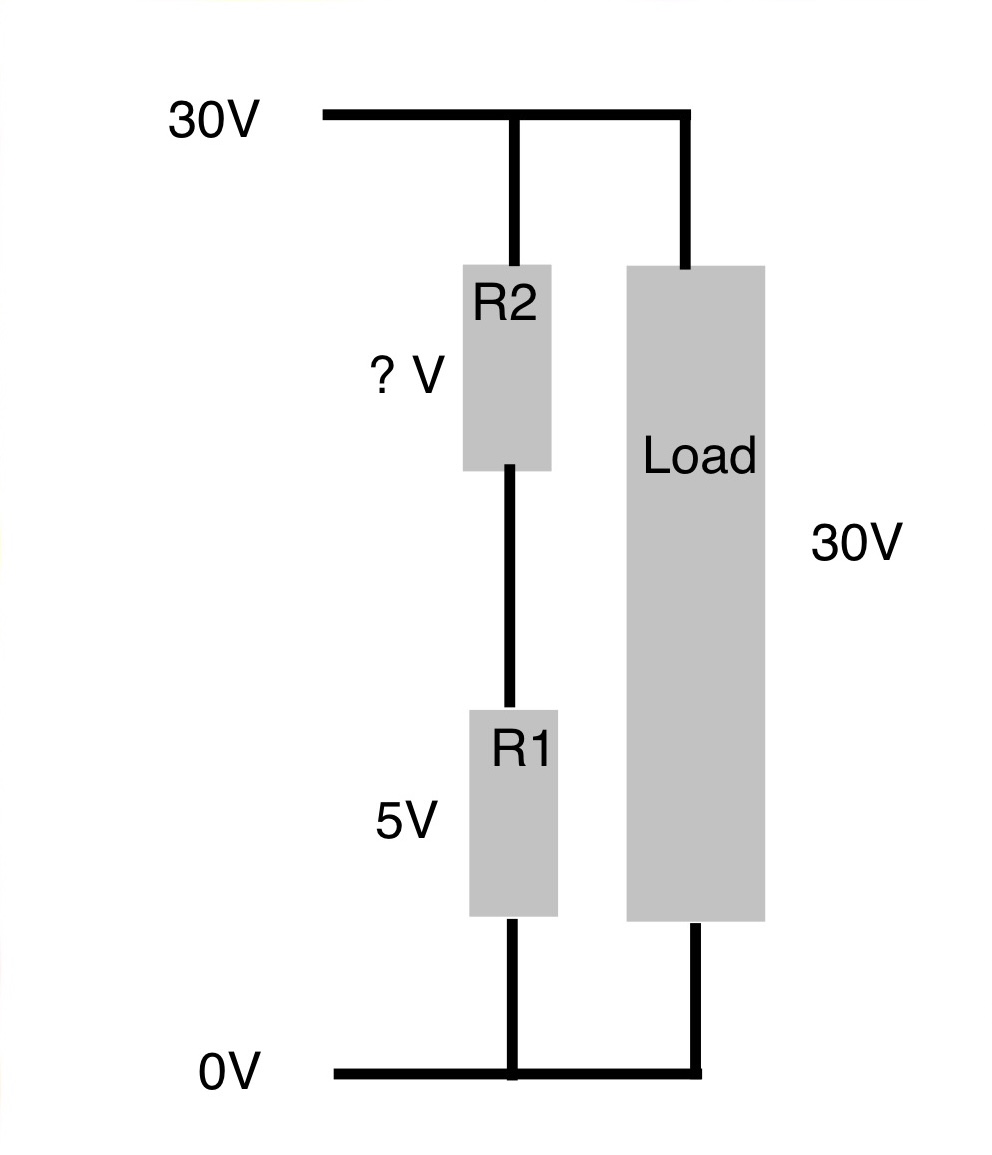
    Assume we apply 30v across a load, and the load has 2 series components across the same load.
    If the bottom series component has 5v across it, what is the voltage across the top series component ? :thinking: