Problème couleur ShowBMP.INO

Bonjour,

Je débute seulement dans le codage Arduino, je voulais tester ShowBMP.ino que je trouve bien sympathique.
tout c'est bien passer pour la vérification et le téléversement du code que je trouver sur le internet pour cette carte : https://www.amazon.fr/Elegoo-ATmega328P-ATMEGA16U2-Controller-Microcontrôleur/dp/B01N91PVIS/ref=asc_df_B01N91PVIS/?tag=googshopfr-21&linkCode=df0&hvadid=194956736627&hvpos=&hvnetw=g&hvrand=6397621278416650929&hvpone=&hvptwo=&hvqmt=&hvdev=c&hvdvcmdl=&hvlocint=&hvlocphy=9056015&hvtargid=pla-329356109727&psc=1&mcid=2193ae8f85b33dd3bc8948b351aabc81

Maintenant que que j'ai alimenté la carte, un problème de couleur sur l'écran TFT LCD Ecran Tactile 3,5 pouces: https://www.amazon.fr/Hilitand-Module-Tactile-Arduino-480x320/dp/B07HT6ZH7L/ref=sr_1_11?keywords=tft+lcd+module&qid=1701959576&sr=8-11
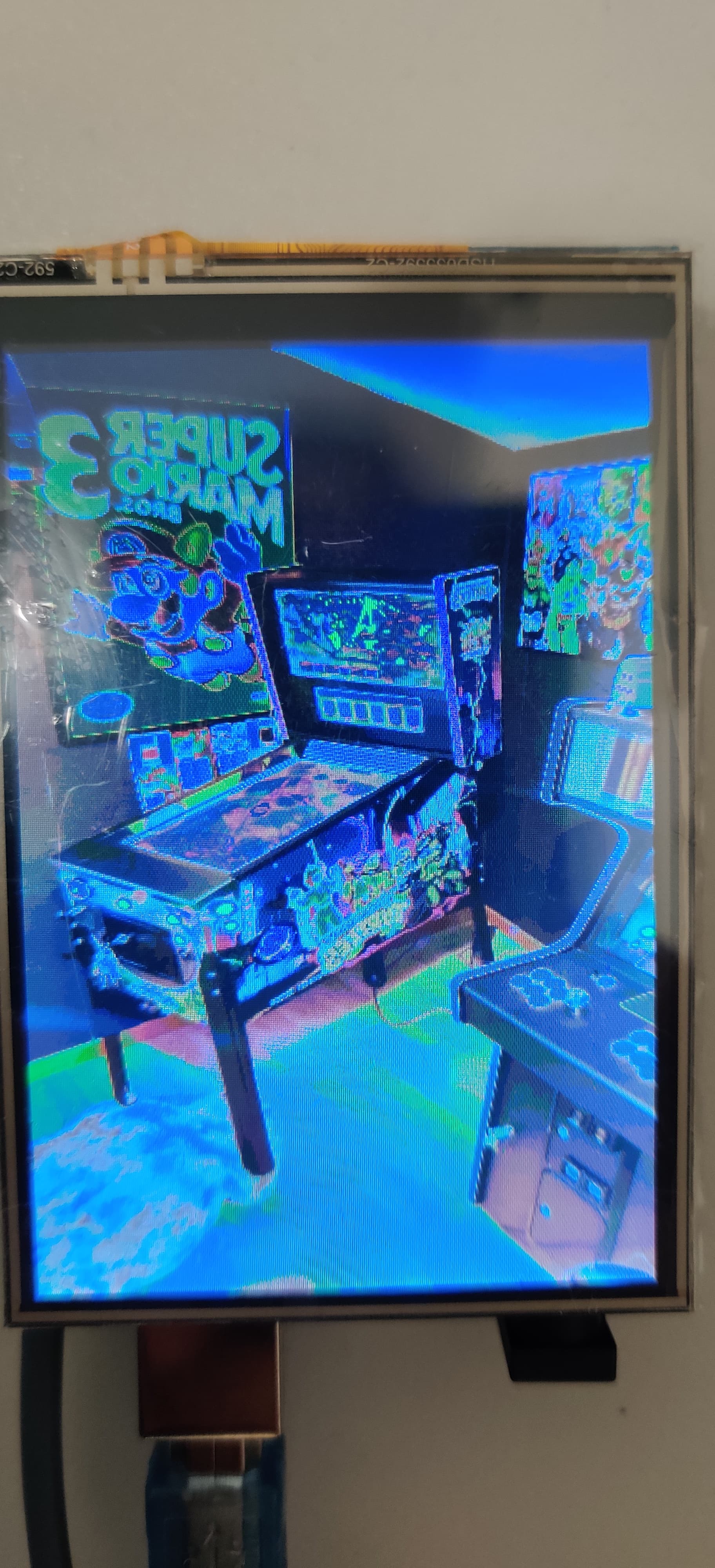
voici le code que j'ai actuellement :

// IMPORTANT: Adafruit_TFTLCD LIBRARY MUST BE SPECIFICALLY
// CONFIGURED FOR EITHER THE TFT SHIELD OR THE BREAKOUT BOARD.
// SEE RELEVANT COMMENTS IN Adafruit_TFTLCD.h FOR SETUP.
//Technical support:goodtft@163.com

#include <Adafruit_GFX.h>    // Core graphics library
#include <Adafruit_TFTLCD.h> // Hardware-specific library
#include <SD.h>
#include <SPI.h>


// The control pins for the LCD can be assigned to any digital or
// analog pins...but we'll use the analog pins as this allows us to
// double up the pins with the touch screen (see the TFT paint example).
#define LCD_CS A3 // Chip Select goes to Analog 3
#define LCD_CD A2 // Command/Data goes to Analog 2
#define LCD_WR A1 // LCD Write goes to Analog 1
#define LCD_RD A0 // LCD Read goes to Analog 0
#define PIN_SD_CS 10 // Adafruit SD shields and modules: pin 10

#define LCD_RESET A4 // Can alternately just connect to Arduino's reset pin

// When using the BREAKOUT BOARD only, use these 8 data lines to the LCD:
// For the Arduino Uno, Duemilanove, Diecimila, etc.:
//   D0 connects to digital pin 8  (Notice these are
//   D1 connects to digital pin 9   NOT in order!)
//   D2 connects to digital pin 2
//   D3 connects to digital pin 3
//   D4 connects to digital pin 4
//   D5 connects to digital pin 5
//   D6 connects to digital pin 6
//   D7 connects to digital pin 7
// For the Arduino Mega, use digital pins 22 through 29
// (on the 2-row header at the end of the board).

// Assign human-readable names to some common 16-bit color values:
#define	BLACK   0x0000
#define	BLUE    0x001F
#define	RED     0xF800
#define	GREEN   0x07E0
#define CYAN    0x07FF
#define MAGENTA 0xF81F
#define YELLOW  0xFFE0
#define WHITE   0xFFFF

Adafruit_TFTLCD tft(LCD_CS, LCD_CD, LCD_WR, LCD_RD, LCD_RESET);
// If using the shield, all control and data lines are fixed, and
// a simpler declaration can optionally be used:
// Adafruit_TFTLCD tft;


#define MAX_BMP         10                      // bmp file num
#define FILENAME_LEN    20                      // max file name length

const int __Gnbmp_height = 320;                 // bmp hight
const int __Gnbmp_width  = 240;                 // bmp width

unsigned char __Gnbmp_image_offset  = 0;        // offset

int __Gnfile_num = 4;                           // num of file

char __Gsbmp_files[4][FILENAME_LEN] =           // add file name here
{
"flower.bmp",
"tiger.bmp",
"tree.bmp",
"RedRose.bmp",
};
File bmpFile;

/*********************************************/
// This procedure reads a bitmap and draws it to the screen
// its sped up by reading many pixels worth of data at a time
// instead of just one pixel at a time. increading the buffer takes
// more RAM but makes the drawing a little faster. 20 pixels' worth
// is probably a good place

#define BUFFPIXEL       60                      // must be a divisor of 240 
#define BUFFPIXEL_X3    180                     // BUFFPIXELx3

void bmpdraw(File f, int x, int y)
{
    bmpFile.seek(__Gnbmp_image_offset);

    uint32_t time = millis();

    uint8_t sdbuffer[BUFFPIXEL_X3];                 // 3 * pixels to buffer

    for (int i=0; i< __Gnbmp_height; i++) {
        for(int j=0; j<(240/BUFFPIXEL); j++) {
            bmpFile.read(sdbuffer, BUFFPIXEL_X3);
            
            uint8_t buffidx = 0;
            int offset_x = j*BUFFPIXEL;
            unsigned int __color[BUFFPIXEL];
            
            for(int k=0; k<BUFFPIXEL; k++) {
                __color[k] = sdbuffer[buffidx+2]>>3;                        // read
                __color[k] = __color[k]<<6 | (sdbuffer[buffidx+1]>>2);      // green
                __color[k] = __color[k]<<5 | (sdbuffer[buffidx+0]>>3);      // blue
                
                buffidx += 3;
            }

	    for (int m = 0; m < BUFFPIXEL; m ++) {
              tft.drawPixel(m+offset_x, i,__color[m]);
	    }
        }
    }
    
    Serial.print(millis() - time, DEC);
    Serial.println(" ms");
}

boolean bmpReadHeader(File f) 
{
    // read header
    uint32_t tmp;
    uint8_t bmpDepth;
    
    if (read16(f) != 0x4D42) {
        // magic bytes missing
        return false;
    }

    // read file size
    tmp = read32(f);
    Serial.print("size 0x");
    Serial.println(tmp, HEX);

    // read and ignore creator bytes
    read32(f);

    __Gnbmp_image_offset = read32(f);
    Serial.print("offset ");
    Serial.println(__Gnbmp_image_offset, DEC);

    // read DIB header
    tmp = read32(f);
    Serial.print("header size ");
    Serial.println(tmp, DEC);
    
    int bmp_width = read32(f);
    int bmp_height = read32(f);
    
    if(bmp_width != __Gnbmp_width || bmp_height != __Gnbmp_height)  {    // if image is not 320x240, return false
        return false;
    }

    if (read16(f) != 1)
    return false;

    bmpDepth = read16(f);
    Serial.print("bitdepth ");
    Serial.println(bmpDepth, DEC);

    if (read32(f) != 0) {
        // compression not supported!
        return false;
    }

    Serial.print("compression ");
    Serial.println(tmp, DEC);

    return true;
}

/*********************************************/
// These read data from the SD card file and convert them to big endian
// (the data is stored in little endian format!)

// LITTLE ENDIAN!
uint16_t read16(File f)
{
    uint16_t d;
    uint8_t b;
    b = f.read();
    d = f.read();
    d <<= 8;
    d |= b;
    return d;
}

// LITTLE ENDIAN!
uint32_t read32(File f)
{
    uint32_t d;
    uint16_t b;

    b = read16(f);
    d = read16(f);
    d <<= 16;
    d |= b;
    return d;
}

void setup(void) {
  Serial.begin(9600);
  Serial.println(F("TFT LCD test"));

#ifdef USE_ADAFRUIT_SHIELD_PINOUT
  Serial.println(F("Using Adafruit 2.4\" TFT Arduino Shield Pinout"));
#else
  Serial.println(F("Using Adafruit 2.4\" TFT Breakout Board Pinout"));
#endif

  Serial.print("TFT size is "); Serial.print(tft.width()); Serial.print("x"); Serial.println(tft.height());

  tft.reset();

  uint16_t identifier = tft.readID();
  if(identifier==0x0101)
      identifier=0x9341;
  
  if(identifier == 0x9325) {
    Serial.println(F("Found ILI9325 LCD driver"));
  } else if(identifier == 0x4535) {
    Serial.println(F("Found LGDP4535 LCD driver"));
  }else if(identifier == 0x9328) {
    Serial.println(F("Found ILI9328 LCD driver"));
  } else if(identifier == 0x7575) {
    Serial.println(F("Found HX8347G LCD driver"));
  } else if(identifier == 0x9341) {
    Serial.println(F("Found ILI9341 LCD driver"));
  } else if(identifier == 0x8357) {
    Serial.println(F("Found HX8357D LCD driver"));
  } else {
    Serial.print(F("Unknown LCD driver chip: "));
    Serial.println(identifier, HEX);
    Serial.println(F("If using the Adafruit 2.4\" TFT Arduino shield, the line:"));
    Serial.println(F("  #define USE_ADAFRUIT_SHIELD_PINOUT"));
    Serial.println(F("should appear in the library header (Adafruit_TFT.h)."));
    Serial.println(F("If using the breakout board, it should NOT be #defined!"));
    Serial.println(F("Also if using the breakout, double-check that all wiring"));
    Serial.println(F("matches the tutorial."));
    return;
  }
  
  tft.begin(identifier);
  tft.fillScreen(BLUE);


  //Init SD_Card
  pinMode(10, OUTPUT);
   
  if (!SD.begin(10)) {
    Serial.println("initialization failed!");
    tft.setCursor(0, 0);
    tft.setTextColor(WHITE);    
    tft.setTextSize(1);
    tft.println("SD Card Init fail.");   
  }else
  Serial.println("initialization done."); 
}

void loop(void) {
     for(unsigned char i=0; i<__Gnfile_num; i++) {
        bmpFile = SD.open(__Gsbmp_files[i]);
        if (! bmpFile) {
            Serial.println("didnt find image");
            tft.setTextColor(WHITE);    tft.setTextSize(1);
            tft.println("didnt find BMPimage");
            while (1);
        }
   
        if(! bmpReadHeader(bmpFile)) {
            Serial.println("bad bmp");
            tft.setTextColor(WHITE);    tft.setTextSize(1);
            tft.println("bad bmp");
            return;
        }

        bmpdraw(bmpFile, 0, 0);
        bmpFile.close();
        delay(1000);
        delay(1000);
    }
    
}


:warning:
Post mis dans la mauvaise section, on parle anglais dans les forums généraux. déplacé vers le forum francophone.

Merci de prendre en compte les recommandations listées dans Les bonnes pratiques du Forum Francophone

en début de code il y a écrit

vous l'avez fait ?

Merci pour votre réponse,

Justement je ne comprend pas Quesque je doit y configurer dans ce fichier ?

Voici le code du fichier Adafruit_TFTLCD.h

// IMPORTANT: SEE COMMENTS @ LINE 15 REGARDING SHIELD VS BREAKOUT BOARD USAGE.

// Graphics library by ladyada/adafruit with init code from Rossum
// MIT license

#ifndef _ADAFRUIT_TFTLCD_H_
#define _ADAFRUIT_TFTLCD_H_

#if ARDUINO >= 100
 #include "Arduino.h"
#else
 #include "WProgram.h"
#endif

#include <Adafruit_GFX.h>

// **** IF USING THE LCD BREAKOUT BOARD, COMMENT OUT THIS NEXT LINE. ****
// **** IF USING THE LCD SHIELD, LEAVE THE LINE ENABLED:             ****

//#define USE_ADAFRUIT_SHIELD_PINOUT 1

class Adafruit_TFTLCD : public Adafruit_GFX {

 public:

  Adafruit_TFTLCD(uint8_t cs, uint8_t cd, uint8_t wr, uint8_t rd, uint8_t rst);
  Adafruit_TFTLCD(void);

  void     begin(uint16_t id = 0x9325);
  void     drawPixel(int16_t x, int16_t y, uint16_t color);
  void     drawFastHLine(int16_t x0, int16_t y0, int16_t w, uint16_t color);
  void     drawFastVLine(int16_t x0, int16_t y0, int16_t h, uint16_t color);
  void     fillRect(int16_t x, int16_t y, int16_t w, int16_t h, uint16_t c);
  void     fillScreen(uint16_t color);
  void     reset(void);
  void     setRegisters8(uint8_t *ptr, uint8_t n);
  void     setRegisters16(uint16_t *ptr, uint8_t n);
  void     setRotation(uint8_t x);
       // These methods are public in order for BMP examples to work:
  void     setAddrWindow(int x1, int y1, int x2, int y2);
  void     pushColors(uint16_t *data, uint8_t len, boolean first);

  uint16_t color565(uint8_t r, uint8_t g, uint8_t b),
           readPixel(int16_t x, int16_t y),
           readID(void);
  uint32_t readReg(uint8_t r);

 private:

  void     init(),
           // These items may have previously been defined as macros
           // in pin_magic.h.  If not, function versions are declared:
#ifndef write8
           write8(uint8_t value),
#endif
#ifndef setWriteDir
           setWriteDir(void),
#endif
#ifndef setReadDir
           setReadDir(void),
#endif
#ifndef writeRegister8
           writeRegister8(uint8_t a, uint8_t d),
#endif
#ifndef writeRegister16
           writeRegister16(uint16_t a, uint16_t d),
#endif
    writeRegister24(uint8_t a, uint32_t d),
    writeRegister32(uint8_t a, uint32_t d),
#ifndef writeRegisterPair
           writeRegisterPair(uint8_t aH, uint8_t aL, uint16_t d),
#endif
           setLR(void),
           flood(uint16_t color, uint32_t len);
  uint8_t  driver;

#ifndef read8
  uint8_t  read8fn(void);
  #define  read8isFunctionalized
#endif

#ifndef USE_ADAFRUIT_SHIELD_PINOUT

  #ifdef __AVR__
    volatile uint8_t *csPort    , *cdPort    , *wrPort    , *rdPort;
	uint8_t           csPinSet  ,  cdPinSet  ,  wrPinSet  ,  rdPinSet  ,
					  csPinUnset,  cdPinUnset,  wrPinUnset,  rdPinUnset,
					  _reset;
  #endif
  #if defined(__SAM3X8E__)
    Pio *csPort    , *cdPort    , *wrPort    , *rdPort;
	uint32_t          csPinSet  ,  cdPinSet  ,  wrPinSet  ,  rdPinSet  ,
					  csPinUnset,  cdPinUnset,  wrPinUnset,  rdPinUnset,
					  _reset;
  #endif
  
#endif
};

// For compatibility with sketches written for older versions of library.
// Color function name was changed to 'color565' for parity with 2.2" LCD
// library.
#define Color565 color565

#endif

Le vendeur de l'afficheur recommande d'utiliser la librairie UTFT.
L'écran fait 480 x 320 donc une "image" dépasse largement la capacité mémoire de la UNO, et même d'une MEGA2560. Ce qui limite pas mal l'usage.
Il me semble que UTFT, travaille sans buffer d'image c'est peut-être pour cela que cette librairie est recommandée.

Merci pour votre reponse,

J'ai redimensionné les images en 480x320 bmp justement

essayez avec UTFT. il se peut que l'ordre des pixels ne soit pas le bon pour la couleur ?

Je début vraiment, je ne connais pas encor le langage des codes, UTFT je ne c'est, surement en rapport avec l'écran, mais a quel ligne de quel fichier je doit modifier ? désolé j'essai de comprendre en même temps, il y a tellement d'info sur le net que je m'y perd

non c'est pas un code secret, juste sans doute cette bibliothèque

http://www.rinkydinkelectronics.com/library.php?id=51

:slight_smile:

Pour utiliser un BMP avec la librairie Adafruit, il faut que le BMP soit en format RGB 8-8-8.

je viens de décompresser l'archive et j'ai mi le dossier UTFT dans la librairie mais ça change rien

Bonsoir,
Je me répond a moi même, j'ai trouver ce code qui fonctionne bien sur mon matériel.
Je vous remercie encore pour vos aides

// MCUFRIEND UNO shields have microSD on pins 10, 11, 12, 13
// The official <SD.h> library only works on the hardware SPI pins
// e.g. 11, 12, 13 on a Uno  (or STM32 Nucleo)
//
// copy all your BMP files to the root directory on the microSD with your PC
// (or another directory)

#include <SPI.h>            // f.k. for Arduino-1.5.2
//#define USE_SDFAT
#include <SD.h>             // Use the official SD library on hardware pins

#include <Adafruit_GFX.h>   // Hardware-specific library
#include <MCUFRIEND_kbv.h>
MCUFRIEND_kbv tft;

#if defined(ESP32)
#define SD_CS     5
#else
#define SD_CS     10
#endif
#define NAMEMATCH ""        // "" matches any name
//#define NAMEMATCH "tiger"   // *tiger*.bmp
#define PALETTEDEPTH   0     // do not support Palette modes
//#define PALETTEDEPTH   8     // support 256-colour Palette

char namebuf[32] = "/";   //BMP files in root directory
//char namebuf[32] = "/bitmaps/";  //BMP directory e.g. files in /bitmaps/*.bmp

File root;
int pathlen;

void setup()
{
    uint16_t ID;
    Serial.begin(9600);
    Serial.print("Show BMP files on TFT with ID:0x");
    ID = tft.readID();
    Serial.println(ID, HEX);
    if (ID == 0x0D3D3) ID = 0x9481;
    tft.begin(ID);
    tft.fillScreen(0x001F);
    tft.setTextColor(0xFFFF, 0x0000);
    bool good = SD.begin(SD_CS);
    if (!good) {
        Serial.print(F("cannot start SD"));
        while (1);
    }
    root = SD.open(namebuf);
    pathlen = strlen(namebuf);
}

void loop()
{
    char *nm = namebuf + pathlen;
    File f = root.openNextFile();
    uint8_t ret;
    uint32_t start;
    if (f != NULL) {
#ifdef USE_SDFAT
        f.getName(nm, 32 - pathlen);
#else
        strcpy(nm, (char *)f.name());
#endif
        f.close();
        strlwr(nm);
        if (strstr(nm, ".bmp") != NULL && strstr(nm, NAMEMATCH) != NULL) {
            Serial.print(namebuf);
            Serial.print(F(" - "));
            tft.fillScreen(0);
            start = millis();
            ret = showBMP(namebuf, 5, 5);
            switch (ret) {
                case 0:
                    Serial.print(millis() - start);
                    Serial.println(F("ms"));
                    delay(10000);
                    break;
                case 1:
                    Serial.println(F("bad position"));
                    break;
                case 2:
                    Serial.println(F("bad BMP ID"));
                    break;
                case 3:
                    Serial.println(F("wrong number of planes"));
                    break;
                case 4:
                    Serial.println(F("unsupported BMP format"));
                    break;
                case 5:
                    Serial.println(F("unsupported palette"));
                    break;
                default:
                    Serial.println(F("unknown"));
                    break;
            }
        }
    }
    else root.rewindDirectory();
}

#define BMPIMAGEOFFSET 54

#define BUFFPIXEL      20

uint16_t read16(File& f) {
    uint16_t result;         // read little-endian
    f.read((uint8_t*)&result, sizeof(result));
    return result;
}

uint32_t read32(File& f) {
    uint32_t result;
    f.read((uint8_t*)&result, sizeof(result));
    return result;
}

uint8_t showBMP(char *nm, int x, int y)
{
    File bmpFile;
    int bmpWidth, bmpHeight;    // W+H in pixels
    uint8_t bmpDepth;           // Bit depth (currently must be 24, 16, 8, 4, 1)
    uint32_t bmpImageoffset;    // Start of image data in file
    uint32_t rowSize;           // Not always = bmpWidth; may have padding
    uint8_t sdbuffer[3 * BUFFPIXEL];    // pixel in buffer (R+G+B per pixel)
    uint16_t lcdbuffer[(1 << PALETTEDEPTH) + BUFFPIXEL], *palette = NULL;
    uint8_t bitmask, bitshift;
    boolean flip = true;        // BMP is stored bottom-to-top
    int w, h, row, col, lcdbufsiz = (1 << PALETTEDEPTH) + BUFFPIXEL, buffidx;
    uint32_t pos;               // seek position
    boolean is565 = false;      //

    uint16_t bmpID;
    uint16_t n;                 // blocks read
    uint8_t ret;

    if ((x >= tft.width()) || (y >= tft.height()))
        return 1;               // off screen

    bmpFile = SD.open(nm);      // Parse BMP header
    bmpID = read16(bmpFile);    // BMP signature
    (void) read32(bmpFile);     // Read & ignore file size
    (void) read32(bmpFile);     // Read & ignore creator bytes
    bmpImageoffset = read32(bmpFile);       // Start of image data
    (void) read32(bmpFile);     // Read & ignore DIB header size
    bmpWidth = read32(bmpFile);
    bmpHeight = read32(bmpFile);
    n = read16(bmpFile);        // # planes -- must be '1'
    bmpDepth = read16(bmpFile); // bits per pixel
    pos = read32(bmpFile);      // format
    if (bmpID != 0x4D42) ret = 2; // bad ID
    else if (n != 1) ret = 3;   // too many planes
    else if (pos != 0 && pos != 3) ret = 4; // format: 0 = uncompressed, 3 = 565
    else if (bmpDepth < 16 && bmpDepth > PALETTEDEPTH) ret = 5; // palette 
    else {
        bool first = true;
        is565 = (pos == 3);               // ?already in 16-bit format
        // BMP rows are padded (if needed) to 4-byte boundary
        rowSize = (bmpWidth * bmpDepth / 8 + 3) & ~3;
        if (bmpHeight < 0) {              // If negative, image is in top-down order.
            bmpHeight = -bmpHeight;
            flip = false;
        }

        w = bmpWidth;
        h = bmpHeight;
        if ((x + w) >= tft.width())       // Crop area to be loaded
            w = tft.width() - x;
        if ((y + h) >= tft.height())      //
            h = tft.height() - y;

        if (bmpDepth <= PALETTEDEPTH) {   // these modes have separate palette
            //bmpFile.seek(BMPIMAGEOFFSET); //palette is always @ 54
            bmpFile.seek(bmpImageoffset - (4<<bmpDepth)); //54 for regular, diff for colorsimportant
            bitmask = 0xFF;
            if (bmpDepth < 8)
                bitmask >>= bmpDepth;
            bitshift = 8 - bmpDepth;
            n = 1 << bmpDepth;
            lcdbufsiz -= n;
            palette = lcdbuffer + lcdbufsiz;
            for (col = 0; col < n; col++) {
                pos = read32(bmpFile);    //map palette to 5-6-5
                palette[col] = ((pos & 0x0000F8) >> 3) | ((pos & 0x00FC00) >> 5) | ((pos & 0xF80000) >> 8);
            }
        }

        // Set TFT address window to clipped image bounds
        tft.setAddrWindow(x, y, x + w - 1, y + h - 1);
        for (row = 0; row < h; row++) { // For each scanline...
            // Seek to start of scan line.  It might seem labor-
            // intensive to be doing this on every line, but this
            // method covers a lot of gritty details like cropping
            // and scanline padding.  Also, the seek only takes
            // place if the file position actually needs to change
            // (avoids a lot of cluster math in SD library).
            uint8_t r, g, b, *sdptr;
            int lcdidx, lcdleft;
            if (flip)   // Bitmap is stored bottom-to-top order (normal BMP)
                pos = bmpImageoffset + (bmpHeight - 1 - row) * rowSize;
            else        // Bitmap is stored top-to-bottom
                pos = bmpImageoffset + row * rowSize;
            if (bmpFile.position() != pos) { // Need seek?
                bmpFile.seek(pos);
                buffidx = sizeof(sdbuffer); // Force buffer reload
            }

            for (col = 0; col < w; ) {  //pixels in row
                lcdleft = w - col;
                if (lcdleft > lcdbufsiz) lcdleft = lcdbufsiz;
                for (lcdidx = 0; lcdidx < lcdleft; lcdidx++) { // buffer at a time
                    uint16_t color;
                    // Time to read more pixel data?
                    if (buffidx >= sizeof(sdbuffer)) { // Indeed
                        bmpFile.read(sdbuffer, sizeof(sdbuffer));
                        buffidx = 0; // Set index to beginning
                        r = 0;
                    }
                    switch (bmpDepth) {          // Convert pixel from BMP to TFT format
                        case 32:
                        case 24:
                            b = sdbuffer[buffidx++];
                            g = sdbuffer[buffidx++];
                            r = sdbuffer[buffidx++];
                            if (bmpDepth == 32) buffidx++; //ignore ALPHA
                            color = tft.color565(r, g, b);
                            break;
                        case 16:
                            b = sdbuffer[buffidx++];
                            r = sdbuffer[buffidx++];
                            if (is565)
                                color = (r << 8) | (b);
                            else
                                color = (r << 9) | ((b & 0xE0) << 1) | (b & 0x1F);
                            break;
                        case 1:
                        case 4:
                        case 8:
                            if (r == 0)
                                b = sdbuffer[buffidx++], r = 8;
                            color = palette[(b >> bitshift) & bitmask];
                            r -= bmpDepth;
                            b <<= bmpDepth;
                            break;
                    }
                    lcdbuffer[lcdidx] = color;

                }
                tft.pushColors(lcdbuffer, lcdidx, first);
                first = false;
                col += lcdidx;
            }           // end cols
        }               // end rows
        tft.setAddrWindow(0, 0, tft.width() - 1, tft.height() - 1); //restore full screen
        ret = 0;        // good render
    }
    bmpFile.close();
    return (ret);
}

Par contre j'aimerais savoir comment faire la rotation vertical de l'image ? et aussi comment ne pas avoir la page défilante noire, j'aimerais qu'elle soi transparente a chaque fois que ca change d'image.
Je vous remercie par avance

C'est l'effacement de l'écran qui fait ça

tft.fillScreen(0);

Mais je ne vois pas très bien ce que tu entends pas

j'aimerais qu'elle soi transparente

Si tu n'effaces pas l'écran et que la nouvelle image ne recouvre pas complètement la précédente tu vas avoir un patchwork d'images sur l'écran. Si elles font toutes 480x320, elles se recouvriront et effectivement, il ne sera pas nécessaire de procéder à un effacement avant d'afficher la nouvelle image. Dans ce cas tu peux retirer la ligne en question (ligne 69)

Tu parles d'une symétrie haut/bas?
Dans showBMP, il y a un booléen flip qui indique si l'image est stockée de haut en bas ou inversement. Il suffit, je pense, de complémenter ce booléen ligne 199

Super, merci beaucoup ! J'ai réussi grâce à vous à ne plus avoir le défilement en noir entre chaque image. Pareil pour la rotation verticale.

Je constate que j'ai un léger décalage de l'image sur le côté droit et en bas, je vois le fond bleu de l'écran. Je sais que les positions sont x et y, mais j'en vois un peu partout dans le code, du coup, je ne sais pas quelle est la ligne à modifier.

postez le nouveau code

// MCUFRIEND UNO shields have microSD on pins 10, 11, 12, 13
// The official <SD.h> library only works on the hardware SPI pins
// e.g. 11, 12, 13 on a Uno  (or STM32 Nucleo)
//
// copy all your BMP files to the root directory on the microSD with your PC
// (or another directory)

#include <SPI.h>            // f.k. for Arduino-1.5.2
//#define USE_SDFAT
#include <SD.h>             // Use the official SD library on hardware pins

#include <Adafruit_GFX.h>   // Hardware-specific library
#include <MCUFRIEND_kbv.h>
MCUFRIEND_kbv tft;

#if defined(ESP32)
#define SD_CS     5
#else
#define SD_CS     10
#endif
#define NAMEMATCH ""        // "" matches any name
//#define NAMEMATCH "tiger"   // *tiger*.bmp
#define PALETTEDEPTH   0     // do not support Palette modes
//#define PALETTEDEPTH   8     // support 256-colour Palette

char namebuf[32] = "/";   //BMP files in root directory
//char namebuf[32] = "/bitmaps/";  //BMP directory e.g. files in /bitmaps/*.bmp

File root;
int pathlen;

void setup()
{
    uint16_t ID;
    Serial.begin(9600);
    Serial.print("Show BMP files on TFT with ID:0x");
    ID = tft.readID();
    Serial.println(ID, HEX);
    if (ID == 0x0D3D3) ID = 0x9481;
    tft.begin(ID);
    tft.fillScreen(0x001F);
    tft.setTextColor(0xFFFF, 0x0000);
    bool good = SD.begin(SD_CS);
    if (!good) {
        Serial.print(F("cannot start SD"));
        while (1);
    }
    root = SD.open(namebuf);
    pathlen = strlen(namebuf);
}

void loop()
{
    char *nm = namebuf + pathlen;
    File f = root.openNextFile();
    uint8_t ret;
    uint32_t start;
    if (f != NULL) {
#ifdef USE_SDFAT
        f.getName(nm, 32 - pathlen);
#else
        strcpy(nm, (char *)f.name());
#endif
        f.close();
        strlwr(nm);
        if (strstr(nm, ".bmp") != NULL && strstr(nm, NAMEMATCH) != NULL) {
            Serial.print(namebuf);
            Serial.print(F(" - "));
            start = millis();
            ret = showBMP(namebuf, 5, 5);
            switch (ret) {
                case 0:
                    Serial.print(millis() - start);
                    Serial.println(F("ms"));
                    delay(5000);
                    break;
                case 1:
                    Serial.println(F("bad position"));
                    break;
                case 2:
                    Serial.println(F("bad BMP ID"));
                    break;
                case 3:
                    Serial.println(F("wrong number of planes"));
                    break;
                case 4:
                    Serial.println(F("unsupported BMP format"));
                    break;
                case 5:
                    Serial.println(F("unsupported palette"));
                    break;
                default:
                    Serial.println(F("unknown"));
                    break;
            }
        }
    }
    else root.rewindDirectory();
}

#define BMPIMAGEOFFSET 54

#define BUFFPIXEL      20

uint16_t read16(File& f) {
    uint16_t result;         // read little-endian
    f.read((uint8_t*)&result, sizeof(result));
    return result;
}

uint32_t read32(File& f) {
    uint32_t result;
    f.read((uint8_t*)&result, sizeof(result));
    return result;
}

uint8_t showBMP(char *nm, int x, int y)
{
    File bmpFile;
    int bmpWidth, bmpHeight;    // W+H in pixels
    uint8_t bmpDepth;           // Bit depth (currently must be 24, 16, 8, 4, 1)
    uint32_t bmpImageoffset;    // Start of image data in file
    uint32_t rowSize;           // Not always = bmpWidth; may have padding
    uint8_t sdbuffer[3 * BUFFPIXEL];    // pixel in buffer (R+G+B per pixel)
    uint16_t lcdbuffer[(1 << PALETTEDEPTH) + BUFFPIXEL], *palette = NULL;
    uint8_t bitmask, bitshift;
    boolean flip = true;        // BMP is stored bottom-to-top
    int w, h, row, col, lcdbufsiz = (1 << PALETTEDEPTH) + BUFFPIXEL, buffidx;
    uint32_t pos;               // seek position
    boolean is565 = false;      //

    uint16_t bmpID;
    uint16_t n;                 // blocks read
    uint8_t ret;

    if ((x >= tft.width()) || (y >= tft.height()))
        return 1;               // off screen

    bmpFile = SD.open(nm);      // Parse BMP header
    bmpID = read16(bmpFile);    // BMP signature
    (void) read32(bmpFile);     // Read & ignore file size
    (void) read32(bmpFile);     // Read & ignore creator bytes
    bmpImageoffset = read32(bmpFile);       // Start of image data
    (void) read32(bmpFile);     // Read & ignore DIB header size
    bmpWidth = read32(bmpFile);
    bmpHeight = read32(bmpFile);
    n = read16(bmpFile);        // # planes -- must be '1'
    bmpDepth = read16(bmpFile); // bits per pixel
    pos = read32(bmpFile);      // format
    if (bmpID != 0x4D42) ret = 2; // bad ID
    else if (n != 1) ret = 3;   // too many planes
    else if (pos != 0 && pos != 3) ret = 4; // format: 0 = uncompressed, 3 = 565
    else if (bmpDepth < 16 && bmpDepth > PALETTEDEPTH) ret = 5; // palette 
    else {
        bool first = true;
        is565 = (pos == 3);               // ?already in 16-bit format
        // BMP rows are padded (if needed) to 4-byte boundary
        rowSize = (bmpWidth * bmpDepth / 8 + 3) & ~3;
        if (bmpHeight < 0) {              // If negative, image is in top-down order.
            bmpHeight = -bmpHeight;
            flip = false;
        }

        w = bmpWidth;
        h = bmpHeight;
        if ((x + w) >= tft.width())       // Crop area to be loaded
            w = tft.width() - x;
        if ((y + h) >= tft.height())      //
            h = tft.height() - y;

        if (bmpDepth <= PALETTEDEPTH) {   // these modes have separate palette
            //bmpFile.seek(BMPIMAGEOFFSET); //palette is always @ 54
            bmpFile.seek(bmpImageoffset - (4<<bmpDepth)); //54 for regular, diff for colorsimportant
            bitmask = 0xFF;
            if (bmpDepth < 8)
                bitmask >>= bmpDepth;
            bitshift = 8 - bmpDepth;
            n = 1 << bmpDepth;
            lcdbufsiz -= n;
            palette = lcdbuffer + lcdbufsiz;
            for (col = 0; col < n; col++) {
                pos = read32(bmpFile);    //map palette to 5-6-5
                palette[col] = ((pos & 0x0000F8) >> 3) | ((pos & 0x00FC00) >> 5) | ((pos & 0xF80000) >> 8);
            }
        }

        // Set TFT address window to clipped image bounds
        tft.setAddrWindow(x, y, x + w - 1, y + h - 1);
        for (row = 0; row < h; row++) { // For each scanline...
            // Seek to start of scan line.  It might seem labor-
            // intensive to be doing this on every line, but this
            // method covers a lot of gritty details like cropping
            // and scanline padding.  Also, the seek only takes
            // place if the file position actually needs to change
            // (avoids a lot of cluster math in SD library).
            uint8_t r, g, b, *sdptr;
            int lcdidx, lcdleft;
            if (flip)   // Bitmap is stored bottom-to-top order (normal BMP)
                pos = bmpImageoffset + (bmpHeight - 1 - row) * rowSize;
            else        // Bitmap is stored top-to-bottom
                pos = bmpImageoffset + row * rowSize;
            if (bmpFile.position() != pos) { // Need seek?
                bmpFile.seek(pos);
                buffidx = sizeof(sdbuffer); // Force buffer reload
            }

            for (col = 0; col < w; ) {  //pixels in row
                lcdleft = w - col;
                if (lcdleft > lcdbufsiz) lcdleft = lcdbufsiz;
                for (lcdidx = 0; lcdidx < lcdleft; lcdidx++) { // buffer at a time
                    uint16_t color;
                    // Time to read more pixel data?
                    if (buffidx >= sizeof(sdbuffer)) { // Indeed
                        bmpFile.read(sdbuffer, sizeof(sdbuffer));
                        buffidx = 0; // Set index to beginning
                        r = 0;
                    }
                    switch (bmpDepth) {          // Convert pixel from BMP to TFT format
                        case 32:
                        case 24:
                            b = sdbuffer[buffidx++];
                            g = sdbuffer[buffidx++];
                            r = sdbuffer[buffidx++];
                            if (bmpDepth == 32) buffidx++; //ignore ALPHA
                            color = tft.color565(r, g, b);
                            break;
                        case 16:
                            b = sdbuffer[buffidx++];
                            r = sdbuffer[buffidx++];
                            if (is565)
                                color = (r << 8) | (b);
                            else
                                color = (r << 9) | ((b & 0xE0) << 1) | (b & 0x1F);
                            break;
                        case 1:
                        case 4:
                        case 8:
                            if (r == 0)
                                b = sdbuffer[buffidx++], r = 8;
                            color = palette[(b >> bitshift) & bitmask];
                            r -= bmpDepth;
                            b <<= bmpDepth;
                            break;
                    }
                    lcdbuffer[lcdidx] = color;

                }
                tft.pushColors(lcdbuffer, lcdidx, first);
                first = false;
                col += lcdidx;
            }           // end cols
        }               // end rows
        tft.setAddrWindow(0, 0, tft.width() - 1, tft.height() - 1); //restore full screen
        ret = 0;        // good render
    }
    bmpFile.close();
    return (ret);
}

je n'ai pas lu tout le code mais ici

on dirait que vous passez (5,5) comme coordonnées pour afficher le BMP

essayez avec 0,0

super ! merci beaucoup c'est bien cette ligne ! je ne comprend pas pourquoi c'est pas sur ret = showBMP(namebuf, 0, 0); d'origine ?

peut être que celui qui avait fait le code avait un liseré autour de ses images parce qu'elles étaient plus petites ?

d'accord je comprend,

Merci encore !