This is an engineering project. I have 6 months to complete this.
If you give me your email address I will be more than happy to send my literature review.
I didn't ask this particular question on reddit, just points to research for underwater communication.
Yup, as soon as I get the parts described in the video from my original post. I shall do just that. Im just worried about the physical transducer itself.
Sorry there I didn't mean to offend you, I am simply re-iterating what I have been told from lecturer. As I mentioned earlier I'm a student, a Mechanical E student at that.
Perhaps I should have mentioned in my original post that demonstrating this project will consist of placing the device in a tub, not the ocean. Therefore I assume background noise would be minimal.
Is it that hard to get an LED to light up when a sensor hears a ping at 40kHz?
It should not be too difficult to reproduce the results in that video, as a one time demonstration in your tub, and perhaps that would satisfy the class requirement.
The demonstration device would have no practical use, like that mentioned in your first post.
to deploy a buoy attached to a lobster pot resting on the seabed via ultrasonic signal.
You seem to be confusing lots of things and intelligent responses for a lack of understanding your project. I don’t think this is the case. Your project has been described and is very simple to understand. The problem is you don’t understand lots of the issues and you are using language in an imprecise way.
Doing something at point A that causes something to happen at point B IS transmitting data! The fact that you intend to transmit only a small amount of data at a very low rate does not change that.
To transmit the data you require in a tub is actually quite simple with many different methods but none of them translate easily to your stated purpose and would, essentially just be cheating. The point of demonstrating something in a lab environment is that it should be potentially reproducible in the “wild” by extrapolation. It is not to make it unrepresentative of the intended use so that you can get a positive result.
You can transmit data under water but it is difficult as stated. The drawbacks to using any ultrasound is that most boats use this and there will be a lot of noise in the real world. It is power hungry and easily distorted by sediment, sea weed, rocks etc so not great for transmitting data. The navy’s of many rich countries try these things with big budgets but that doesn’t mean yours will fail.
Light and low frequency noise will also work in a bathtub! I suspect, however that your main issue is that you are over engineering something that wouldn’t be either effective or affordable in real life, very prone to failure even if it did occasionally work and difficult to make sustainable in a marine environment. Not to be negative but a bit of wire to make it hard to cut a buoy off would be an available solution that could be used and isn’t because this would overestimate the problem already.
Maybe none of this matters and the point is not to make something with any use but simply demonstrate anything at all.
If I was doing anything for non commercial fishermen as a demonstration I would be thinking more of important issues like safety. Eg easily detecting MOB (man over board) or when single handed sending data to someone on shore of issues. Devices for these things exist but cheaper or simpler devices could be developed
For an ME with no or little electronics background, it may be hard. For a EE, maybe not so much.
If you can understand the following, then with some ingenuity you should be able to hack it to create a receiver to accomplish that simple goal (provided that the JSN really does work under water).
Not to pile it on, but as others have said, the real world, the marine environment, is an exceedingly harsh place, as is the deck of a lobster boat. I suspect deckhands will treat this device worse than baggage handlers at JFK. Not to mention the difficulties of keeping things charged and designing a robust, reliable, low power, and easy to use buoy release mechanism.
Yes, this is another part of our project. We have designed and will be machining a spring loaded bolt in the efforts to reduce power consumption. If my calculations are correct, a 9g servo should have sufficient torque to overcome the static friction between the bolt and it's latch. Fingers crossed.
Thank you so much for your time DaveEvans, from reading your posts on previous threads I hoping to hear from you the most.
Yes and no, this is a ME Research & Design / Realization assignment. There several other aspects which we will be marked on and remote activation is kind of a bonus. Worst case scenario we use a mechanical timer.
For now, I'm simply trying to break the task into smaller parts. I thought that replicating and testing the hackaday method for Ultrasonic Data Communication (original post) would be a good starting point.
I am currently waiting for parts to complete this (and I have also found another positive test result using this method), so now I am looking at sourcing appropriate transducers for underwater use.
Next step is communication through the easiest liquid based medium. If I even get this far, Ill then attempt to tackle the harder environment.
These waterproof sensors are the waterproof for applications like automotive backup obstacle detection sensors, and are probably not rated for continuous submersion. They might be fine for a demo.
If it's an issue for your project, you can also increase the protection by potting them in epoxy or mineral oil and a membrane.
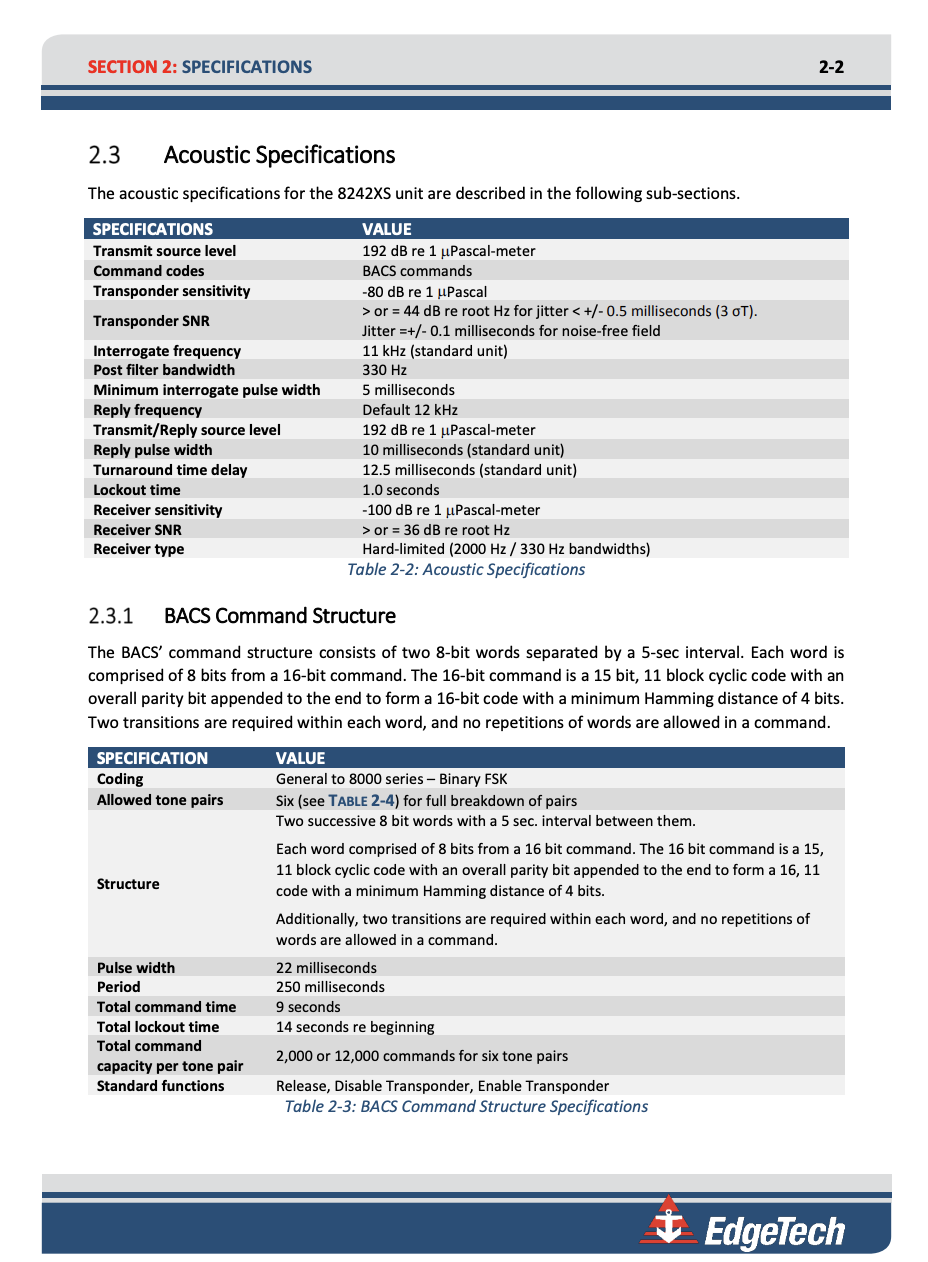
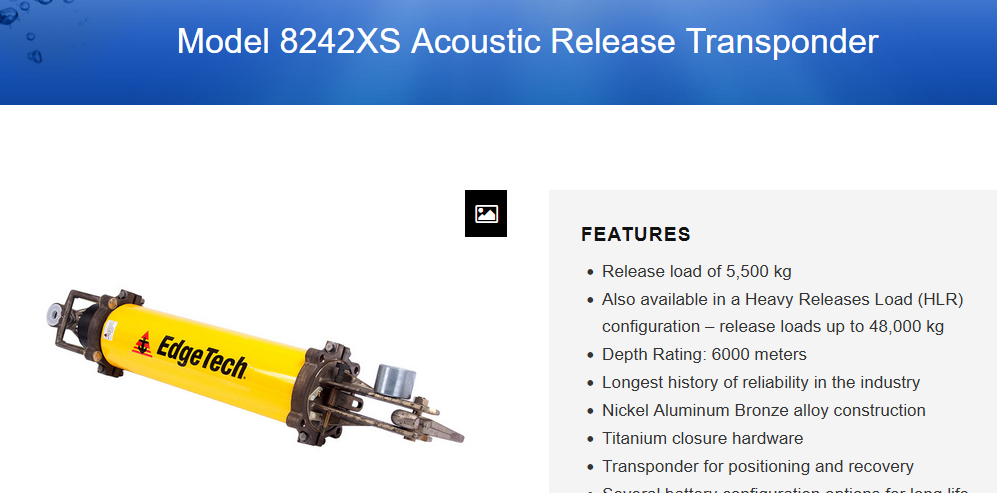
Commercial "acoustic release" systems use an acoustic modem to negotiate a buoy release:
The use for your project is for smuggling large quantities of cocaine. The problems of cost, and fishing environmental factors are much less then. I couldn’t get excited about a project that doesn’t solve a problem effectively without over engineering it and the alternative use is rather unpalatable.
Do you not get points for recognition of the fact the initial idea doesn’t hold water and moving on before investing too much time in it? You should, it is a great lesson. Iterative development is a great technique where you start something, get info that shows a flaw, reject and start alternative iteration. The first iteration was not a failure but an important learning experience


 huh?
huh?