So I recently bought some voltage reulators for a project. My plan is to have a 9v and 1.5v battery wired together for 10.5 volts. then I want to separate it into two 5 volt wires.
for now I'm just gonna make one 5 volt output, to simplify things
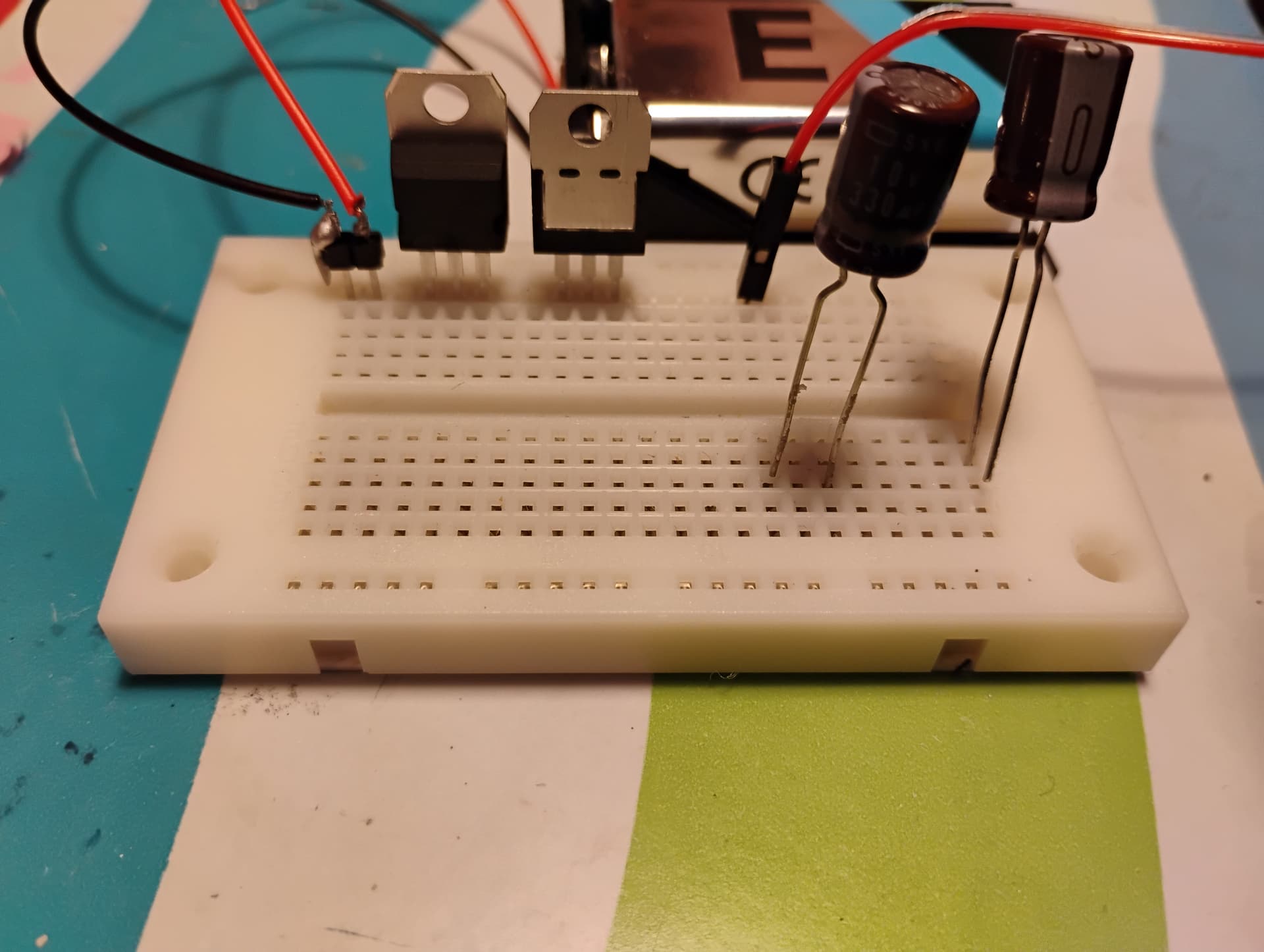
Howerer I can't seem ito get the voltage regulators to work. when I plug them in as according to youtube, no power is produced out. sometimes the wires heat up tho (probobly not good).
here's a picture for reference.
but also when you mention [quote="lobotomizednerd, post:1, topic:1367254"]
My plan is to have a 9v and 1.5v battery wired together for 10.5 volts. then I want to separate it into two 5 volt wires.
[/quote]
Not possible.
[/quote]
Do you refer to using multiple regulators on the same battery or wiering batteries to increse voltage?
Are you trying to get +5V and -5V? If so, for what purpose?
It's easy with two 9V batteries.
You can use a voltage divider with two equal-value resistors, and ground the center-point. That will split the voltage in half, giving you two equal and opposite voltages. BUT, they are only "signal" or "reference" voltages and they will change if you try to get power or current out of it. And that center-point has to be the only ground.
If you want +5V and -5V power supplies there are DC-DC converters (example). This isn't something you'd want to build yourself.
You only need 9V (or 7.5V) battery and one 5V regulator for that. You don't need to divide the voltage any how.
You can't connect 9V battery to 1.5V battery.
If you ever need 10.5V you can use 7*AA batteries in series for it.
But not needed for what you were looking for.
You only need to use one of those 2-pins.
If your led strip is longer than few inches you need something else than 9V battery.
5*AA makes 7.5V and could be used with the 5V regulator. Most strips work perfectly with 4.5V (3AA without regulator).
Some led strips accept 6V, that could be done with 4AA without regulator.
Post a link to your strip.
Yes, but if it's very long you need beefier battery like 3*D.
Anyway, is your intention to use the controller as well or just the strip and control it from arduino?
They can share the same 5V supply (and the same ground). And you probably don't need to connect both of them.
You can estimate 60mA "worst case" per LED with all colors on at full brightness.
With 60 LEDs per meter that could be 3.6 Amps for 1 meter and from there you can check the mAh (milliamp hour) rating for the battery to estimate battery life.)
I've powered my arduino using the usb C port to my pc, an outlet and I've used the DC-power with a 9-volt battery. however each time all I could get is a very small amount of light from the first led in the colour order, so I figured the power was insufficient. all the tutorials recomended using external power
edit: now I realize I'm a dumbass, it was obiously a software problem when looking at the effects

 There are a LOT of things wrong with your idea...

