You don't say what part of the world you are in. There are different codes and techniques for different areas. I can't really comment if you are outside of north america, but the circuit would be the same. the terminology and voltages will be different.
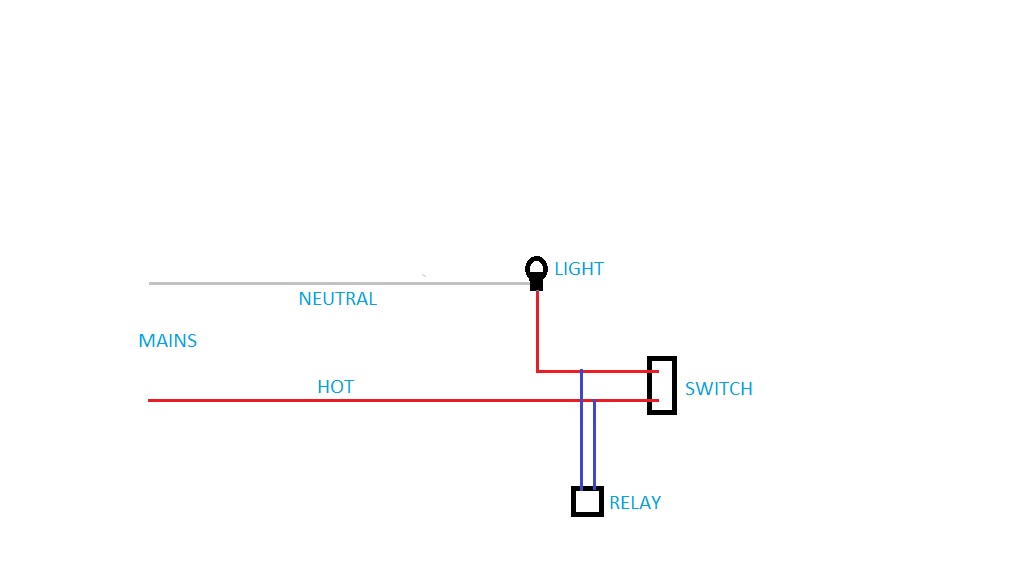
In my simple drawing, I show a 2 pole stardard switch, and a light bulb. What you want to do is put your relay in parallel with the existing switch, so either the relay or the switch will turn on the light.
Connecting the circuit may not be as straight forward as you want since the wiring will be inside the walls and not all run to a central point or "home run".
In the drawing, the grey wire from the mains is what is called (in the USA) the NEUTRAL wire. If you measure the voltage between a ground or earth point to this wire with no load on the circuit it will show zero or a very low voltage.
The red wire from the mains is called the "hot" wire. This is the dangerous one. If it connects through you to the neutral or ground you get a shock. This wire is switched because when the switch is open, the light socket and wire back to the switch is all dead. So this makes it safe to change light bulbs with the switch off. If the circuit is wired incorrectly then the bulb will be "hot" all the time but still will only light when the switch is closed.
Your relay contacts (the blue wires) will mimic the action of the wall switch to turn on the light.
The problem with doing this in an existing building is the way the building is actually wired. Normally the wires from the mains are run to the light fixture. From there an identical pair is run down to the switch. At the light fixture the hot wire from the mains will be only connected to one of the wires going to the switch and the neutral will go directly to the light socket terminal of the threaded part. The wire connected to the hot goes to one terminal of the switch. The other wire in the pair is connected to the other switch terminal and then to the center terminal of the light socket center terminal.
This example is only for a one switch, one light circuit. There are many variations.
Here in the USA it is legal for a HOMEOWNER to do their own wiring, but it must be under a permit and signed off by an inspector to be legal. This includes any modification of existing circuits, breakers, etc. Legally, since the 2015 code the only thing you can do without a permit is replace an existing light bulb with an identical replacement. It is very restrictive.
When installing any electrical equipment, it must be rated for the voltages, loads, and location.
Mains voltages need to be respected not feared. ALWAYS turn off and lock out the voltage source. If you work on mains equipment always have a volt meter and one other kind of tester like a non contact pen type tester to verify that everything is dead....so you won't be. The higher voltage the more important this is.