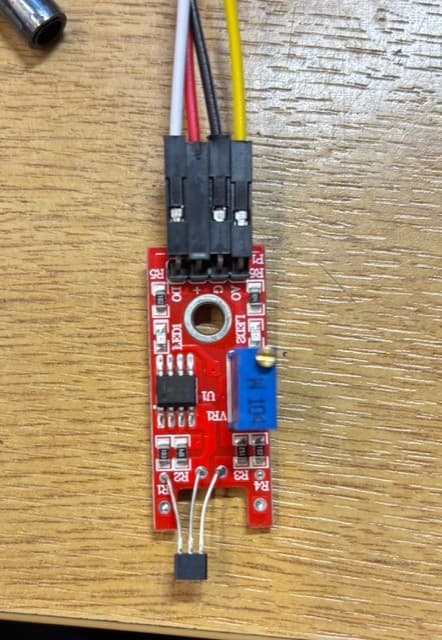
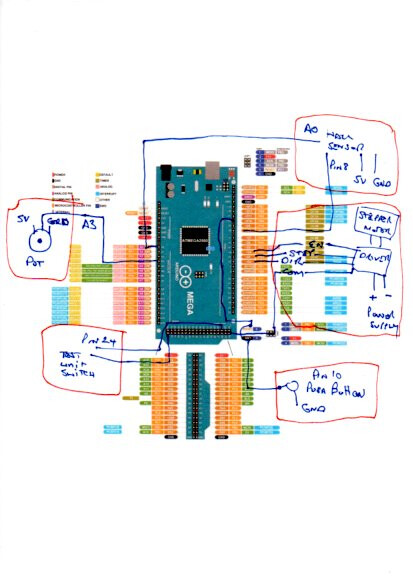
I took exactly your prompt text and gave it deepseek
deepseek came up with this code
#include <AccelStepper.h>
#include <ButtonFever.h>

// Pin Definitions
#define DIR_PIN 2
#define STEP_PIN 3
#define EN_PIN 4
#define HALL_SENSOR_PIN 8
#define POT_PIN A3
#define BUTTON_PIN 26
#define TRIP_SWITCH_1 22
#define TRIP_SWITCH_2 23
#define TRIP_SWITCH_3 24
#define TRIP_SWITCH_4 25
#define TRIP_SWITCH_5 27
#define TRIP_SWITCH_6 28

// Motor Parameters
AccelStepper stepper(AccelStepper::DRIVER, STEP_PIN, DIR_PIN);
BF::Button button180(BUTTON_PIN);
long stepsPerRevolution = 0;
long stepsPer180 = 0;
bool isCalibrated = false;
unsigned long lastMovementTime = 0;
bool motorEnabled = false;
int lastPotValue = 0;
const int deadZone = 50;  // Adjust dead zone threshold as needed
const int maxSpeed = 1000; // Maximum motor speed in steps per second

void setup() {
  Serial.begin(9600);

  // Initialize pins
  pinMode(EN_PIN, OUTPUT);
  digitalWrite(EN_PIN, HIGH); // Disable motor initially
  pinMode(HALL_SENSOR_PIN, INPUT_PULLUP);

  // Initialize trip switches
  const int tripPins[] = {TRIP_SWITCH_1, TRIP_SWITCH_2, TRIP_SWITCH_3,
                         TRIP_SWITCH_4, TRIP_SWITCH_5, TRIP_SWITCH_6};
  for (int pin : tripPins) {
    pinMode(pin, INPUT_PULLUP);
  }

  button180.begin();
  stepper.setMaxSpeed(maxSpeed);
  stepper.setAcceleration(maxSpeed * 0.5);

  calibrateStepsPerRevolution();
  stepsPer180 = stepsPerRevolution / 2;
  enableMotor();
}

void loop() {
  // Read potentiometer and handle speed control
  int potValue = analogRead(POT_PIN);
  int mappedSpeed = map(potValue, 0, 1023, -maxSpeed, maxSpeed);

  // Apply dead zone around center position
  if (abs(potValue - 512) < deadZone) {
    mappedSpeed = 0;
  }

  // Check for potentiometer movement to wake motor
  if (abs(potValue - lastPotValue) > 10) {
    lastPotValue = potValue;
    if (!motorEnabled) {
      enableMotor();
    }
    lastMovementTime = millis();
  }

  // Check trip switches
  bool tripTriggered = false;
  const int tripPins[] = {TRIP_SWITCH_1, TRIP_SWITCH_2, TRIP_SWITCH_3,
                         TRIP_SWITCH_4, TRIP_SWITCH_5, TRIP_SWITCH_6};
  for (int pin : tripPins) {
    if (digitalRead(pin) == LOW) {
      tripTriggered = true;
      break;
    }
  }

  // Handle emergency stop
  if (tripTriggered) {
    stepper.stop();
    stepper.disableOutputs();
    motorEnabled = false;
    lastMovementTime = millis();
  }

  // Handle 180-degree button
  button180.update();
  if (button180.isPressed() && !tripTriggered && motorEnabled) {
    long target = stepper.currentPosition() + stepsPer180;
    stepper.moveTo(target);
    lastMovementTime = millis();
  }

  // Motor control logic
  if (stepper.distanceToGo() != 0) {
    stepper.run();
    lastMovementTime = millis();
  } else if (motorEnabled && !tripTriggered) {
    stepper.setSpeed(mappedSpeed);
    stepper.runSpeed();
    if (mappedSpeed != 0) lastMovementTime = millis();
  }

  // Handle motor shutdown after 1 minute of inactivity
  if (motorEnabled && (millis() - lastMovementTime) > 60000) {
    disableMotor();
  }
}

void calibrateStepsPerRevolution() {
  enableMotor();
  stepper.setSpeed(200); // Slow calibration speed

  // Move until first sensor trigger
  while (digitalRead(HALL_SENSOR_PIN)) {
    stepper.runSpeed();
  }
  long firstPosition = stepper.currentPosition();

  // Move until sensor releases
  while (!digitalRead(HALL_SENSOR_PIN)) {
    stepper.runSpeed();
  }

  // Move until second trigger
  while (digitalRead(HALL_SENSOR_PIN)) {
    stepper.runSpeed();
  }
  long secondPosition = stepper.currentPosition();

  stepsPerRevolution = abs(secondPosition - firstPosition);
  stepper.setCurrentPosition(0);
  Serial.print("Calibrated steps per revolution: ");
  Serial.println(stepsPerRevolution);
}

void enableMotor() {
  digitalWrite(EN_PIN, LOW);
  motorEnabled = true;
  lastMovementTime = millis();
  Serial.println("Motor enabled");
}

void disableMotor() {
  digitalWrite(EN_PIN, HIGH);
  motorEnabled = false;
  Serial.println("Motor disabled");
}
I confronted deepseek with the compiler-error
deepseek if I compile your code I get this error-message exit status 1
ButtonFever.h: No such file or directory
deepseek removed buttonfever and posted a modified code-snippet.
Typical AI reaction try to save computation time
So I explicitly told deepseek
deepseek output the FULL functional code
deepseek obeyed
#include <AccelStepper.h>

// Pin Definitions
#define DIR_PIN 2
#define STEP_PIN 3
#define EN_PIN 4
#define HALL_SENSOR_PIN 8
#define POT_PIN A3
#define BUTTON_PIN 26
#define TRIP_SWITCH_1 22
#define TRIP_SWITCH_2 23
#define TRIP_SWITCH_3 24
#define TRIP_SWITCH_4 25
#define TRIP_SWITCH_5 27
#define TRIP_SWITCH_6 28

// Motor Parameters
AccelStepper stepper(AccelStepper::DRIVER, STEP_PIN, DIR_PIN);
long stepsPerRevolution = 0;
long stepsPer180 = 0;
bool isCalibrated = false;
unsigned long lastMovementTime = 0;
bool motorEnabled = false;
int lastPotValue = 0;
const int deadZone = 50;
const int maxSpeed = 1000;

// Button handling
bool buttonState = HIGH;
bool lastButtonState = HIGH;
unsigned long lastDebounceTime = 0;
const unsigned long debounceDelay = 50;

void setup() {
  Serial.begin(9600);

  // Initialize pins
  pinMode(EN_PIN, OUTPUT);
  digitalWrite(EN_PIN, HIGH); // Disable motor initially
  pinMode(HALL_SENSOR_PIN, INPUT_PULLUP);
  pinMode(BUTTON_PIN, INPUT_PULLUP);

  // Initialize trip switches
  const int tripPins[] = {TRIP_SWITCH_1, TRIP_SWITCH_2, TRIP_SWITCH_3,
                         TRIP_SWITCH_4, TRIP_SWITCH_5, TRIP_SWITCH_6};
  for (int i = 0; i < 6; i++) {
    pinMode(tripPins[i], INPUT_PULLUP);
  }

  stepper.setMaxSpeed(maxSpeed);
  stepper.setAcceleration(maxSpeed * 0.5);

  calibrateStepsPerRevolution();
  stepsPer180 = stepsPerRevolution / 2;
  enableMotor();
}

void loop() {
  // Handle potentiometer input
  int potValue = analogRead(POT_PIN);
  int mappedSpeed = map(potValue, 0, 1023, -maxSpeed, maxSpeed);

  // Apply dead zone
  if (abs(potValue - 512) < deadZone) {
    mappedSpeed = 0;
  }

  // Wake on potentiometer movement
  if (abs(potValue - lastPotValue) > 10) {
    lastPotValue = potValue;
    if (!motorEnabled) enableMotor();
    lastMovementTime = millis();
  }

  // Check trip switches
  bool tripTriggered = checkTripSwitches();

  // Handle emergency stop
  if (tripTriggered) {
    stepper.stop();
    stepper.disableOutputs();
    motorEnabled = false;
    lastMovementTime = millis();
  }

  // Handle 180-degree button with debounce
  handle180Button(tripTriggered);

  // Motor control logic
  if (stepper.distanceToGo() != 0) {
    stepper.run();
    lastMovementTime = millis();
  } else if (motorEnabled && !tripTriggered) {
    stepper.setSpeed(mappedSpeed);
    stepper.runSpeed();
    if (mappedSpeed != 0) lastMovementTime = millis();
  }

  // Auto-shutdown after 1 minute
  if (motorEnabled && (millis() - lastMovementTime) > 60000) {
    disableMotor();
  }
}

bool checkTripSwitches() {
  const int tripPins[] = {TRIP_SWITCH_1, TRIP_SWITCH_2, TRIP_SWITCH_3,
                         TRIP_SWITCH_4, TRIP_SWITCH_5, TRIP_SWITCH_6};
  for (int i = 0; i < 6; i++) {
    if (digitalRead(tripPins[i]) == LOW) return true;
  }
  return false;
}

void handle180Button(bool tripTriggered) {
  bool reading = digitalRead(BUTTON_PIN);

  if (reading != lastButtonState) {
    lastDebounceTime = millis();
  }

  if ((millis() - lastDebounceTime) > debounceDelay) {
    if (reading != buttonState) {
      buttonState = reading;
      if (buttonState == LOW && motorEnabled && !tripTriggered) {
        stepper.move(stepsPer180);
        lastMovementTime = millis();
      }
    }
  }
  lastButtonState = reading;
}

void calibrateStepsPerRevolution() {
  enableMotor();
  stepper.setSpeed(200);

  // Find first trigger
  while (digitalRead(HALL_SENSOR_PIN)) stepper.runSpeed();
  long firstPosition = stepper.currentPosition();

  // Wait for release
  while (!digitalRead(HALL_SENSOR_PIN)) stepper.runSpeed();

  // Find second trigger
  while (digitalRead(HALL_SENSOR_PIN)) stepper.runSpeed();
  long secondPosition = stepper.currentPosition();

  stepsPerRevolution = abs(secondPosition - firstPosition);
  stepper.setCurrentPosition(0);
  Serial.print("Steps per revolution: ");
  Serial.println(stepsPerRevolution);
}

void enableMotor() {
  digitalWrite(EN_PIN, LOW);
  motorEnabled = true;
  lastMovementTime = millis();
  stepper.enableOutputs();
  Serial.println("Motor enabled");
}

void disableMotor() {
  digitalWrite(EN_PIN, HIGH);
  motorEnabled = false;
  stepper.disableOutputs();
  Serial.println("Motor disabled");
}
This code does compile. But I have no idea if it really works.
The compilation-error was caused by a deviation between the libraryname in the library-manager
ButtonFever
and the filenames
#include <BfButton.h>
#include <BfButtonManager.h>
deepseek did not check for this
after correcting this manually there was another error
"C:\\Arduino-Pure-Portable\\arduino-1.8.19\\portable\\packages\\arduino\\tools\\avr-gcc\\7.3.0-atmel3.6.1-arduino7/bin/avr-g++" -c -g -Os -w -std=gnu++11 -fpermissive -fno-exceptions -ffunction-sections -fdata-sections -fno-threadsafe-statics -Wno-error=narrowing -MMD -flto -mmcu=atmega2560 -DF_CPU=16000000L -DARDUINO=10819 -DARDUINO_AVR_MEGA2560 -DARDUINO_ARCH_AVR "-IC:\\Arduino-Pure-Portable\\arduino-1.8.19\\portable\\packages\\arduino\\hardware\\avr\\1.8.6\\cores\\arduino" "-IC:\\Arduino-Pure-Portable\\arduino-1.8.19\\portable\\packages\\arduino\\hardware\\avr\\1.8.6\\variants\\mega" "-IC:\\Arduino-Pure-Portable\\arduino-1.8.19\\portable\\sketchbook\\libraries\\AccelStepper\\src" "-IC:\\Arduino-Pure-Portable\\arduino-1.8.19\\portable\\sketchbook\\libraries\\ButtonFever\\src" "C:\\Users\\dipl-\\AppData\\Local\\Temp\\arduino_build_597875\\sketch\\buttonfever-turnrable-001.ino.cpp" -o "C:\\Users\\dipl-\\AppData\\Local\\Temp\\arduino_build_597875\\sketch\\buttonfever-turnrable-001.ino.cpp.o"
buttonfever-turnrable-001:22:1: error: 'BF' does not name a type; did you mean 'B1'?
 BF::Button button180(BUTTON_PIN);
 ^~
 B1
C:\Arduino-Pure-Portable\arduino-1.8.19\portable\sketchbook\buttonfever-turnrable-001\buttonfever-turnrable-001.ino: In function 'void setup()':
buttonfever-turnrable-001:47:3: error: 'button180' was not declared in this scope
   button180.begin();
   ^~~~~~~~~
C:\Arduino-Pure-Portable\arduino-1.8.19\portable\sketchbook\buttonfever-turnrable-001\buttonfever-turnrable-001.ino: In function 'void loop()':
buttonfever-turnrable-001:95:3: error: 'button180' was not declared in this scope
   button180.update();
   ^~~~~~~~~
Using library AccelStepper at version 1.64 in folder: C:\Arduino-Pure-Portable\arduino-1.8.19\portable\sketchbook\libraries\AccelStepper
Using library ButtonFever at version 1.0 in folder: C:\Arduino-Pure-Portable\arduino-1.8.19\portable\sketchbook\libraries\ButtonFever
exit status 1
'BF' does not name a type; did you mean 'B1'?
In the ongoing process I had to tell deepseek to completely remove the buttonfever library.
Then I got compiling code. No idea if this code is really working as intended
#include <AccelStepper.h>

// Pin Definitions
#define DIR_PIN 2
#define STEP_PIN 3
#define EN_PIN 4
#define HALL_SENSOR_PIN 8
#define POT_PIN A3
#define BUTTON_PIN 26
#define TRIP_SWITCH_1 22
#define TRIP_SWITCH_2 23
#define TRIP_SWITCH_3 24
#define TRIP_SWITCH_4 25
#define TRIP_SWITCH_5 27
#define TRIP_SWITCH_6 28

// Motor Parameters
AccelStepper stepper(AccelStepper::DRIVER, STEP_PIN, DIR_PIN);
long stepsPerRevolution = 0;
long stepsPer180 = 0;
bool isCalibrated = false;
unsigned long lastMovementTime = 0;
bool motorEnabled = false;
int lastPotValue = 0;
const int deadZone = 50;
const int maxSpeed = 1000;

// Button handling
bool buttonState = HIGH;
bool lastButtonState = HIGH;
unsigned long lastDebounceTime = 0;
const unsigned long debounceDelay = 50;

void setup() {
  Serial.begin(9600);

  // Initialize pins
  pinMode(EN_PIN, OUTPUT);
  digitalWrite(EN_PIN, HIGH); // Disable motor initially
  pinMode(HALL_SENSOR_PIN, INPUT_PULLUP);
  pinMode(BUTTON_PIN, INPUT_PULLUP);

  // Initialize trip switches
  const int tripPins[] = {TRIP_SWITCH_1, TRIP_SWITCH_2, TRIP_SWITCH_3,
                         TRIP_SWITCH_4, TRIP_SWITCH_5, TRIP_SWITCH_6};
  for (int i = 0; i < 6; i++) {
    pinMode(tripPins[i], INPUT_PULLUP);
  }

  stepper.setMaxSpeed(maxSpeed);
  stepper.setAcceleration(maxSpeed * 0.5);

  calibrateStepsPerRevolution();
  stepsPer180 = stepsPerRevolution / 2;
  enableMotor();
}

void loop() {
  // Handle potentiometer input
  int potValue = analogRead(POT_PIN);
  int mappedSpeed = map(potValue, 0, 1023, -maxSpeed, maxSpeed);

  // Apply dead zone
  if (abs(potValue - 512) < deadZone) {
    mappedSpeed = 0;
  }

  // Wake on potentiometer movement
  if (abs(potValue - lastPotValue) > 10) {
    lastPotValue = potValue;
    if (!motorEnabled) enableMotor();
    lastMovementTime = millis();
  }

  // Check trip switches
  bool tripTriggered = checkTripSwitches();

  // Handle emergency stop
  if (tripTriggered) {
    stepper.stop();
    stepper.disableOutputs();
    motorEnabled = false;
    lastMovementTime = millis();
  }

  // Handle 180-degree button with debounce
  handle180Button(tripTriggered);

  // Motor control logic
  if (stepper.distanceToGo() != 0) {
    stepper.run();
    lastMovementTime = millis();
  } else if (motorEnabled && !tripTriggered) {
    stepper.setSpeed(mappedSpeed);
    stepper.runSpeed();
    if (mappedSpeed != 0) lastMovementTime = millis();
  }

  // Auto-shutdown after 1 minute
  if (motorEnabled && (millis() - lastMovementTime) > 60000) {
    disableMotor();
  }
}

bool checkTripSwitches() {
  const int tripPins[] = {TRIP_SWITCH_1, TRIP_SWITCH_2, TRIP_SWITCH_3,
                         TRIP_SWITCH_4, TRIP_SWITCH_5, TRIP_SWITCH_6};
  for (int i = 0; i < 6; i++) {
    if (digitalRead(tripPins[i]) == LOW) return true;
  }
  return false;
}

void handle180Button(bool tripTriggered) {
  bool reading = digitalRead(BUTTON_PIN);

  if (reading != lastButtonState) {
    lastDebounceTime = millis();
  }

  if ((millis() - lastDebounceTime) > debounceDelay) {
    if (reading != buttonState) {
      buttonState = reading;
      if (buttonState == LOW && motorEnabled && !tripTriggered) {
        stepper.move(stepsPer180);
        lastMovementTime = millis();
      }
    }
  }
  lastButtonState = reading;
}

void calibrateStepsPerRevolution() {
  enableMotor();
  stepper.setSpeed(200);

  // Find first trigger
  while (digitalRead(HALL_SENSOR_PIN)) stepper.runSpeed();
  long firstPosition = stepper.currentPosition();

  // Wait for release
  while (!digitalRead(HALL_SENSOR_PIN)) stepper.runSpeed();

  // Find second trigger
  while (digitalRead(HALL_SENSOR_PIN)) stepper.runSpeed();
  long secondPosition = stepper.currentPosition();

  stepsPerRevolution = abs(secondPosition - firstPosition);
  stepper.setCurrentPosition(0);
  Serial.print("Steps per revolution: ");
  Serial.println(stepsPerRevolution);
}

void enableMotor() {
  digitalWrite(EN_PIN, LOW);
  motorEnabled = true;
  lastMovementTime = millis();
  stepper.enableOutputs();
  Serial.println("Motor enabled");
}

void disableMotor() {
  digitalWrite(EN_PIN, HIGH);
  motorEnabled = false;
  stepper.disableOutputs();
  Serial.println("Motor disabled");
}