Hi, high school sophomore here. I'm planning to do a project on using peltier cooling modules and an arduino microcontroller to collect dew from air. Energy will come from a battery, which is powered by a solar panel. The general gist of it is that **if you can cool the air enough, dew will condense on a cold surface.**Assuming I can collect the necessary resources, how would you guys suggest I put this together? FYI, I have an Arduino Uno R3 Starter Kit.
Sorry if this question is a little vague, let me know if you need any clarifications. Thank you!
Peltier cells draw quite a bit of power, so rather than run it continuously you’ll probably want to detect the ambient temperature and humidity to determine the best time to turn it on.
An h-bridge will let you run it as a cooler or heater depending in the point in tim you want to ‘charge’ the chamber or not.
A solar charged battery is a good idea, as you can grab as much sun .
‘off peak’ that gives you the best discharge cycle and profile for the selected battery / daylight exposure,
Since you need a means of removing heat from the warm side of the Peltier module, you could start with something like this:
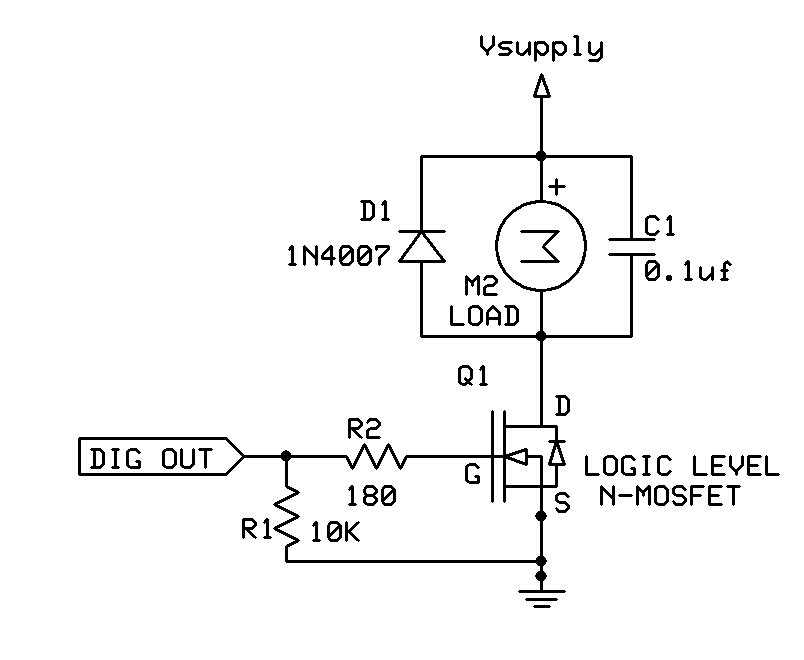
You will need a control circuit to handle the high current. A lead acid car or motorcycle battery will work for power, and this simple motor driver will control the module, if it is wired in the correct orientation. The diode and capacitor are not required for Peltier control.
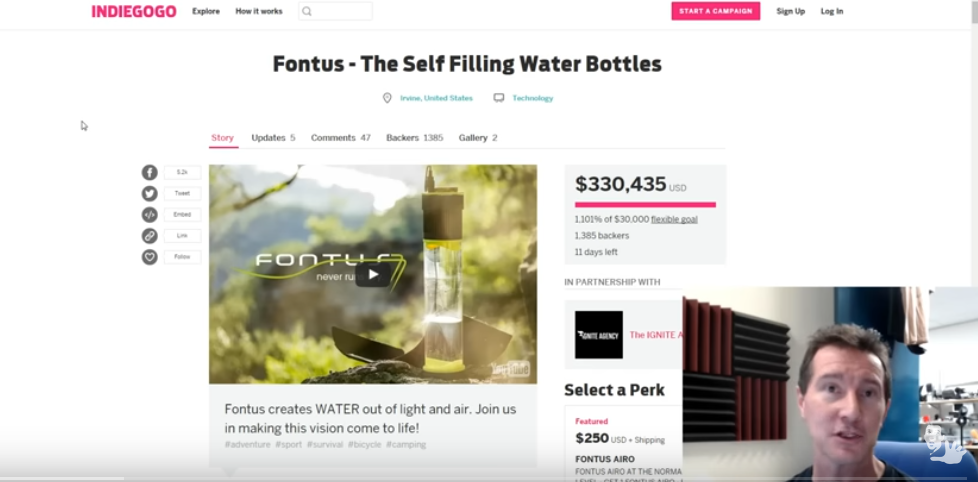
Who would not want one? An online campaign raised a huge amount of money before it was explained that a solar panel on the bottle would be too small to collect a detectable amount of water.
An Arduino is not necessary. All of your project will run continuously on DC from your massive battery/solar charging system. Remember, there is no sun during the night and your device will be most effective at night when the air is cooler.
Thank you, this is incredibly helpful! I'm curious, are there any smaller and potentially cheaper batteries for this kind of project? I guess that would depend on the size/type of the Peltier module and the amount of power it requires, but do you have any estimates? Thank you!
I'm not sure how much dew I want to collect – just as much as possible, I guess? I'm planning to use [this] (Amazon.com) peltier cooling device, which is more within my budget – do you have any predictions for how much water this will be able to collect?
Regarding the purpose of this project, I'm trying to collect dew for drinking (ideally), but if that isn't possible irrigation is the next best option.
Hi @jim-p, thanks for all the help so far. I'm curious if you have any recommendations for peltier cooling modules that are relatively cheap (<50 dollars)? I just posted a link to the one I'm planning on using – any advice for how much water it'll generate/power requirements/other technical stuff? Thanks again!
As you surely learned from the video linked in post #6, it takes about 250 watts, applied for 2.5 hours, to produce 1 liter of condensate under ideal conditions.
I know you are still in high school, but have you ever seen dew form on grass or leaves? Only when there is no wind blowing. So design your project to operate where there is no or very limited moving air.
I have no idea how much energy it will take and of course it depends on the humidity.
Air conditioners create enough condensation that you can see it on the ground under cars, and home air conditioners have a pump to pump it outside when enough has collected.
Somebody told me, or I read somewhere, that the (non-bottled) water served on airplanes is collected from the air conditioner. ...Is there an air conditioner on a plane? It's usually cold at higher altitudes. It wouldn't be the compressor that pressurizes the plane because that makes heat. (The compressor on an air conditioner is outside of the house for the same reason The condenser is inside.)
P.S.
One thing the Arduino could do is measure temperature and humidity to find the dew point and then only consume power when it's possible to get condensation, or when it's most efficient.
... I assume this is an inefficient and impractical way to "make water" because I don't hear about anybody doing it on a practical scale. Desalination is also inefficient and expensive... It costs something like 1000 times as much as traditional sources and of course you have to be close to the ocean... You aren't pulling water out of "thin air".