Hello, all.
I am trying to figure out what module/code I need to detect a MHZ frequency, I’ve seen some stuff online, but it didn’t really specify on what I needed.
The other thing I need is antenna attachment thing, the project I need this for heavily depends on the use of antennas with frequency detection.
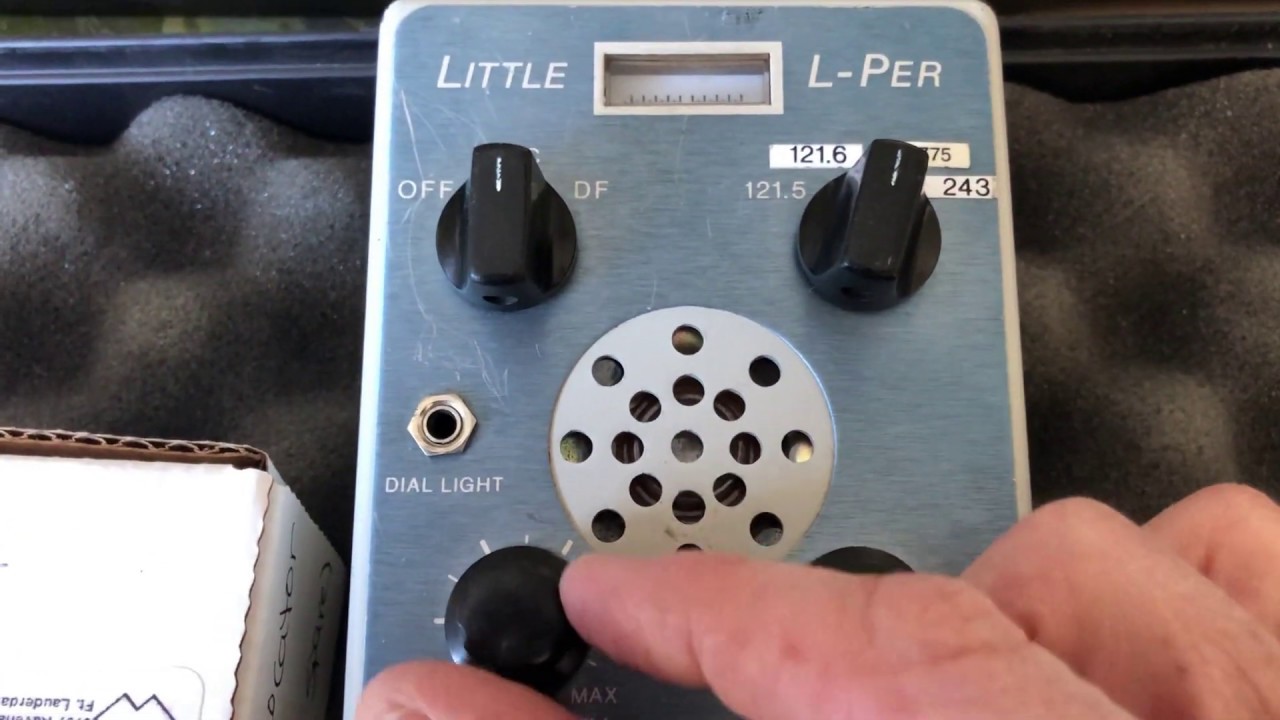
If anyone knows what a little L-PER is with an H antenna array, that’s what I’m going for.
You need a proper coil and variable capacitor that will tune the frequency you want. How much power is in that MHZ frequency? That will determine how you will know the signal is present.
In order to decide on the sensor, you must know the strength of the signal you are trying to sense. A very strong signal could be sensed by a tuned circuit and an incandescent light bulb. A very tiny signal power will require a very sensitive complex receiver along with a proper antenna. You decide.
I did not clarify what I want to do with this so it is easier to help. Sorry I did not do this earlier.
I am trying to make a device that can detect frequencies from ELTs (Emergency Locator Transmitter). These are found in planes, boats, and there are personal models. They send out a frequency on 121.5.
For both modes it needs to ”listen” to the signal and send out a sound based on it. (I’m gonna use a pizo buzzer for that).
For receive mode the device needs to act as a directional receiver, with its antennas forming a beam most sensitive off the left end of the unit. When the left end is pointed toward a signal source, the received signal strength is maximized, providing a general direction to the source. This mode is used for obtaining initial bearings and is more sensitive, allowing for signal detection from greater distances.
In DF mode , the Little L-Per rapidly alternates reading left and right antennas, comparing signal strengths to determine the direction of the source. The device displays this information on a horizontal bar; if the signal source is to the right, the bar extends to the right, and vice versa. By turning in the indicated direction until the bar centers, the operator can accurately face the signal source. This mode provides precise direction finding, essential for pinpointing the exact location of a transmitter.
Let's just quit talking about detecting frequencies!!!! You want to detect a SIGNAL from an ELT.
How will you test this capability? Do you have a receiver right now that you can connect to an ARduino? IF not, are you going to buy one, are you going to BUILD one?
Please continue to reveal your project, it seems to be growing.
Problem I see is that your receiver must have the selectivity to reject transmissions on either side of 121.5 or you will get constant false triggers from nearby channels.
Someone mentioned the signal was AM. Do you know if it is AM or FM or ? Possible my portable ham radio hand held will receive on the frequency and be either AM or FM, depending on the programming. The radio is old, but look for a Yaesu VX-6.
If you had such a receiver, how does an Arduino fit into you scheme?
PS: I just checked and the device can be programmed to receive 121.5 and comes up in AM mode. Plus it will not transmit on that frequency. So, there is a possible receiver for you. It also has a coax connector for an antenna of your choice.
H just stands for Horizontal, the way the array is pointing, as opposed to Vertical which is a 90˚ rotation away.
However, the more complex (number of elements) an antenna has the more nodes it has in the polar diagram, making it difficult to pick the correct node that points to the required transmitter.
See:-
In Ham radio circles this is known as a "Fox Hunt", well it is in the UK anyway. This is where someone hides with a transmitter and broadcasts at some regular interval like for 30 seconds every five minuets. Then individuals or groups chase around the surrounding country side trying to locate them.
This often requires a different receiver / antenna for when you are miles away and when you are within 100 meters or closer. This is often done on the two meter band at 144 to 148 (or 146 depending on your region) MHz Band.
Is there a way to interface it with the arduino?
There is feedback the radio can give that the radio cannot that I would like, that’s why I am using one.