It pains me to write this. I feel dumb and ready to explode as I know nothing. Where is a basic dictionary for this program? I cannot create anything from searches that yield zero results.
Dronebot Workshop Big stepper motor video- I watched, I liked, I recreated. That's it. I can follow his actions but I have no idea how he got to the result. Can someone break this down a little more elementary for us dumb people?
If you notice his videos, the stepper motor never is at a complete zero RPM.
So I complete the tutorial together with the video. Easy. Now how on earth do I achieve zero RPM's with the pot turned all the way to the left? Now how do I get 160 RPM with the pot turned all the way up to the right?
I am a machinist and welder. Electronics and this lingo is not my forte but you guys write and speak as if it is as easy as taking out the trash, or brushing your teeth. Please don't tell me some calculation I have no ability to decipher. Speak to me like I am stupid. Why in the big stepper motor video (by dronebotworkshop) does speed ,0 ,1023 ,2000 ,50 speed it up to an unknown speed and slow it down, but changing these from ,0 ,160 ,160, 0? I need it to start at zero RPM with 160 rpm max. Please help me experiment step by step at a slow pace to where I can understand this!!!
Show me how to get a stepper to start in a paused/zero state, then show me how to elevate it up from say zero to 10 RPM, then zero to 80 RPM. Etc. And again, A dictionary would be nice.
How can I decipher when one person is speaking RPM's, another is speaking steps per revolution, another is speaking increments? What is the standard set of values?
I have no code I don't know where to start I'm lost.
Working with
NEMA 23
23HS30-2804S Stepper Motor
MA860H Driver U
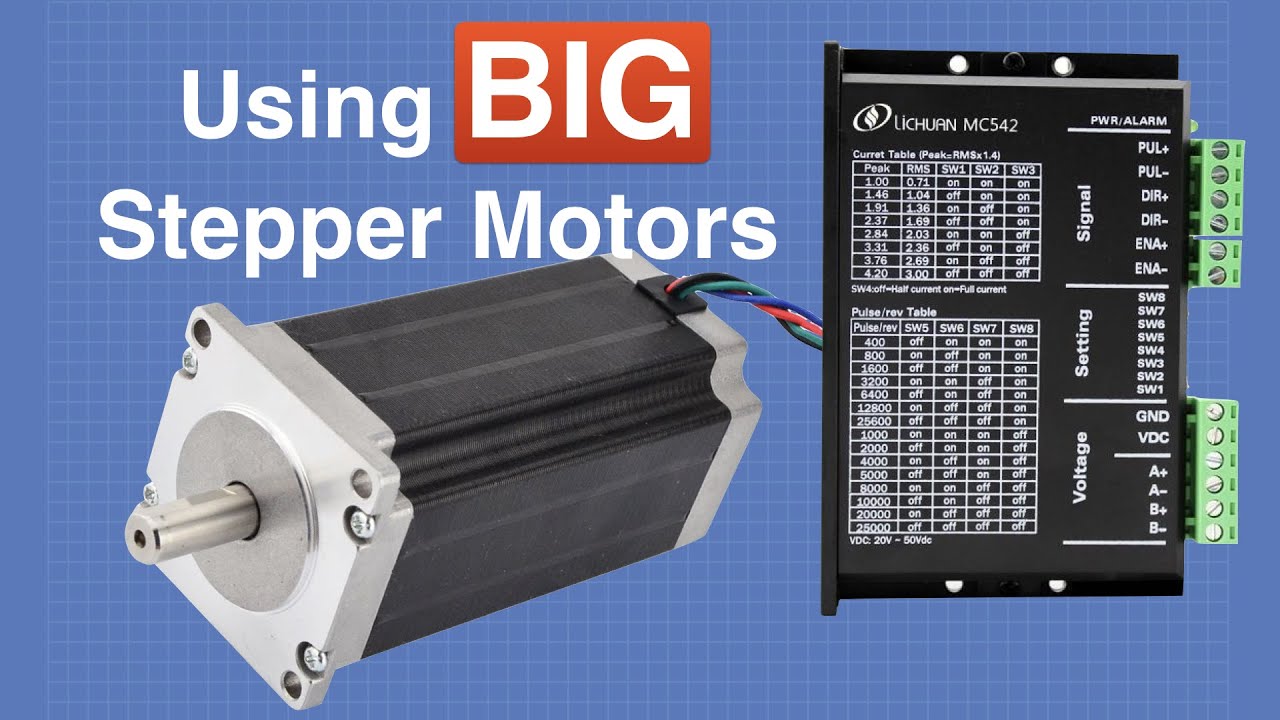
I got everything in the above video to work with his guidance, but I cannot evolve my motor from zero rpm to 160 RPM.
Below this line is my best guess of what I anticipate my feeds and speeds and actions should be. AKA (Parameters)
Using 23HS30-2804S Stepper Motor
MA860H Driver
Arduino UNO Board
Potentiometer for speed control
Push button switch CW/CCW
The weld positioner has a 40:1 ratio-the stepper motor needs to spin 40 revolutions for the table of the weld positioner to spin 1 revolution
The stepper motor has to complete 200 steps to make a full revolution.
Arduino speaks in milliseconds only… SO EVEN AFTER WE DO MATH ABOVE, IT HAS TO BE THEN CONVERTED TO MILLISECONDS
Welding Positioner Parameters
The only parameter is that the welding positioners table makes at least 1 full revolution. In order to complete a full revolution, the stepper motor must complete 40 revolutions.
Therefor the ratio is 40:1
We will speed up or slow down the revolutions of this by adjusting the stepper motors parameters.
Stepper Motor Parameters
1 revolution per 1 minute=200 steps per minute
200 steps multiplied by 40 revolutions=8000 steps 40 revolutions or 8000 steps is required for one complete revolution of the welding table
8000 steps per 60 seconds=133.333333 steps per 1 second or 40 RPM-- 1:1 this is now the constant. To speed up revolutions per minute, multiply, to slow down revolutions per minute, divide. It is unknown whether Arduino code recognizes RPM or SPR. Either way, there are formulas built into the program, but inputting them correctly is an unknown variable because none of us know the program well enough.
16000 steps per 60 seconds=266.666666 steps per 1 second or 80 RPM-- 2:1 2 times multiplier
24000 steps per 60 seconds=399.999999 steps per 1 second or 120 RPM-- 3:1 3 times multiplier
32000 steps per 60 seconds=533.333332 steps per 1 second or 160 RPM-- 4:1 4 times multiplier
At its fastest speed, 533.333 steps per second should suffice. The Stepper Motor will be at 160 RPM. This is equal to 1 revolution of the welding table/40 revolution of stepper motor every 15 seconds.
At its slowest speed, 22.222222 steps per second should suffice. This is equal to 6.66666 RPM. This will only be needed if welding something that exceeds 6 inches in diameter.
Now we have MAX HIGH AND MAX LOW- we need speeds in between for a happy medium… Best case guess is we need between 10 RPM and 160 RPM. Below are the parameters for the Speed Code. If 40 RPM is the Constant, within the code, dividing or multiplying within the parenthesis should provide results.
1 RPM=200 Steps
SPD Dial Turned all the way down to the left-
1=0 RPM 0 STEPS
2=10 RPM or 2000 Steps
3=20 RPM or 4000 Steps
4=30 RPM or 6000 Steps
5=40 RPM or 8000 STEPS
6=80 RPM or 16000 Steps
7=100 RPM or 20000 Steps
8=120 RPM or 24000 Steps
9=140 RPM or 28000 Steps
10=160 RPM or 32000 Steps
SPD Dial Turned all the way up to the right-