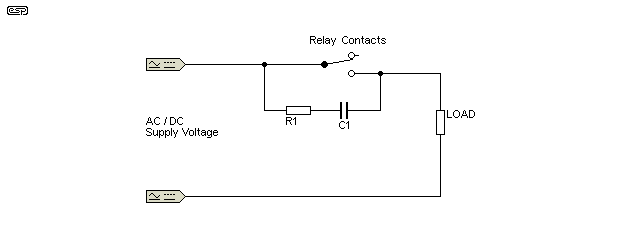
The problem I'm having is that when I close the circuit while the fan is connected is that the relay gets stuck in the closed position. When i try to open the relay there is a faint click whereas the click was just as loud as the closing click before the fan was connected.
I've gone through 4 or 5 relays now. I've tried connecting the snubber in parallel with the fan (live and neutral wire, brown/blue), in parallel with the relay and in serial between the relay output and the fan (Separate relays/instances, only did one of the mentioned methods at a time).
I'm getting desperate with only one last relay to spare, any ideas?
"The module uses genuine quality relay, normally open interfaces Maximum load: AC 250V/10A, DC 30V/10A"
This forum and countless electrical/electronic forums are loaded with endless stories of those relays failing. After a few On/Off switches the contacts burn up normally welding themselves together. I suggest you take one which has failed and dissect it. You have a 40 watt load but don't mention the voltage? If I believe the numbers 250 VAC @ 10 Amps it would be 2500 watts and yet you keep having to replace them. That plus you are using a snubber.
My best suggestion is to replace with a reputable part because my take is somehow the Chinese Amp is much, much smaller that the Amp in the rest of the world. You may want to replace the relay with a quality SSR (Solid State Relay)from a reputable manufacturer and use your existing snubber. With quality parts your setup should run forever (which is a long time).
Even if it is a c$%p chinese relay the difference between 40W and the rated V&A it should last forever. I have always considered relays to be a great device. You should only need a reverse biased diode across the coil to reduce back EMF and a capacitor across the contacts. If it is still frying then maybe the inrush current at start up is a bit high. You also try a relay with mercury wetted contacts, these prevent a lot of burnt contacts.
It looks like this one is only rated to 240v 2A which would be even less than the ones I already have (assuming the ratings are not taken from thin air)
Ron_Blain:
"The module uses genuine quality relay, normally open interfaces Maximum load: AC 250V/10A, DC 30V/10A"
This forum and countless electrical/electronic forums are loaded with endless stories of those relays failing. After a few On/Off switches the contacts burn up normally welding themselves together. I suggest you take one which has failed and dissect it. You have a 40 watt load but don't mention the voltage? If I believe the numbers 250 VAC @ 10 Amps it would be 2500 watts and yet you keep having to replace them. That plus you are using a snubber.
My best suggestion is to replace with a reputable part because my take is somehow the Chinese Amp is much, much smaller that the Amp in the rest of the world. You may want to replace the relay with a quality SSR (Solid State Relay)from a reputable manufacturer and use your existing snubber. With quality parts your setup should run forever (which is a long time).
What would be considered a reputable manufacturer/brand?
antonlil:
It looks like this one is only rated to 240v 2A...
Using that SSR in a bathroom extraction fan of similar/higher wattage already for the past five years.
No snubber circuit. No problems.
230V/40W is only 0.2A.
I wonder if your relays are actually damaged.
Relays like that need 5volt/75mA for the coil (2mA from the pin).
Can your circuit provide that?
Post a diagram/pictures.
Leo..
MarkT:
Sounds like the fan is pulling very high inrush current. Snubbers normally work only at switch-off,
not switch-on.
I think the fan is the problem, its likely an induction motor with very high inrush current.
How can I protect the relay against the inrush current? Would an inrush current that high not kill the fuse in the socket if used without a relay like normal? I believe the fuse in the cord/socket is 3A
You appear from this: Imgur: The magic of the Internet to have wired the snubber in parallel with the load. It should be wired across the active relay contacts, like this:
antonlil:
How can I protect the relay against the inrush current? Would an inrush current that high not kill the fuse in the socket if used without a relay like normal? I believe the fuse in the cord/socket is 3A
While there are ways to reduce inrush current you have a 40 watt AC fan motor. Inrush current can't be all that much. My guess is a 40 watt fan motor running on 220 VAC has a normal run current of about 182 mA or lets say 200 mA and a stall or locked rotor current of 10 times run current or about 2 Amps. A fractional HP maybe 1/10th HP fan motor 208 ~ 230 VAC typically will draw about 0.75 Full Load Amps. That would be about 165 watts.
I would be looking at a Crydon, Gordos, Hamlin or similar SSR or if you really want a relay names like Omron, NTE, Potter Brumfield and similar.
6v6gt:
You appear from this: Imgur: The magic of the Internet to have wired the snubber in parallel with the load. It should be wired across the active relay contacts, like this:
I've tried this setup too which made the led on the fan flicker as some electricity was seeping through however it still broke the relay when closed
Ron_Blain:
While there are ways to reduce inrush current you have a 40 watt AC fan motor. Inrush current can't be all that much. My guess is a 40 watt fan motor running on 220 VAC has a normal run current of about 182 mA or lets say 200 mA and a stall or locked rotor current of 10 times run current or about 2 Amps. A fractional HP maybe 1/10th HP fan motor 208 ~ 230 VAC typically will draw about 0.75 Full Load Amps. That would be about 165 watts.
I would be looking at a Crydon, Gordos, Hamlin or similar SSR or if you really want a relay names like Omron, NTE, Potter Brumfield and similar.
Ron
Hm these seem a bit overkill for what I'm doing looking at the price. I have some really cheap smart plugs that cost £8 or so with a relay inside that switches my fan without any problem so I feel like it must be possible to do "on the cheap" somehow
How do you have the HIGH / LOW trigger jumper set on the relay? If set to HIGH can the esp-32 3.3V output fully switch the opto coupler?
EDIT: Does anyone have a schematic of that type relay module? Curious as to how the HIGH / LOW switching is done.
JCA34F:
How do you have the HIGH / LOW trigger jumper set on the relay? If set to HIGH can the esp-32 3.3V output fully switch the opto coupler?
It's set to HIGH, it seems like the 3.3V is enough to switch it yes. I've tried putting the jumper on LOW too but it seems like it just inverts the normally open and normally closed