Continuity Testing for a mosfet

Im wanting to know if its possible to test continuity using an arduino for a circuit that uses a mosfet. Basically, im making a pyrotechnic igniter that when i go high on the gate, the pyro will fire.

I have the mosfet and circuit all setup and working but I want to be able to test if the igniter has continuity. That means that if no igniter is connected, or the igniter is broken and wont complete the circuit, then the arduino will print Fail or something in the serial monitor and else, no error.

Have researched and looked at others but cant seem to find an answer that will work.

One way is to mock up a circuit and try it.

If VDS is low, the transistor is fully turned on.

A LED and series resistor can be used as a check for continuity, an opto-isolator, going to the Arduino, can also be incorporated.

Some example circuits:

Show us a good schematic of your proposed circuit.
Show us a good image of your ‘actual’ wiring.
Give links to components.

I would consider myself a little big more then beginner. I am slightly confused by some of the things you said so i thought i would just post the actual wiring image.

The transistor used is a IRF520. The code will switch the pyro on and off in a loop. The blue screw terminal is where i put the probes on the multimeter onto and get 9v on, the off (the code looping)

Sorry if i misunderstood anything.

When you want to control a MOSFET with an Arduino, you need a logic level MOSFET.

Your IRF540 is not the correct type of MOSFET for this application.


You need an IRL540 or one of the MOSFETs listed, bottom left, of the schematic offered above.

  • Circuit B2 is probably what is needed. (M1 and D1 would be replaced by your igniter).

How much current is needed to make the igniter glow?

so i learn, what is wrong with using the one i currently have?

An IRF540 requires 10V on the gate for it to turn on fully.

Your 5V UNO will not fully turn on an IRF540 MOSFET.

Not trying to be a know all, just trying to get understanding. Why would the arduino kit include a mosfet that it cant use? From my quick reasearch, the IRF520 needs 4v ( IRF520 MOSFET Pinout, Datasheet, Features & Alternatives (components101.com)) .

Hopefully this didnt come across as a know all.

To make the igniter go, minimum 2v at 0.2 amps

The supplier of these kits are using IRF540 (which is obsolete) by mistake OR they are trying to get rid of components that they got a good price on but are the wrong ones for use with a 5V microcontroller.
We see this all the time.
They should have used an IRL540 which is designed for microcontrollers like the UNO.


  • Gate threshold voltage (VGS-th) is 4V (max)
    The line above is the voltage where the MOSFET is essentially turned OFF.

You want to look at the datasheet line as seen below.
2022-07-05_2-07-49

You keep mentioning the IRF540 but the mosfet says IRF520. Just checking you are not thinking the wrong one? Everything seems to work absolutely fine with it

Same difference.

An IRF520 is 10V MOSFET

An IRL520 is a logic level MOSFET i.e. for the 5V UNO


Note:
At very small currents, your MOSFET may work, however, at higher current levels, it will not.

So basically I need a new mosfet?

Is it safe to test with an igniter? Or could it damage the arduino and circuit?

At currents less than 2A, your MOSFET might work.

You said 200mA so you might be okay to use it.

What is the voltage you are using for the igniter power ?


Do you have a DMM (digital multi meter) ?

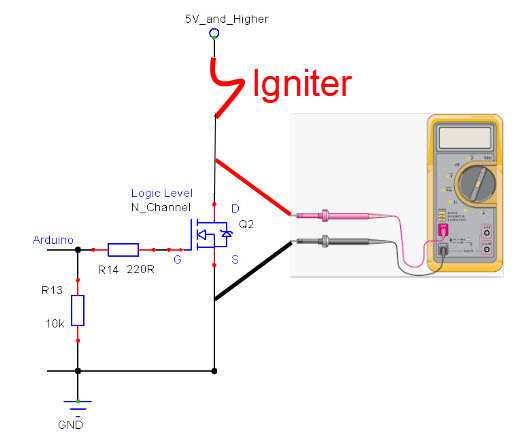
If you do, measure the voltage Drain to Source when the igniter is glowing.

This voltage should be very small, at only 200mA you should see less than 0.1 volts.
If it is, then your are okay.

I do have a DMM, where abouts do i put the probes?

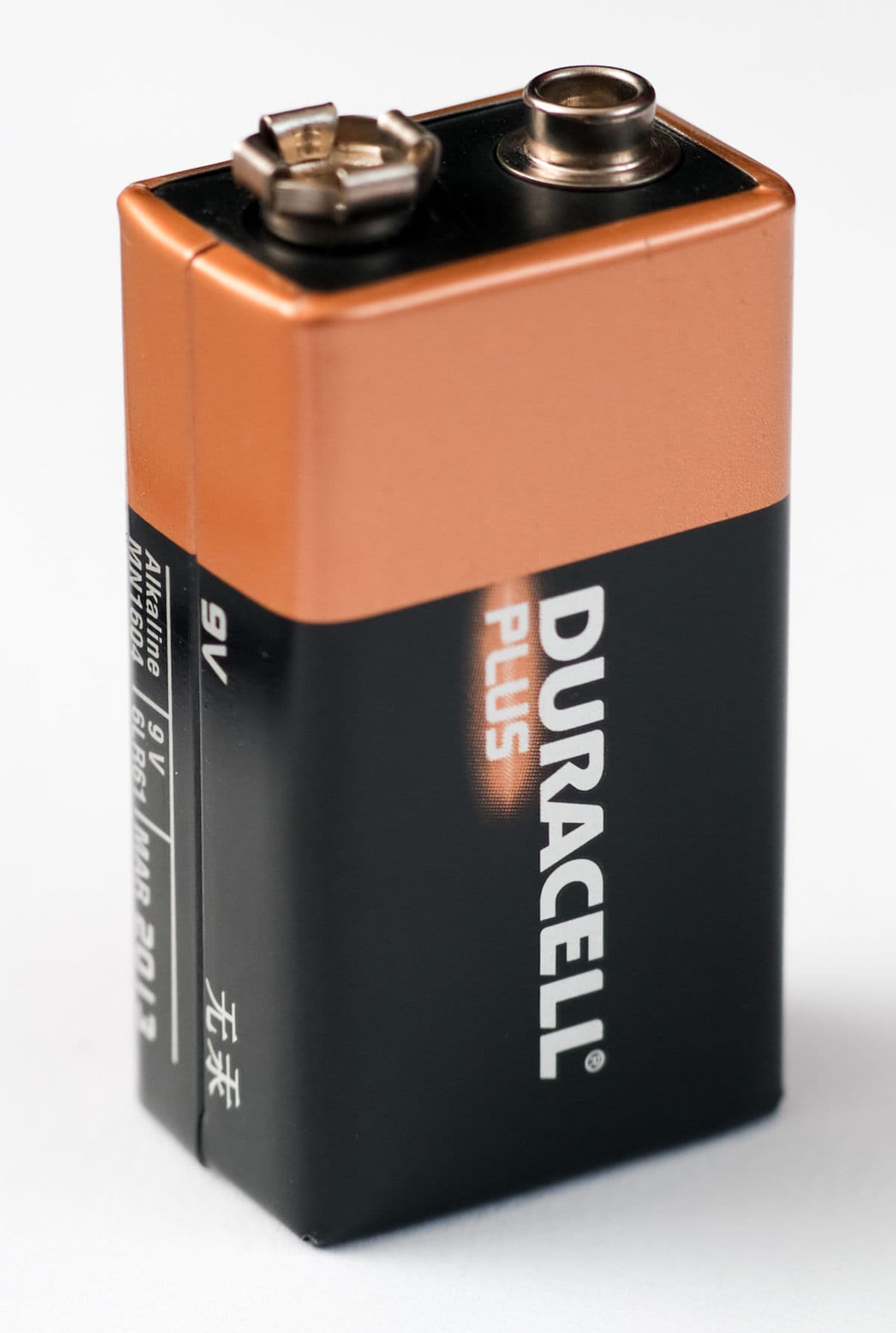
And I am using 9V battery

"Is it safe to test with an igniter? Or could it damage the arduino and circuit?"

If you are connected similar to circuit B2 in the image in Post #2, you will not damage your UNO.


Note:
Some igniters will burn out when current flows though them.

In b2, what do i replace the terminal block with?

Across the Drain and Source.

2022-07-05_3-02-55

2022-07-05_3-07-41

1 Like

You should note a 9V battery cannot supply very much current.

Suggest you use AA batteries in a battery holder.
4AA will give 6V
6AA will give 9V