This question was asked many times but I have another question regarding this.
I have a sensor working at 12V and my ESP32 is at 3.3V. My power supply is made of 3 batteries (18650), so between 12 and 13V.
In order to decrease the voltage, I used different strategies : a voltage divider made of 2 resistors (220 kohm) or a series of diodes (1N4007), both followed by a voltage regulator (HT7833)... Each time, I managed to get 3.3V as output. But as soon as I plug the 3.3V to either my homemade ESP32 that I designed on JLCPCB or any classical ESP32 module, the voltage drop to 1.5 to 1.9 V.
Why? and what should I do to have a stable 3.3V from a 12-14V supply?
I hope my question is not too stupid as I'm not specialist at all (I just burnt a diode today!).
Thanks in advance for your time and advice.
Laurent
I was using these modules before but I need to make a circuit on a PCB this time and I can't use these modules.
Unless I'm wrong, the max. input voltage for HT7833 is 8V. That's why I first dropped the voltage with these strategies.
I forgot something important. I need to have the lowest current consumption (a few tens of uA). The voltage converter I was using before was consumming too much. Is there a good LDO which could convert directly from 12 to 3.3V?
And trying to drop the voltage with diodes?
With any other approach from buck-converter you just burn the difference of input and output voltages (multiplied the current). In your case ~70% of your battery capacity.
Also, 3S battery voltage can be anything between 9V and 12.6V
Same thing, like I wrote..
Bad English?
Let's try again.
Only buck converter can convert the voltage without wasting all the energy in to heat proportionally to the voltage difference.
Oh really! That's not really what I wanted to hear That's what I was using in my original circuit. I had about 11mA in deepsleep mode. Is there a way to minimize current consumption with these modules? Or to design a simple one directly on my PCB?
You should choose your converter based on "consumption profile". If it's mainly deep sleep, LDO is best choice. If high current active time is the main consumption, step down converter suites better. There are really efficient step-down converters available, but they usually have relatively low max current.
On the other hand, you should try to design your setup the way you don't have to do 12V to 3V conversion.
For example single cell battery with HT7833 might be very efficient solution for Esp that is mainly sleeping. If 12V sensor is only occasionally used, boost converter with "disable function" could be used for it.
To power the ESP32 ? For that you should use either a buck converter or a linear regulator, but since LM1117 3.3 (or AMS1117 3.3v) has 12v as a maximum input, if you are going to use a linear regulator you will need to drop down from 12v to something lower first. The ESP32 devkit has an onboard 3.3v regulator and providing it with 5v will do the trick, so i tend to use an 7805 in a TO-220 package which his enough heatsink for the current demand of the ESP32. Not the most efficient and since you are using batteries you should probably go for a buck converter.
I didn't know there are LDO buck converter. I did a quick search and found some. The problem is that they consum around 1-1.5mA in deep sleep. Do you know a good one which consum in the range of tens of uA for instance?
I like this idea. I looked in different forums and I guess I need to use a MOSFET or so to disable the boost converter. Have you done that? Could you help me on that (a schematic, a reference for a boost converter...)? Thank you so much
Hi, SORRY BUT, THE FIRST QUESTIONS THAT SHOULD HAVE BEEN ASKED.
What is the sensor?
Can you please post a link to specs/data?
Is the sensor output a varying analogue level?
OR
Is the sensor output a digital, HIGH/LOW level?
Can you please post a copy of your circuit, a picture of a hand drawn circuit in jpg, png?
Hand drawn and photographed is perfectly acceptable.
Please include ALL hardware, power supplies, component names and pin labels.
"LDO" is not important here. It stands for Low Drop Out. It is the voltage dropped/lost by the regulator. With ~12V input and 3.3V output, the voltage dropped is not a problem at all, there is plenty of overhead.
LDO is important when the input voltage is only just a little higher than the output voltage, like using a 3.7V battery input and 3.3V output. In this situation, you can't afford to lose much voltage, otherwise your circuit will stop working long before the battery is empty.
What is important here is "Quiescent Current" which is the current naturally consumed/wasted by the regulator itself, even when no current is being drawn from its output. For a battery circuit that is in a sleep mode for most of the time, a low quiescent current can be more important than high efficiency.
Buck regulators have high efficiency at higher currents, but often also have a high quiescent current.
Linear regulators have low efficiency, but some have very low quiescent current.
Another regulator to consider could be MCP1702, which can accept input voltage up to 13.2V and has a quiescent current of 2uA. However, it's max output is 250mA, which may not be sufficient.
I never measured that. I will work on it this week-end.
Sorry, you're right @TomGeorge , I need to give more details.
The sensor (analog output 4-20mA): Pressure transmitter submersible 10m H2O/ 1bar - AF904
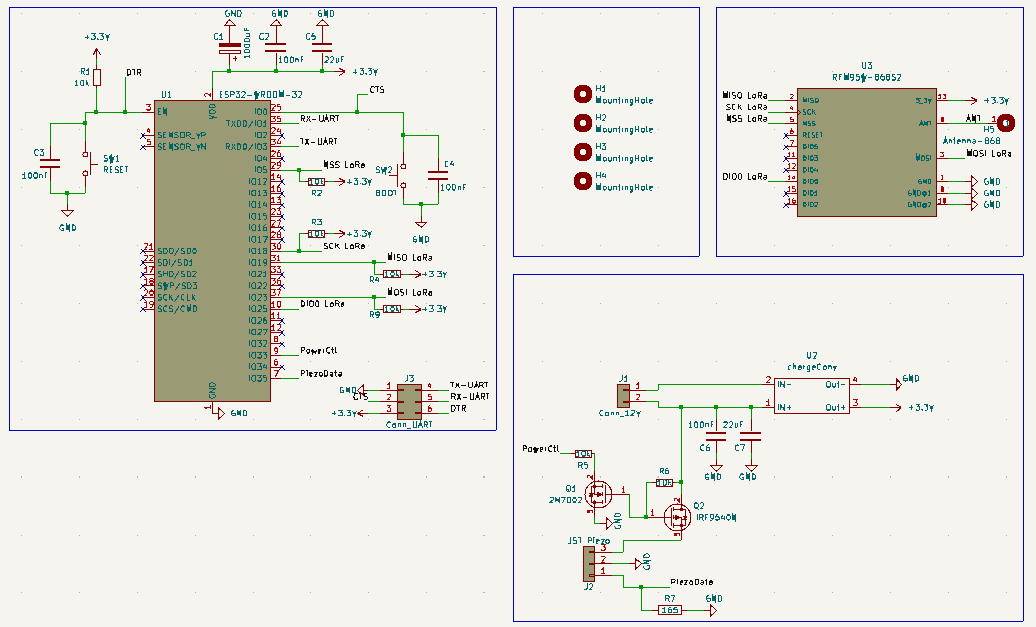
This is the circuit I was using and that I need Uto improve in terms of current consumption:
So the wake time is only 0.03%. Even if linear regulator is wasting energy, you get better battery performance than with step-down. With single cell the efficiency would be great.
You could use your 3S battery just for the sensor and use NPN transistor to disconnect it when sleeping.

 That's what I was using in my original circuit. I had about 11mA in deepsleep mode. Is there a way to minimize current consumption with these modules? Or to design a simple one directly on my PCB?