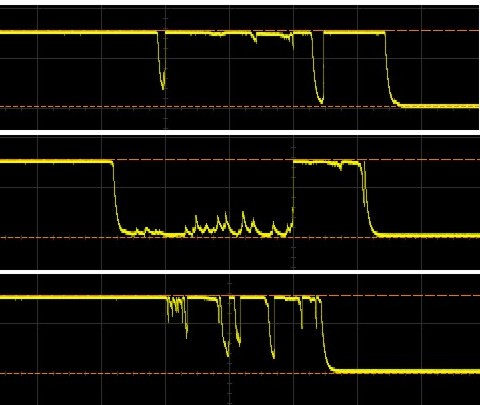
OK, I will throw some serious code at you.
This does various things, the trick is to take pieces which do what you need, in this case the debounce routine. It is admittedly overly complex, but is designed to allow you to debounce many things at once.
Note that this is the full debounce algorithm - it requires the input to be stable for every test of the specified debounce interval, not just at the end of the interval or just - as you code - waiting and hoping. 
It also detects a specific direction of change - from HIGH to LOW - in the input. Inputs should always be a switch connected from the input to ground and either using pinMode of INPUT_PULLUP or/ and a 4k7 pull-up resistor to 5 V. You may even wish to use the protection circuit I posted yesterday:

D1 prevents a higher voltage being applied to the Arduino input but allows it to pull down to ground when the "contact" is closed.
D2 prevents a voltage less than (negative to) ground being applied to the Arduino input at any time.
I actually suggest you try out the code to get a feel for how it works. Obviously you need to have the parts to do that but frankly, I feel using a simulator is a bit of a waste of time.
// Blink without "delay()" - multi!  With button de-bounce.
// Note that this code is immediately extensible to *many* buttons.

const int led1Pin =  13;    // LED pin number
const int led2Pin =  10;
const int led3Pin =  11;
const int button1 =  4;     // buttons & switches always connect from input to ground

int led1State = LOW;        // initialise the LED
int led2State = LOW;
int led3State = LOW;
char bstate1 = 0;

unsigned long count1 = 0;   // will store last time LED was updated
unsigned long count2 = 0;
unsigned long count3 = 0;
unsigned long bcount1 = 0; // button debounce timer.  Replicate as necessary.

// Have we completed the specified interval since last confirmed event?
// "marker" chooses which counter to check
boolean timeout(unsigned long *marker, unsigned long interval) {
  if (millis() - *marker >= interval) {
    *marker += interval;    // move on ready for next interval
    return true;
  }
  else return false;
}

// Deal with a button read; true if button pressed and debounced is a new event
// Uses reading of button input, debounce store, state store and debounce interval.
boolean butndown(char button, unsigned long *marker, char *butnstate, unsigned long interval) {
  switch (*butnstate) {               // Odd states if was pressed, >= 2 if debounce in progress
  case 0: // Button up so far,
    if (button == HIGH) return false; // Nothing happening!
    else {
      *butnstate = 2;                 // record that is now pressed
      *marker = millis();             // note when was pressed
      return false;                   // and move on
    }

  case 1: // Button down so far,
    if (button == LOW) return false; // Nothing happening!
    else {
      *butnstate = 3;                 // record that is now released
      *marker = millis();             // note when was released
      return false;                   // and move on
    }

  case 2: // Button was up, now down.
    if (button == HIGH) {
      *butnstate = 0;                 // no, not debounced; revert the state
      return false;                   // False alarm!
    }
    else {
      if (millis() - *marker >= interval) {
        *butnstate = 1;               // jackpot!  update the state
        return true;                  // because we have the desired event!
      }
      else
        return false;                 // not done yet; just move on
    }

  case 3: // Button was down, now up.
    if (button == LOW) {
      *butnstate = 1;                 // no, not debounced; revert the state
      return false;                   // False alarm!
    }
    else {
      if (millis() - *marker >= interval) {
        *butnstate = 0;               // Debounced; update the state
        return false;                 // but it is not the event we want
      }
      else
        return false;                 // not done yet; just move on
    }
  default:                            // Error; recover anyway
    {
      *butnstate = 0;
      return false;                   // Definitely false!
    }
  }
}

void setup() {
  pinMode(led1Pin, OUTPUT);
  pinMode(led2Pin, OUTPUT);
  pinMode(led3Pin, OUTPUT);
  pinMode(button1, INPUT);
  digitalWrite(button1,HIGH);        // internal pullup all versions
}

void loop() {
  // Toggle LED if button debounced
  if (butndown(digitalRead(button1), &bcount1, &bstate1, 10UL )) {
    if (led1State == LOW) {
      led1State = HIGH;
    }
    else {
      led1State = LOW;
    }
    digitalWrite(led1Pin, led1State);
  }

  // Act if the latter time (ms) has now passed on this particular counter,
  if (timeout(&count2, 300UL )) {
    if (led2State == LOW) {
      led2State = HIGH;
    }
    else {
      led2State = LOW;
    }
    digitalWrite(led2Pin, led2State);
  }

  if (timeout(&count3, 77UL )) {
    if (led3State == LOW) {
      led3State = HIGH;
    }
    else {
      led3State = LOW;
    }
    digitalWrite(led3Pin, led3State);
  }
}