Hi,
I am a newbie in electronics. Please correct me if I am wrong.
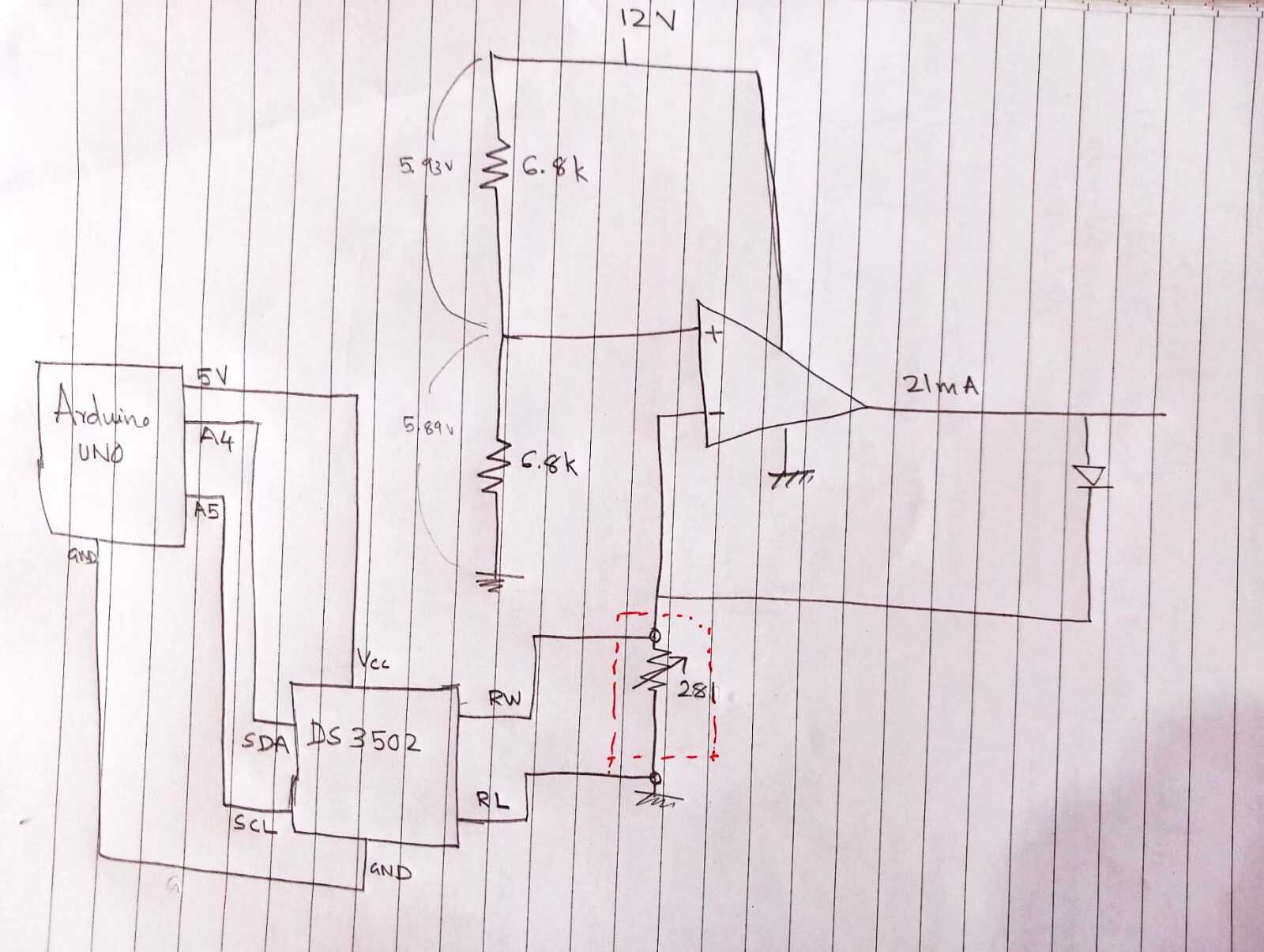
I am replacing a pot with a digital pot (DS3502) in a circuit.
The Vcc of the circuit is 12V. But the digital pot can have a maximum of 5.5V as Vcc.
I am controlling the digital pot with an Arduino UNO. Can I use 5V from the Arduino as the Vcc of the digital pot and 12V as the Vcc of the circuit?
I kept the ground common for both.
This is a constant current circuit of 21mA, to drive a laser. But I want to slightly tune the intensity of laser using the digital pot. So I am replacing it with digital pot. My question is since the Vcc of circuit (12V) is different, will my digital pot work in circuit if connect 5V Vcc(from Arduino UNO) to it. For me, it is not working and showing as an open circuit
I have only use RL and RW to circuit. RH is kept opened. Do I need to connect RH? I don't have much knowledge in circuits. Please spare me if I am wrong
Well... Theoretically YES. (If you're using the Output of the Dev board to input to your device)
But i agree with @sterretje that
A Circuit diagram would be invaluable
There are a few things missing here as well (that would be solved with the diagram)
I reckon draw up a diagram or do the C.A.D. thing and take a picture of the project and upload both photos. Get as close up as you can on the project (Most people casually take a shot from way back which is rather useless)
this way we can help you better.
Thats a very clumsy way to control the current.
Also have you seen this:
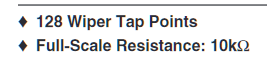
1 step is 78 ohms
and
Maximum RW Current ...........................................................1mA
Why not just do a voltage to current conversion with your op amp and supply the cotrol voltage from the arduino either with filtered PWM or for more precision with a DAC?
In addition to the '1 step is 78 ohms' and the 'Maximum RW current of 1mA' that johnerrington pointed out in post #12, there is also a 'wiper resistance of 5000 ohms maximum' that will be detrimental.
My suggestion would be:
Place a fixed value resistor where you have the DS3502, and make it's value a nice round value. e.g. 100Ω so that the current is 10mA per volt.
Use the DS3502 to provide a reference voltage to the non-inverting input of the opamp, with a resistor to limit the maximum voltage the pot can give out.