Hello,
I am trying to get the mention board to play audio through its' on board 3.5mm jack using a Ardunio uno board and a PIR sensor to trigger random sounds on the SD Card. But, for some reason, either my limited knowledge or something else I'm overlooking. I cannot get it to play thought unpowered or powered speakers.
I know that the PIR sensor and board is talking to the DY-SV5W as i can see it detect motion and says playing X track in the serial monitor. But, there is no sound.
The DY-SV5W drip switches is currently in 010, but I have tried using 100 and 001 with no differing results.
Here is the code I am using for the ardunio board. Put it get using my limited knowledge and modding code from a working DFminiPlayer sketch as the basis of my understand. It verified correctly with no problem before uploading it the ardunio.
#include <SoftwareSerial.h>

int pirPin = 12; // Arduino pin the PIR sensor is connected to
int rxPin = 3;   // Arduino pin the TX pin of the DY-SV5W is connected to
int txPin = 2;   // Arduino pin the RX pin of the DY-SV5W is connected to

int motionStatus = 0; // variable to store the PIR's current reading (high or low)
int pirState = 0;     // variable to store the PIR's state change

SoftwareSerial mp3Serial(rxPin, txPin); // Software Serial object for DY-SV5W

void setup() {
  pinMode(pirPin, INPUT);    // Set PIR pin as input
  pinMode(rxPin, INPUT);     // Set mp3 player TX pin as input
  pinMode(txPin, OUTPUT);    // Set mp3 player RX pin as output

  Serial.begin(9600);        // Initialize Serial Monitor
  mp3Serial.begin(9600);     // Initialize Serial communication for DY-SV5W

  delay(30000);              // Allow 30-60 seconds for PIR sensor to calibrate
}

void loop() {
  motionStatus = digitalRead(pirPin); // Read the PIR pin's current output (HIGH or LOW)

  if (motionStatus == HIGH) {
    if (pirState == LOW) {
      Serial.println("Motion Detected"); // Print result to the Serial Monitor
      pirState = HIGH;                  // Update the PIR state to HIGH

      playRandomTrack();                // Play a random track
      delay(13000);                     // Delay for the approximate length of the longest track
    }
  } else {
    if (pirState == HIGH) {
      Serial.println("Motion Ended");   // Print result to the Serial Monitor
      pirState = LOW;                   // Update the PIR state to LOW
    }
  }
}

void playRandomTrack() {
  int track = random(1, 65); // Generate a random track number (1 to 64)
  Serial.print("Playing track: ");
  Serial.println(track);

  sendCommand(0x03, track);  // Command 0x03 plays a specific track
}

void sendCommand(byte command, int parameter) {
  byte highByte = (parameter >> 8) & 0xFF; // Extract high byte of parameter
  byte lowByte = parameter & 0xFF;        // Extract low byte of parameter

  byte checksum = 0xFF - (0xFF + command + highByte + lowByte) + 1; // Calculate checksum

  // Send the 6-byte command sequence
  mp3Serial.write(0x7E);      // Start byte
  mp3Serial.write(0xFF);      // Version byte
  mp3Serial.write(0x06);      // Command length
  mp3Serial.write(command);   // Command byte
  mp3Serial.write((byte) 0x00); // Feedback (0x00 = no feedback)
  mp3Serial.write(highByte);  // High byte of parameter
  mp3Serial.write(lowByte);   // Low byte of parameter
  mp3Serial.write(checksum);  // Checksum
  mp3Serial.write(0xEF);      // End byte
}
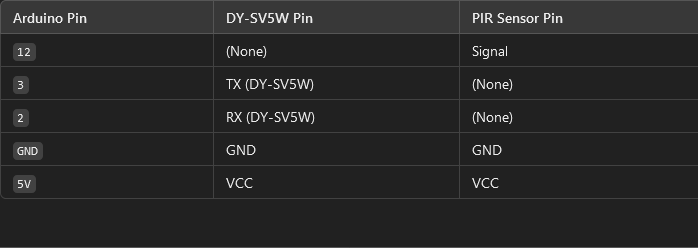
Also here is the basic wiring in text format I used to hook up the PIR sensor, Ardunio, and the DY-SV5W.
Any help with this is appreciated as like I said, I am probably missing something obvious, but don't know I am.