Hi there! Apologies in advance if this is a dumb beginner question.
I'm currently planning a summer project and was wondering if there's such thing as electrically actived latching push buttons i.e. a button I can manually press or can "press" using electrical currents.
The context is that I plan to build a midi drum sequencer over the summer. There will be 5 rows of 8 buttons, all of which correspond to a drum note. I want to use latching buttons for this since they stay in position when pressed.
However there will be a 6th row at the top with preset buttons that when pressed will load a specific drum sequence. When a preset is pressed, all buttons in the 5x8 matrix of buttons should be mechanically pressed or released based on whether or not they are part of the drum sequence.
Much simpler: use buttons with LEDs or separate LEDs to show the button state. Pressing the button then can either mean a momentary press, until released again, or toggle the switch (LED) state.
The usual way to operate a mechanical movement electrically is to use a solenoid. Thats very inefficent - it uses a lot of current for little effect. Having 40 of them (if they do exist) that would be an issue.
That is a good point and had actually considered that, but for sake of argument, how could I achieve what I want. Is it even remotely possible within the confines of buttons as small as the ones found on mechanical keyboards?
Maybe there's something that combines mechanical latches and electromagnets?
I have seen a similar concept be used for SPST style switch (probably some sort of solenoid) in this video: https://youtu.be/EvDfmRq6YCs?t=1199
I also recall using a device years ago that would release a button when another one was pressed so that only one was active at a time.
I only wanted to do it my way because it would look cool.
Either way, if I figure out a custom solution, I'll make a detailed forum post about it here. Otherwise, I'll stick to the LED indicator idea which is a good backup.
Those switches were mechanically connected with latching bar connecting them. Each time a switch was pressed, the bar would slide and release the previous button.
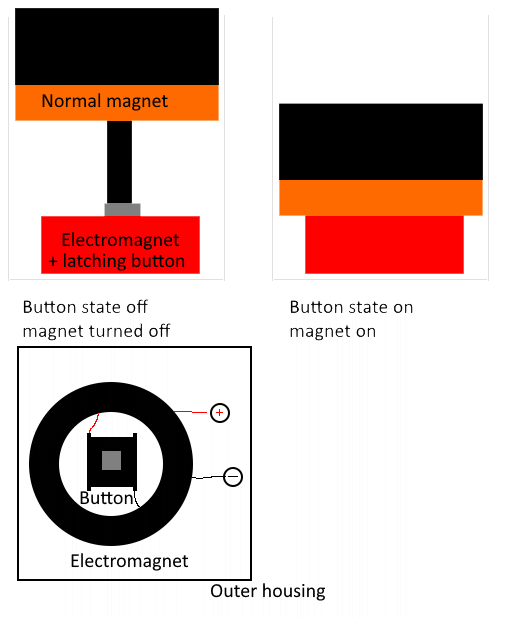
So here's the idea I've come up with as a solution:
Use a small ring shaped electromagnet with a button placed in the middle.
The button would be fastened to a rod with a magnet on top (and a keycap).
When the keycap is pressed it pushes the button and toggles the button state in code on an arduino.
Any button that is ON would have its electromagnet turned on which would lock the button in place.