Most of MCUs can handle brief abuse. That doesn't mean they are "tolerant". It's not a question of immediate "frying", "puffing" or "magic smoking". When they are driven out of specs, they might fail anytime, in one minute or in some years. If you are aware of that, there is no problem.
As far as i know it is not specifically listed in the latest datasheet version, so let's just decide to say that it isn't actually 5v tolerant.
from the datasheet (page 15)
VIH High-level input voltage 0.75×VDD1- VDD1+0.3
I hope this settles it. if powered with 3.3v , anything up to 3.6 v will work safely, but of course closer to 3.3v is better.
The ESP32 has 5 strapping pins, Page 10 of the datasheet lists them and their functions.
Any of the pins that are pullup up by default can not be reduced through use of a simple volatge divider, but that also means that all other pins can. For higher speed reception one should use resistors with a resistance that is not to high. I use 3x 1k (TX -> 1K -> RX -> 1K -> 1K -> GND) which does work for anything up to 115200 bps for sure, but also still a bit higher. Metal film resistors are better than carbon film ones.
You can power ESP32 and Ultrasonic sensor with a single power supply like below:
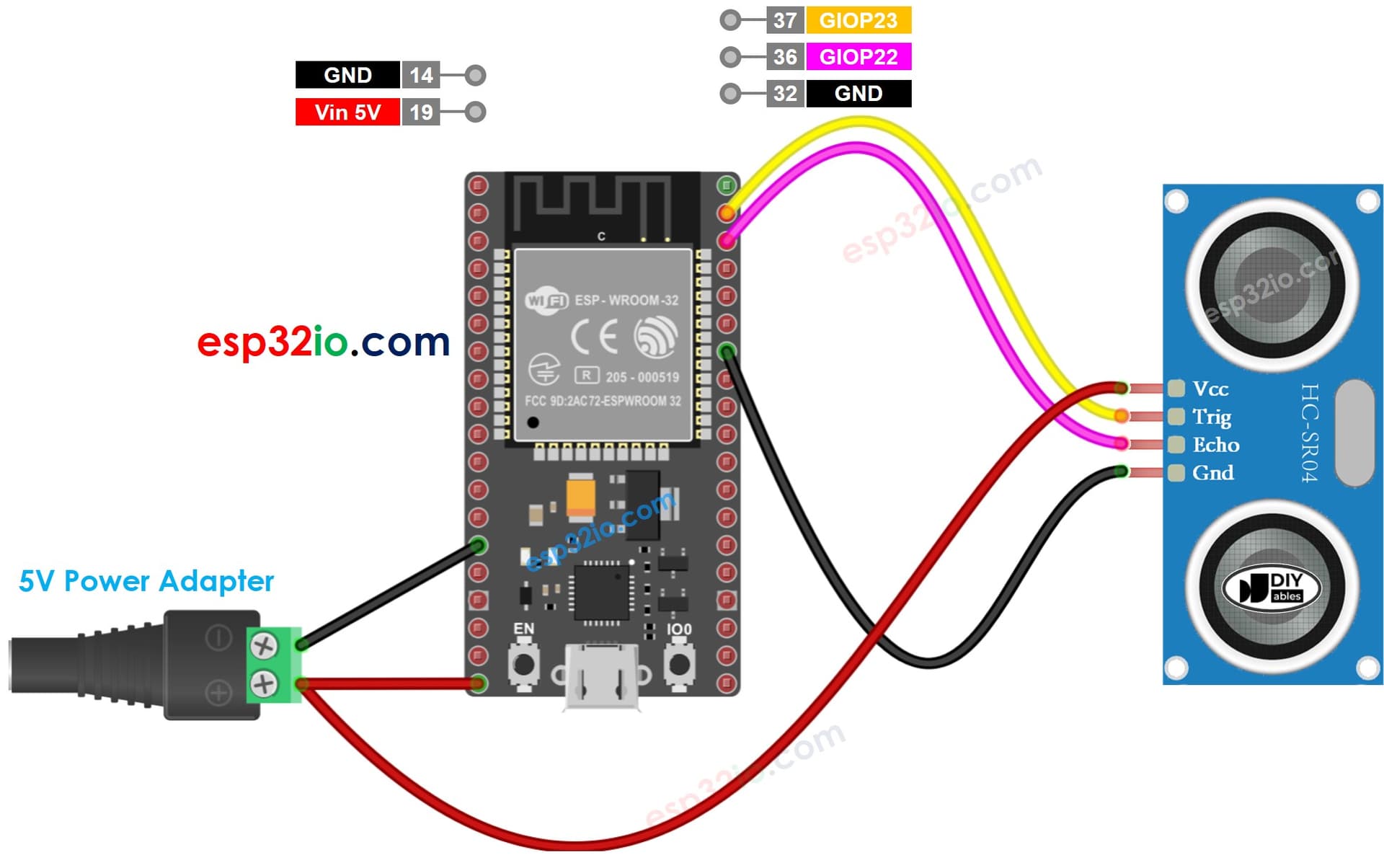
You can see more detailed instruction at ESP32 Ultrasonic Sensor tutorial
Well ADC reads all-ones. (12-bit ADC)
Couple of times I place the piece of paper int the sensor (simulating high turbidity) and then readings drop to zero rapidly. Remove paper - and they rise again.
When it is dead the readings should not be affected by piece of paper.
No you can't. The echo signal will be over the voltage that is safe to use as an input.
At any number of very poor tutorials found on the internet. This is another example of people making a tutorial who do not know what they are doing.
Please do not spread rubbish like this here.
This is very good advice.
I've deleted some of the off topic stuff about over voltage on the ESPxxxx boards because it was getting out of hand. Yes, I know, I probably deleted some good stuff as well, for which I apologise, it was mixed in with the out of hand stuff. I'll summarise what I think is the main point: Don't apply higher voltage to pins than the data sheet specifies as OK. If you want to try higher voltages to see what happens then don't be surprised if the device fails. Note that fails can mean things other than smoke, it might work OK for a while, it might work with strange problems.
Please stick to what the OP wants to know about.
@lakindumuhandirumge , if you want to ask more about over voltage then please do so, then people can advise you.
I thank you.
(No sanctions for anyone)
Thank you to everyone on this thread trying to solve the matter. I sure have learnt a lot of stuff from your responses and will keep them in mind. For now, my doubts about the voltage outputs/inputs of the sensor and esp32 board have been cleared and I was able to successfully obtain readings from the device.
Thank you