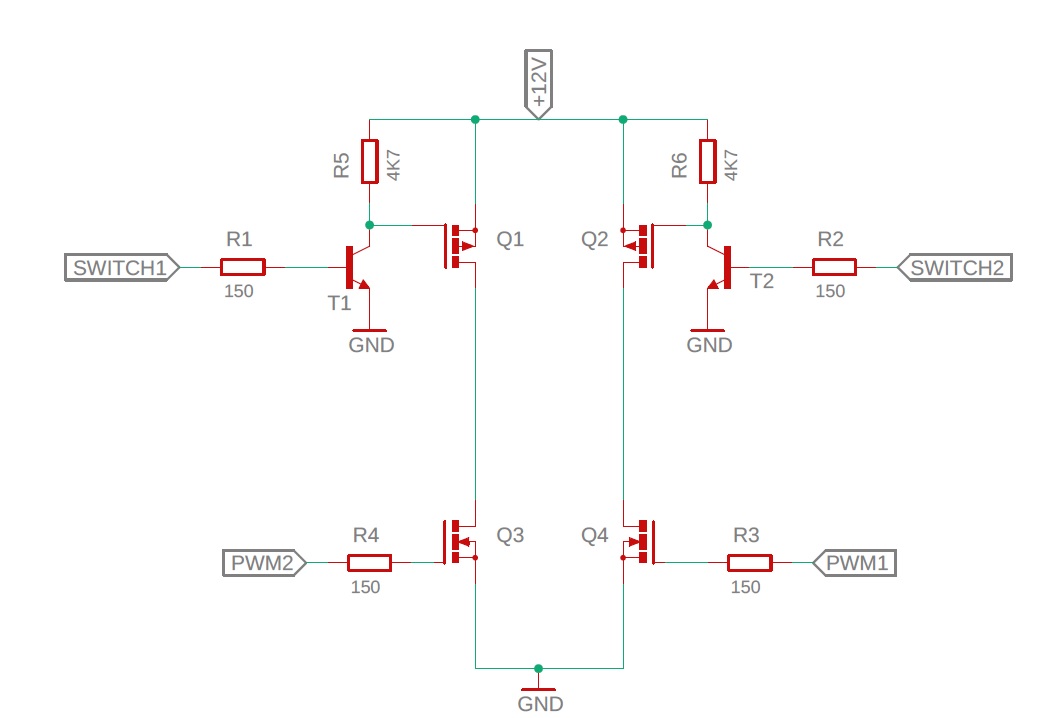
Hello everyone, as my circuit describes itself, nothing is so complicated. A simple H-bridge circuit which controlled by arduino nano, two digital pins and two pwm pins.
My problem is, when I powered the circuit, I got a short between 12V and GND... by troubleshooting I found that Q2 is shorted, so I threw the whole board and soldered a new one, but, I got the same thing again!
Can someone tell me where's my wrong?
P.S. Q1 and Q2 are IRF4905
Q3 and Q4 are IRLZ44
T1 and T2 are BC548
T3 and T4 are 2N3906
Circuit is wrong. Q2 is wired to 12V, so it will pull the Arduino pin up to 11.3V or so, not good news, though R4 probably saved the Arduino from instant failure.
I just made it myself based on many circuits which found in datasheet. But I didn't understand where's the wrong in connecting Q2 to 12V. Arduino pin isn't connected to Q2, but to T2.
Q2 Vgs is -11.981v according to simulator which I tested the circuit with before building.
A BJT transistor looks a bit like two diodes in opposite direction. So the EB junction of T3 (and T4) is like a diode pointing towards the Arduino. The second diode would be the CB junction. An NPN is likewise but in the opposite direction.
Drop T3 and T4, connect the gate of Q3 and Q4 to the Arduino pin directly. The IRLZ44N will be fully on at 5V on the gate.
Note that Q1 and Q2 are slow to turn off, as the gate is discharged through R5. It will turn on fast, as it's charged through T1 with no current limiting resistance.
Q3 and Q4 will switch faster as the gate is charged and discharged though just a 150R resistor, after correcting the circuit.
Tom-4:
Ya ya... now I got what you mean... It was so stupid to use PNP transistor which leads Ib to arduino output pin!
Can N-ch mosfet with Vgs 5V control 12V load?
Absolutely, the source-drain voltage is what matters for the load.
Is it correct now?
New schematic below
No, even more disasterous error, you've shorted the gates to ground! And you've used an emitter follower which is not needed at all, nor is it a switching circuit.
wvmarle:
Drop T3 and T4, connect the gate of Q3 and Q4 to the Arduino pin directly. The IRLZ44N will be fully on at 5V on the gate.
Thank you for your reply. I thought of doing this but as datasheet paragraph says, at 5V on Vgs, the mosfet can't drive 12V load with full amperage. the current will be limited.
One more thing, in my plan Im not going to use IRLZ44N, not IRL4905 neither! they suck! But as they are DIP components so I can use them as far as I'm testing circuits home.
Can you please chech the 2nd schematic and tell me what do you think?
Thank you in advanced.
MarkT:
Absolutely, the source-drain voltage is what matters for the load.No, even more disasterous error, you've shorted the gates to ground! And you've used an emitter follower which is not needed at all, nor is it a switching circuit.
So just controlling the two n mosfet gates direct like this?
Yes, but do bring back the pull-down resistors on the gate. Don't ever leave a gate floating (and they will be when the Arduino is powered down or just starting up).