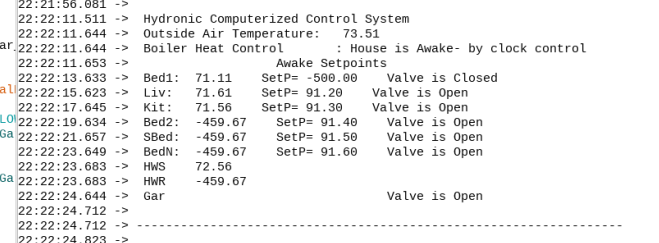
98% finished code , subject, of course, to revision, when arrays are mastered and EEPROM used from GUI.
[code]
// rev 1 - May 30, 2022  --  Boiler Hydronic Program  --  by DDDD Co.
//           Items that Owner can change  ///////////////////////////////////////////////////////

//           Decision for DAY/NIGHT or Automatic from Timeclock program, change as needed, then upload.
int decisionTimeClock = 2;   // Insert 0 for NIGHT,
                            // Insert 1 for DAY,
                           // Insert 2 for Automatic by Python TimeClock program on Raspberry Pi

//           Decision for Garage valve. change as needed, then upload.
int decisionGar_Valve = 0;        // insert 1 for follow the action of BDRM2ndFL valve
                                 // Insert 0 for Closed , remember the valve can be opened my manual lever


//           Decision for Laundry valve. change as needed, then upload.
int decisionLaundry_Valve = 0;        // insert 1 for follow the action of BDRM1stFL valve
                                 // Insert 0 for Closed , remember the valve can be opened my manual lever

//          DAY setpoints
float DAYSetBDRM1stFL =     50;  // change this as needed then upload, and saving file is automatic.
float DAYSetLivingRoom =    99;  // change this as needed
float DAYSetKitchen =       71.3;  // change this as needed
float DAYSetBDRM2ndFL =     98;  // change this as needed
float DAYSetSouthBDRM3FL =  71.5;  // change this as needed
float DAYSetNorthBDRM3FL =  71.6;  // change this as needed

//          NIGHT setpoints
float NIGHTSetBDRM1stFL =     61.1;  // change this as needed then upload, and saving file is automatic.
float NIGHTSetLivingRoom  =   61.2;  // change this as needed
float NIGHTSetKitchen  =      61.3;  // change this as needed
float NIGHTSetBDRM2ndFL =     61.4;  // change this as needed
float NIGHTSetSouthBDRM3FL =  61.5;  // change this as needed
float NIGHTSetNorthBDRM3FL =  61.6;  // change this as needed

// DO NOT CHANGE ANYTHING BELOW THIS LINE //////////////////////////////////////////////////

//---Apartment (BDRM1stFL)
float read1    = 0;             //read 20 times and then take average of all 20
float total1   = 0;         // the running total
float average1 = 0;        // the average
//---

//---Living Room (LivingRoom)
float read2    = 0;
float total2   = 0;         // the running total
float average2 = 0;        // the average
//---

//---Kitchen (Kitchen)
float read3    = 0;
float total3   = 0;         // the running total
float average3 = 0;        // the average
//---

//---BDRM2ndFL (BDRM2ndFL) 2nd level
float read4    = 0;
float total4   = 0;         // the running total
float average4 = 0;        // the average
//---

//---SouthBDRM3FL (SouthBDRM3FL) 3rd Level
float read5    = 0;
float total5   = 0;         // the running total
float average5 = 0;        // the average
//---

//---NorthBDRM3FL 3rd Level (NorthBDRM3FL)
float read6    = 0;
float total6   = 0;         // the running total
float average6 = 0;        // the average
//---

//---HotWaterSupply from Boiler (HWS)
float read7    = 0;
//---

//---HotWaterReturn from Boiler (HWR)
float read8    = 0;
//---

//---Outside Air Temperature (OAT)
float read9    = 0;
//---

//    BDRM1stFL data
int   BDRM1stFLThermistorPin = 0;
int   Vo1;
float logR2z1, R2z1, BDRM1stFLT;
int   BDRM1stFL_Valve = 2;
int   BDRM1stFLHeatState = 0;

//    LivingRoom data
int   LivingRoomThermistorPin = 1;
int   Vo2;
float logR2z2, R2z2, LivingRoomT;
int   LivingRoom_Valve = 3;
int   LivingRoomHeatState = 0;

//    Kitchen data
int   KitchenThermistorPin = 2;
int   Vo3;
float logR2z3, R2z3, KitchenT;
int   Kitchen_Valve = 4;
int   KitchenHeatState = 0;

//    BDRM2ndFL data
int   BDRM2ndFLThermistorPin = 3;
int   Vo4;
float logR2z4, R2z4, BDRM2ndFLT;
int   BDRM2ndFL_Valve = 5;
int   BDRM2ndFLHeatState = 0;

//    SouthBDRM3FL data
int   SouthBDRM3FLThermistorPin = 4;
int   Vo5;
float logR2z5, R2z5, SouthBDRM3FLT;
int   SouthBDRM3FL_Valve = 6;
int   SouthBDRM3FLHeatState = 0;

//    NorthBDRM3FL data
int   NorthBDRM3FLThermistorPin = 5;
int   Vo6;
float logR2z6, R2z6, NorthBDRM3FLT;
int   NorthBDRM3FL_Valve = 7;
int   NorthBDRM3FLHeatState = 0;

//    Garage (Gar) Valve.   Valve opens and closes with BDRM2ndFL valve "IF" Gar  decision is "1" on line 10
int   Gar_Valve = 8;                // otherwise, valve stays closed
int   GarHeatState = 0;

//    Laundry Valve.   Valve opens and closes with BDRM1stFL valve "IF" Laundry  decision is "1" on line 15
int   Laundry_Valve = 9;                // otherwise, valve stays closed
int   LaundryHeatState = 0;

//    HWS data
int   HWSThermistorPin = 6;
int   Vo7;
float logR2z7, R2z7, HWS;

//    HWR data
int   HWRThermistorPin = 7;
int   Vo8;
float logR2z8, R2z8, HWR;

//for all zones
float diff = 1;      //Change this if needed.  example: if setpoint 69 and diff is 1, it will
                     //     go on at 68.0 and go off at 70.0, so +/- is the differential.
                     // If diff is set for 1.5, and setpoint is 69, it will go on at 67.5
                     //     and go off at 70.5.

float R1s1 =  10040;     // thermistor divider resistor actual measured ohms by meter
float R1s2 =  10000;     // --- using these actual values rather than nominal 10k improves accuracy
float R1s3 =   9920;
float R1s4 =  10030;
float R1s5 =  10070;
float R1s6 =  10020;
float R1s7 =  10000;
float R1s8 =   9990;

//     these are factors required for thermistor calculations since temp vs ohm curve is non-linear
float c1   = 1.009249522e-03, c2 = 2.378405444e-04, c3 = 2.019202697e-07;

int   timeClock = 10;     //pin 10 accepts 3.3v from GPIO 14 (pin 8) from RPi4 python program for NIGHT and DAY cycles
int   timeRead  =  0;     // digital read of input from timeclock
int   led_built_in = 13;  // built in led on Nano board. When lit, it indicates time clock program is calling for DAY
                          // if setpoints do not follow clock output, then maybe user choice on line 5 is wrong

int   interReadingDelay = 100;  // delayDelay in microseconds between the 20 readings for each sensor for each loop
                                  // required because Thermistors need calculations and that causes "noise".
// the following lines are for the ninth sensor, DS18B20. I needed 9 sensors and the Arduini Nano only had 8 AO inputs
#include <OneWire.h>                      // the DS18B20 uses a digital input pin instead of needing an analog pin
#include <DallasTemperature.h>

// Data wire is plugged into pin 11 on the Arduino
#define ONE_WIRE_BUS 11

// Setup a oneWire instance to communicate with any OneWire devices
// (not just Dallas temperature ICs)
OneWire oneWire(ONE_WIRE_BUS);

// Pass our oneWire reference to Dallas Temperature.
DallasTemperature sensors(&oneWire);
float sensorread = 0;
//end DB18B20 program

void setup() {
  Serial.begin(9600);
  // Start up the DB18B20 sensor library
  sensors.begin();
                             // declare the valves as an OUTPUT:  valves are closed when not powered on
  pinMode (BDRM1stFL_Valve, OUTPUT);
  pinMode (LivingRoom_Valve,  OUTPUT);
  pinMode (Kitchen_Valve,  OUTPUT);
  pinMode (BDRM2ndFL_Valve, OUTPUT);
  pinMode (SouthBDRM3FL_Valve, OUTPUT);
  pinMode (NorthBDRM3FL_Valve, OUTPUT);
  pinMode (Gar_Valve,  OUTPUT);
  pinMode (Laundry_Valve, OUTPUT);
  pinMode (led_built_in, OUTPUT);  // declare led 13 as an output
  pinMode (timeClock, INPUT);      // declare timeClock as INPUT
  //  normally, Arduino (Atmega) pins default to inputs, so they don't need to be explicitly
  //   declared as inputs with pinMode() when you're using them as inputs.
  }

void loop() {

  sensors.requestTemperatures(); // Send the command to get temperature from ds18b20
  Serial.println (" Hydronic Computerized Control System, DDDD Company, (C) 2022");
  Serial.print(" Outside Air Temperature:   ");
  sensorread = ((((sensors.getTempCByIndex(0))*1.8)+32));
  Serial.println(sensorread); // Why "byIndex"?
    // You can have more than one IC on the same bus.
    // 0 refers to the first IC on the wire

// read timeclock to decide if house is NIGHT or DAY
  if (decisionTimeClock == 1) {                         // if line 5 is 1, DAY
    timeRead = HIGH;
    Serial.println(" Boiler Heat Control : House is in DAY mode by line 5 command");
    Serial.println("                Temp     DAY Setpoints  ");
    }

  if (decisionTimeClock == 0) {                        // if line 5 is 0, NIGHT.
         timeRead = LOW;
         Serial.println(" Boiler Heat Control : House is in NIGHT mode by line 5 command");
         Serial.println("                 Temp   NIGHT Setpoints  ");
    }

  if (decisionTimeClock == 2) {                       // if line 5 is 2, then physical time clock decides
         timeRead = digitalRead(timeClock);
  }

  if ((timeRead == HIGH)&&(decisionTimeClock == 2)){
            digitalWrite(led_built_in, HIGH);    // led on board Nano ligts up if time clock is deciding
            Serial.println(" Boiler Heat Control : House is in DAY mode by clock control");
            Serial.println("               Temp      DAY Setpoints  ");
    }

  if ((timeRead == LOW)&&(decisionTimeClock == 2)) {
            digitalWrite(led_built_in, LOW);
            Serial.println(" Boiler Heat Control : House is in NIGHT mode by clock control");
            Serial.println("               Temp     NIGHT Setpoints  ");

    }

// program for BDRM1stFL, ground level apartment
  float total1 = 0;
  for (int i = 0; i < 20; i++) {                      // take 20 readings and average them to smooth readings, typical.
      Vo1 = analogRead(BDRM1stFLThermistorPin);
      R2z1      = R1s1 * (1023.0 / (float)Vo1 - 1.0);
      logR2z1   = log(R2z1);
      read1 = (1.0 / (c1 + c2*logR2z1 + c3*logR2z1*logR2z1*logR2z1));
      delay (interReadingDelay);
      total1 = total1 + read1;
  }
  average1 = total1/20;
  BDRM1stFLT    = average1 - 273.15;             // Kelvin temperature converted to Celsius
  BDRM1stFLT    = ((BDRM1stFLT * 9.0)/ 5.0) + 32.0;  // Celsius converted to Farhenheit

  //  DAY, as determined by external timeClock or command in program
  // open the valve if below the DAY setpoint less the differential
  if ((BDRM1stFLT < (DAYSetBDRM1stFL-1))&&(timeRead==HIGH)) {    // "HIGH" means DAY and "LOW" means NIGHT.
    digitalWrite(BDRM1stFL_Valve, HIGH);                     // opens valve to allow hot water to zone
  }
  // close the valve if above the DAY setpoint plus the differential
  if ((BDRM1stFLT > (DAYSetBDRM1stFL+1))&&(timeRead==HIGH)) {
    digitalWrite(BDRM1stFL_Valve, LOW);                      // closes valve to stop hot water to zone
  }
  // NIGHT, as determined by external timeClock
 // open the valve if below the NIGHT setpoint less the differential
  if ((BDRM1stFLT < (NIGHTSetBDRM1stFL-1))&&(timeRead==LOW)) {
    digitalWrite(BDRM1stFL_Valve, HIGH);                     // opens valve to allow hot water to zone
  }
  // close the valve if above the NIGHT setpoint plus the differential
  if ((BDRM1stFLT > (NIGHTSetBDRM1stFL+1))&&(timeRead==LOW)) {
    digitalWrite(BDRM1stFL_Valve, LOW);                      // closes valve to stop hot water to zone
  }

  BDRM1stFLHeatState = digitalRead (BDRM1stFL_Valve);
  Serial.print (" BDRM1stFL:     ");
  Serial.print (BDRM1stFLT);
  Serial.print ("    SetP= ");
  if (timeRead == HIGH){
    Serial.print(DAYSetBDRM1stFL);
  }
  else{
    Serial.print(NIGHTSetBDRM1stFL);
  }

  if (BDRM1stFLHeatState == LOW ){
    Serial.println ("    Valve is Closed ");
  }
  else{
    Serial.println ("    Valve is Open ");
  }


// program for LivingRoom, LivingRooming room
 float total2 = 0;
  for (int i = 0; i < 20; i++) {
      Vo2 = analogRead(LivingRoomThermistorPin);
      R2z2      = R1s2 * (1023.0 / (float)Vo2 - 1.0);
      logR2z2   = log(R2z2);
      read2 = (1.0 / (c1 + c2*logR2z2 + c3*logR2z2*logR2z2*logR2z2));
      delay (interReadingDelay);
      total2 = total2 + read2;
  }
  average2 = total2/20;
  LivingRoomT    = average2 - 273.15;             // Kelvin temperature converted to Celsius
  LivingRoomT    = ((LivingRoomT * 9.0)/ 5.0) + 32.0;  // Celsius converted to Farhenheit
  //  DAY, as determined by external timeClock
  // open the valve if below the DAY setpoint less the differential
  if ((LivingRoomT < (DAYSetLivingRoom-1))&&(timeRead==HIGH)) {
    digitalWrite(LivingRoom_Valve, HIGH);                     // opens valve to allow hot water to zone
  }
  // close the valve if above the DAY setpoint plus the differential
  if ((LivingRoomT > (DAYSetLivingRoom+1))&&(timeRead==HIGH)) {
    digitalWrite(LivingRoom_Valve, LOW);                      // closes valve to stop hot water to zone
  }
  // NIGHT, as determined by external timeClock
 // open the valve if below the NIGHT setpoint less the differential
  if ((LivingRoomT < (NIGHTSetLivingRoom-1))&&(timeRead==LOW)) {
    digitalWrite(LivingRoom_Valve, HIGH);                     // opens valve to allow hot water to zone
  }
  // close the valve if above the NIGHT setpoint plus the differential
  if ((LivingRoomT > (NIGHTSetLivingRoom+1))&&(timeRead==LOW)) {
    digitalWrite(LivingRoom_Valve, LOW);                      // closes valve to stop hot water to zone
  }

  LivingRoomHeatState = digitalRead (LivingRoom_Valve);
  Serial.print (" LivingRoom:    ");
  Serial.print (LivingRoomT);
  Serial.print ("    SetP= ");
  if (timeRead == HIGH){
    Serial.print(DAYSetLivingRoom);
  }
  else{
    Serial.print(NIGHTSetLivingRoom);
  }

  if (LivingRoomHeatState == LOW ){
    Serial.println ("    Valve is Closed ");
  }
  else{
    Serial.println ("    Valve is Open ");
  }

// program for Kitchen, Kitchenchen
   float total3 = 0;
  for (int i = 0; i < 20; i++) {
      Vo3 = analogRead(KitchenThermistorPin);
      R2z3      = R1s3 * (1023.0 / (float)Vo3 - 1.0);
      logR2z3   = log(R2z3);
      read3 = (1.0 / (c1 + c2*logR2z3 + c3*logR2z3*logR2z3*logR2z3));
      delay (interReadingDelay);
      total3 = total3 + read3;
  }
  average3 = total3/20;
  KitchenT    = average3 - 273.15;             // Kelvin temperature converted to Celsius
  KitchenT    = ((KitchenT * 9.0)/ 5.0) + 32.0;  // Celsius converted to Farhenheit
  //  DAY, as determined by external timeClock
  // open the valve if below the DAY setpoint less the differential
  if ((KitchenT < (DAYSetKitchen-1))&&(timeRead==HIGH)) {
    digitalWrite(Kitchen_Valve, HIGH);                     // opens valve to allow hot water to zone
  }
  // close the valve if above the DAY setpoint plus the differential
  if ((KitchenT > (DAYSetKitchen+1))&&(timeRead==HIGH)) {
    digitalWrite(Kitchen_Valve, LOW);                      // closes valve to stop hot water to zone
  }
  // NIGHT, as determined by external timeClock
 // open the valve if below the NIGHT setpoint less the differential
  if ((KitchenT < (NIGHTSetKitchen-1))&&(timeRead==LOW)) {
    digitalWrite(Kitchen_Valve, HIGH);                     // opens valve to allow hot water to zone
  }
  // close the valve if above the NIGHT setpoint plus the differential
  if ((KitchenT > (NIGHTSetKitchen+1))&&(timeRead==LOW)) {
    digitalWrite(Kitchen_Valve, LOW);                      // closes valve to stop hot water to zone
  }

  KitchenHeatState = digitalRead (Kitchen_Valve);
  Serial.print (" Kitchen:       ");
  Serial.print (KitchenT);
  Serial.print ("    SetP= ");
  if (timeRead == HIGH){
    Serial.print(DAYSetKitchen);
  }
  else{
    Serial.print(NIGHTSetKitchen);
  }

  if (KitchenHeatState == LOW ){
    Serial.println ("    Valve is Closed ");
  }
  else{
    Serial.println ("    Valve is Open ");
  }

// program for BDRM2ndFL, on middle level of house
  float total4 = 0;
  for (int i = 0; i < 20; i++) {
      Vo4 = analogRead(BDRM2ndFLThermistorPin);
      R2z4      = R1s4 * (1023.0 / (float)Vo4 - 1.0);
      logR2z4   = log(R2z4);
      read4 = (1.0 / (c1 + c2*logR2z4 + c3*logR2z4*logR2z4*logR2z4));
      delay (interReadingDelay);
      total4 = total4 + read4;
  }
  average4 = total4/20;
  BDRM2ndFLT    = average4 - 273.15;             // Kelvin temperature converted to Celsius
  BDRM2ndFLT    = ((BDRM2ndFLT * 9.0)/ 5.0) + 32.0;  // Celsius converted to Farhenheit
  //  DAY, as determined by external timeClock
  // open the valve if below the DAY setpoint less the differential
  if ((BDRM2ndFLT < (DAYSetBDRM2ndFL-1))&&(timeRead==HIGH)) {
    digitalWrite(BDRM2ndFL_Valve, HIGH);                     // opens valve to allow hot water to zone
  }
  // close the valve if above the DAY setpoint plus the differential
  if ((BDRM2ndFLT > (DAYSetBDRM2ndFL+1))&&(timeRead==HIGH)) {
    digitalWrite(BDRM2ndFL_Valve, LOW);                      // closes valve to stop hot water to zone
  }
  // NIGHT, as determined by external timeClock
 // open the valve if below the NIGHT setpoint less the differential
  if ((BDRM2ndFLT < (NIGHTSetBDRM2ndFL-1))&&(timeRead==LOW)) {
    digitalWrite(BDRM2ndFL_Valve, HIGH);                     // opens valve to allow hot water to zone
  }
  // close the valve if above the NIGHT setpoint plus the differential
  if ((BDRM2ndFLT > (NIGHTSetBDRM2ndFL+1))&&(timeRead==LOW)) {
    digitalWrite(BDRM2ndFL_Valve, LOW);                      // closes valve to stop hot water to zone
  }

  BDRM2ndFLHeatState = digitalRead (BDRM2ndFL_Valve);
  Serial.print (" BDRM2ndFL:     ");
  Serial.print (BDRM2ndFLT);
  Serial.print ("    SetP= ");
  if (timeRead == HIGH){
    Serial.print(DAYSetBDRM2ndFL);
  }
  else {
    Serial.print(NIGHTSetBDRM2ndFL);
  }

  if (BDRM2ndFLHeatState == LOW ){
    Serial.println ("    Valve is Closed ");
  }
  else {
    Serial.println ("    Valve is Open ");
  }

// program for SouthBDRM3FL room, on top level, south side
  float total5 = 0;
  for (int i = 0; i < 20; i++) {
      Vo5 = analogRead(SouthBDRM3FLThermistorPin);
      R2z5      = R1s5 * (1023.0 / (float)Vo5 - 1.0);
      logR2z5   = log(R2z5);
      read5 = (1.0 / (c1 + c2*logR2z5 + c3*logR2z5*logR2z2*logR2z5));
      delay (interReadingDelay);
      total5 = total5 + read5;
  }
  average5 = total5/20;
  SouthBDRM3FLT    = average5 - 273.15;             // Kelvin temperature converted to Celsius
  SouthBDRM3FLT    = ((SouthBDRM3FLT * 9.0)/ 5.0) + 32.0;  // Celsius converted to Farhenheit
  //  DAY, as determined by external timeClock
  // open the valve if below the DAY setpoint less the differential
  if ((SouthBDRM3FLT < (DAYSetSouthBDRM3FL-1))&&(timeRead==HIGH)) {
    digitalWrite(SouthBDRM3FL_Valve, HIGH);                     // opens valve to allow hot water to zone
  }
  // close the valve if above the DAY setpoint plus the differential
  if ((SouthBDRM3FLT > (DAYSetSouthBDRM3FL+1))&&(timeRead==HIGH)) {
    digitalWrite(SouthBDRM3FL_Valve, LOW);                      // closes valve to stop hot water to zone
  }
  // NIGHT, as determined by external timeClock
 // open the valve if below the NIGHT setpoint less the differential
  if ((SouthBDRM3FLT < (NIGHTSetSouthBDRM3FL-1))&&(timeRead==LOW)) {
    digitalWrite(SouthBDRM3FL_Valve, HIGH);                     // opens valve to allow hot water to zone
  }
  // close the valve if above the NIGHT setpoint plus the differential
  if ((SouthBDRM3FLT > (NIGHTSetSouthBDRM3FL+1))&&(timeRead==LOW)) {
    digitalWrite(SouthBDRM3FL_Valve, LOW);                      // closes valve to stop hot water to zone
  }

  SouthBDRM3FLHeatState = digitalRead (SouthBDRM3FL_Valve);
  Serial.print (" SouthBDRM3FL:  ");
  Serial.print (SouthBDRM3FLT);
  Serial.print ("    SetP= ");
  if (timeRead == HIGH){
    Serial.print(DAYSetSouthBDRM3FL);
  }
  else {
    Serial.print(NIGHTSetSouthBDRM3FL);
  }

  if (SouthBDRM3FLHeatState == LOW ){
    Serial.println ("    Valve is Closed ");
  }
  else {
    Serial.println ("    Valve is Open ");
  }

// program for 3rd Fl NorthBDRM3FL, on top level, north side
   float total6 = 0;
  for (int i = 0; i < 20; i++) {
      Vo6 = analogRead(NorthBDRM3FLThermistorPin);
      R2z6      = R1s6 * (1023.0 / (float)Vo6 - 1.0);
      logR2z6   = log(R2z6);
      read6 = (1.0 / (c1 + c2*logR2z6 + c3*logR2z6*logR2z6*logR2z6));
      delay (interReadingDelay);
      total6 = total6 + read6;
  }
  average6 = total6/20;
  NorthBDRM3FLT    = average6 - 273.15;             // Kelvin temperature converted to Celsius
  NorthBDRM3FLT    = ((NorthBDRM3FLT * 9.0)/ 5.0) + 32.0;  // Celsius converted to Farhenheit
  //  DAY, as determined by external timeClock
  // open the valve if below the DAY setpoint less the differential
  if ((NorthBDRM3FLT < (DAYSetNorthBDRM3FL-1))&&(timeRead==HIGH)) {
    digitalWrite(NorthBDRM3FL_Valve, HIGH);                     // opens valve to allow hot water to zone
  }
  // close the valve if above the DAY setpoint plus the differential
  if ((NorthBDRM3FLT > (DAYSetNorthBDRM3FL+1))&&(timeRead==HIGH)) {
    digitalWrite(NorthBDRM3FL_Valve, LOW);                      // closes valve to stop hot water to zone
  }
  // NIGHT, as determined by external timeClock
 // open the valve if below the NIGHT setpoint less the differential
  if ((NorthBDRM3FLT < (NIGHTSetNorthBDRM3FL-1))&&(timeRead==LOW)) {
    digitalWrite(NorthBDRM3FL_Valve, HIGH);                     // opens valve to allow hot water to zone
  }
  // close the valve if above the NIGHT setpoint plus the differential
  if ((NorthBDRM3FLT > (NIGHTSetNorthBDRM3FL+1))&&(timeRead==LOW)) {
    digitalWrite(NorthBDRM3FL_Valve, LOW);                      // closes valve to stop hot water to zone
  }

  NorthBDRM3FLHeatState = digitalRead (NorthBDRM3FL_Valve);
  Serial.print (" NorthBDRM3FL:  ");
  Serial.print (NorthBDRM3FLT);
  Serial.print ("    SetP= ");
  if (timeRead == HIGH){
    Serial.print(DAYSetNorthBDRM3FL);
  }
  else {
    Serial.print(NIGHTSetNorthBDRM3FL);
  }

  if (NorthBDRM3FLHeatState == LOW ){
    Serial.println ("    Valve is Closed ");
  }
  else {
    Serial.println ("    Valve is Open ");
  }

// Program for Garage Valve
  delay (1000);
  if ((BDRM2ndFLHeatState == HIGH) && (decisionGar_Valve == 1)) {
    digitalWrite(Gar_Valve, HIGH);                     // opens valve if BDRM2ndFL valve is open and
                                                      // if Owner chooses Garage to follow BDRM2ndFL valve
  }
  else {
        digitalWrite(Gar_Valve, LOW);                  //close the valve
     }

  GarHeatState = digitalRead (Gar_Valve);

  if (GarHeatState == LOW ){
    Serial.println (" Garage (can follow Bed2ndFloor)        Valve is Closed ");
  }
  else {
    Serial.println (" Garage (can follow Bed2ndFloor)        Valve is Open ");
  }


// Program for Laundry Valve
  delay (1000);
  if ((BDRM1stFLHeatState == HIGH) && (decisionLaundry_Valve == 1)) {
    digitalWrite(Laundry_Valve, HIGH);                     // opens valve if BDRM1stFL valve is open and
                                                      // if Owner chooses Garage to follow BDRM1stFL valve
  }
  else {
        digitalWrite(Laundry_Valve, LOW);                  //close the valve
     }

  LaundryHeatState = digitalRead (Laundry_Valve);

  if (LaundryHeatState == LOW ){
    Serial.println (" Laundry (can follow Bed1stFloor)       Valve is Closed ");
  }
  else {
    Serial.println (" Laundry (can follow Bed1stFloor)       Valve is Open ");
  }
  Serial.println(" ");

  // program for HWR.     No need to average these water sensor readings since they are just for info.
  Vo7 = analogRead(HWSThermistorPin);
  R2z7      = R1s7 * (1023.0 / (float)Vo7 - 1.0);
  logR2z7   = log(R2z7);
  read7 = (1.0 / (c1 + c2*logR2z7 + c3*logR2z7*logR2z7*logR2z7));
  HWS    = read7 - 273.15;             // Kelvin temperature converted to Celsius
  HWS    = ((HWS * 9.0)/ 5.0) + 32.0;  // Celsius converted to Farhenheit

  // program for HWR
  Vo8 = analogRead(HWRThermistorPin);
  R2z8      = R1s8 * (1023.0 / (float)Vo8 - 1.0);
  logR2z8   = log(R2z8);
  read8 = (1.0 / (c1 + c2*logR2z8 + c3*logR2z8*logR2z8*logR2z8));
  HWR    = read8 - 273.15;             // Kelvin temperature converted to Celsius
  HWR    = ((HWR * 9.0)/ 5.0) + 32.0;  // Celsius converted to Farhenheit

  Serial.print (" Hot Water Supply Temp    ");
  Serial.println (HWS);
  Serial.print (" Hot Water Return Temp    ");
  Serial.println (HWR);


  Serial.println(" ");
  Serial.println("------------------------------------------------------------------ ");
  Serial.println(" ");

  delay(15000);   // delay 15 seconds

}
[/code]