Is using the Arduino Uno mandatory ? You better use another Arduino board.
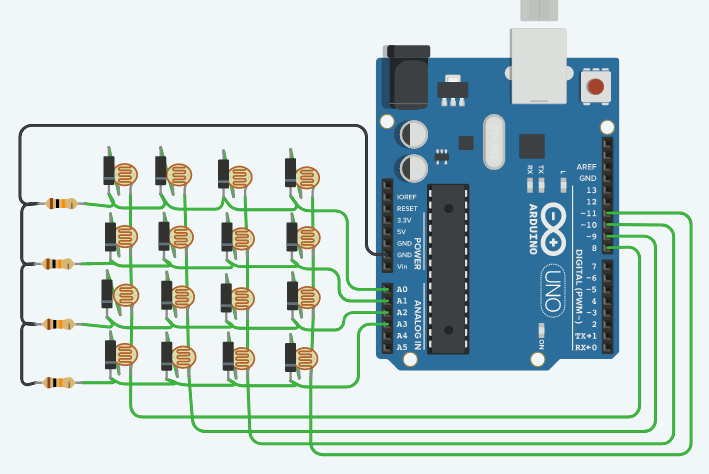
I did a simulation test in Tinkercad.com with an Arduino Uno and 4x4 matrix of LDR without and with diodes.
Without diodes:
With one column 5V and the other columns open.
All LDRs dark:
54, 54, 54, 54,
54, 54, 54, 54,
54, 54, 54, 54,
54, 54, 54, 54,
One LDR gets full light:
963, 88, 88, 88,
54, 54, 54, 54,
54, 54, 54, 54,
54, 54, 54, 54,
With one column 5V and the other columns 0V.
All LDRs dark:
47, 47, 47, 47,
47, 47, 47, 47,
47, 47, 47, 47,
47, 47, 47, 47,
One LDR gets full light:
960, 46, 46, 46,
3, 54, 54, 54,
3, 54, 54, 54,
3, 54, 54, 54,
(perhaps I have made a mistake here and the "54" should be "47" ?)
Then I tried to add diodes to every LDR:
With one column 5V and the other columns open.
All LDRs dark:
49, 49, 49, 49,
49, 49, 49, 49,
49, 49, 49, 49,
49, 49, 49, 49,
One LDR gets full light:
869, 49, 49, 49,
49, 49, 49, 49,
49, 49, 49, 49,
49, 49, 49, 49,
With one column 5V and the other columns 0V.
All LDRs dark:
49, 49, 49, 49,
49, 49, 49, 49,
49, 49, 49, 49,
49, 49, 49, 49,
One LDR gets full light:
869, 49, 49, 49,
49, 49, 49, 49,
49, 49, 49, 49,
49, 49, 49, 49,
That confirms that the diodes do help. Without diodes and setting the other columns LOW (0V), the change to the other LDRs is only a little. Perhaps that is good enough. Perhaps someone can make a calculation to get rid of it.
const int n = 4;   // matrix size

// columns are digital pins
const int colPins[n] = { 8, 9, 10, 11 };

// rows are analog inputs with 10k resistor to GND.
const int rowPins[n] = { A0, A1, A2, A3 };

int ldr[n][n];

void setup()
{
  Serial.begin( 9600);
  Serial.println( "LDR Matrix sketch");

  for( int i=0; i<n; i++)
  {
//    pinMode( colPins[i], INPUT);
    pinMode( colPins[i], OUTPUT);
    digitalWrite( colPins[i], LOW);
  }
}

void loop()
{
  // retrieve all LDR values.
  fillLdrMatrix();

  // print all LDR values.
  Serial.println( "----------------");
  for( int i=0; i<n; i++)
  {
    for( int j=0; j<n; j++)
    {
      Serial.print( ldr[i][j]);
      Serial.print( ", ");
    }
    Serial.println();
  }

  delay( 1000);
}

void fillLdrMatrix()
{
  // One colum gets 5V, then four rows can be read.
  for( int i=0; i<n; i++)
  {
    pinMode( colPins[i], OUTPUT);
    digitalWrite( colPins[i], HIGH);

    for( int j=0; j<n; j++)
    {
      ldr[i][j] = analogRead( rowPins[j]);
    }

//    pinMode( colPins[i], INPUT);
    pinMode( colPins[i], OUTPUT);
    digitalWrite( colPins[i], LOW);
  }
}