I had another thread going that finally ended up with this basic question so I'm restating the problem here to get a fresh start.
The goal is to measure water pressure at a depth of 1 to 3 ft.
So, I've got a pressure sensor on a dock. I have a tube from the sensor pressure port to a point 2 feet (+/- 1 ft) under water. But that doesn't work. If there is air in the tube then the air raises the pressure in the tube when/if the temperature rises. If the tube is completely filled with water then gravity causes a negative pressure at the sensor. Locating the sensor at the point of measurement (2' under) might work but the sensor wiring would have to be made waterproof. I don't think the sensor was intended to be used under water or it would have been made waterproof. Still, it might work with some effort.
The primary difference between atmospheric (absolute) pressure sensors and gauge pressure sensors lies in the reference point they use for measuring pressure. Here's a detailed explanation:
1. Atmospheric (Absolute) Pressure Sensor
Reference Point: Measures pressure relative to a perfect vacuum (absolute zero pressure).
Output: Always includes atmospheric pressure. For example, at sea level, where atmospheric pressure is approximately 101.3 kPa (14.7 psi), an absolute pressure sensor would show this value when there is no additional pressure applied.
Uses: Commonly used in applications requiring precise measurements of pressure regardless of ambient conditions, such as in:
Weather monitoring (barometers).
Altitude measurement in aircraft.
Vacuum systems.
Example:
If the atmospheric pressure is 101.3 kPa and the system is at sea level with no added pressure, the sensor reads 101.3 kPa.
If a perfect vacuum is applied, the sensor reads 0 kPa.
2. Gauge Pressure Sensor
Reference Point: Measures pressure relative to the ambient atmospheric pressure.
Output: Shows the pressure difference above or below atmospheric pressure. A gauge pressure of 0 indicates it is equal to the surrounding atmospheric pressure.
Uses: Commonly used in applications where the pressure is measured relative to the local atmospheric pressure, such as:
Tire pressure gauges.
Hydraulic systems.
Compressors.
Example:
If the atmospheric pressure is 101.3 kPa and the system is at atmospheric pressure, the sensor reads 0 kPa.
If a pressurized system has 150 kPa (absolute pressure), the gauge sensor reads 48.7 kPa (150 kPa - 101.3 kPa).
Comparison
Feature
Absolute Pressure Sensor
Gauge Pressure Sensor
Reference
Perfect vacuum
Ambient atmospheric pressure
Reading at Vacuum
0 kPa
-101.3 kPa (at sea level)
Reading at Atmosphere
101.3 kPa (at sea level)
0 kPa
Applications
Barometers, altitude measurement, vacuums
Tire pressure, hydraulics, compressors
3. Differential Pressure Sensor
A related type of sensor measures the difference in pressure between two points, with no fixed reference. These are useful in applications like:
Hopefully this helps, that is a lot of words stating the difference is the reference point. In your case the level will change with the barometer if you use an absolute sensor.
Thanks for that info gil. If that physics book is old enough I probably read it in high school.
And that's why I thought gauge pressure would be what I needed.
Anyway for what I'm trying to do, natural air pressure variations are the least of my worries. If I get an inch or 2 resolution I think I'll be happy. After all, if the thing says the wave height is 11" but it's really 12" I'm still going to know what kind of a ride to expect when out on my boat, even though all I have to do to know that is to look at the water. Projects like this are what you do when you're retired.
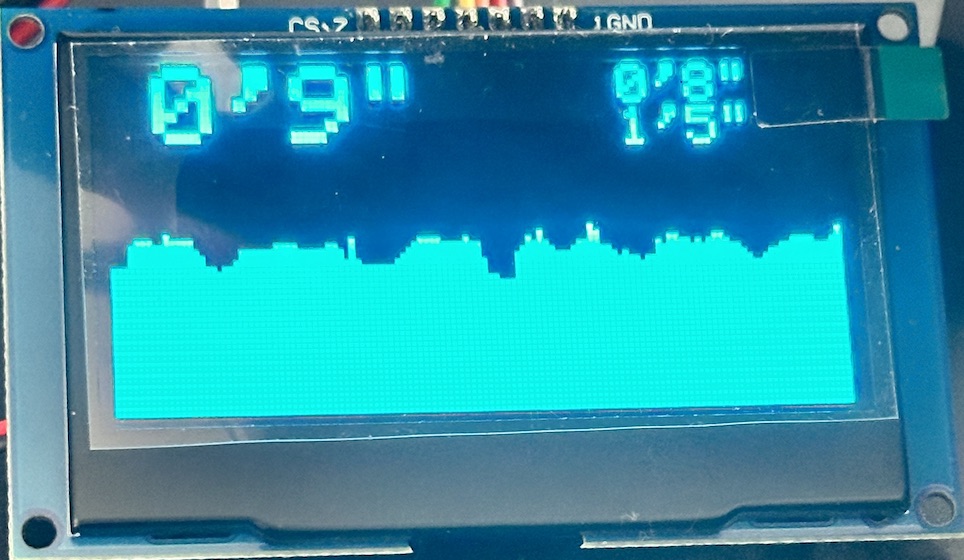
In case you're curious this is the output from my previous wavemeter, the one that measured the distance from the dock to the water using sonar. 9" wave height over past 20 seconds, average wave height of 8" over past 2 hours, peak wave height of 1'5" over past 2 hours.
Because that one was totally destroyed by hurricane Milton. Rather to rebuild it I thought I would try a different method because the buoy collected so many barnacles that the buoy became heavy and slow to respond.
Sadly, that one can remain submerged for a day, or else drift is an issue. If you can tolerate some drift, maybe it would be fine for you. If the sample rate is fast enough.
You should build the test to show the environment when in use. Your boat does not react like a ball. It acts like the device in post #11 from your other topic with the same subject.
I just ordered and received a 3x3 copper wire mesh to be used to encase the sensor if I placed it under water.... but now, maybe what I should do is to cover the bottom of the buoy with that copper mesh and do the sonar method again. Copper is kryptonite to a barnacle.