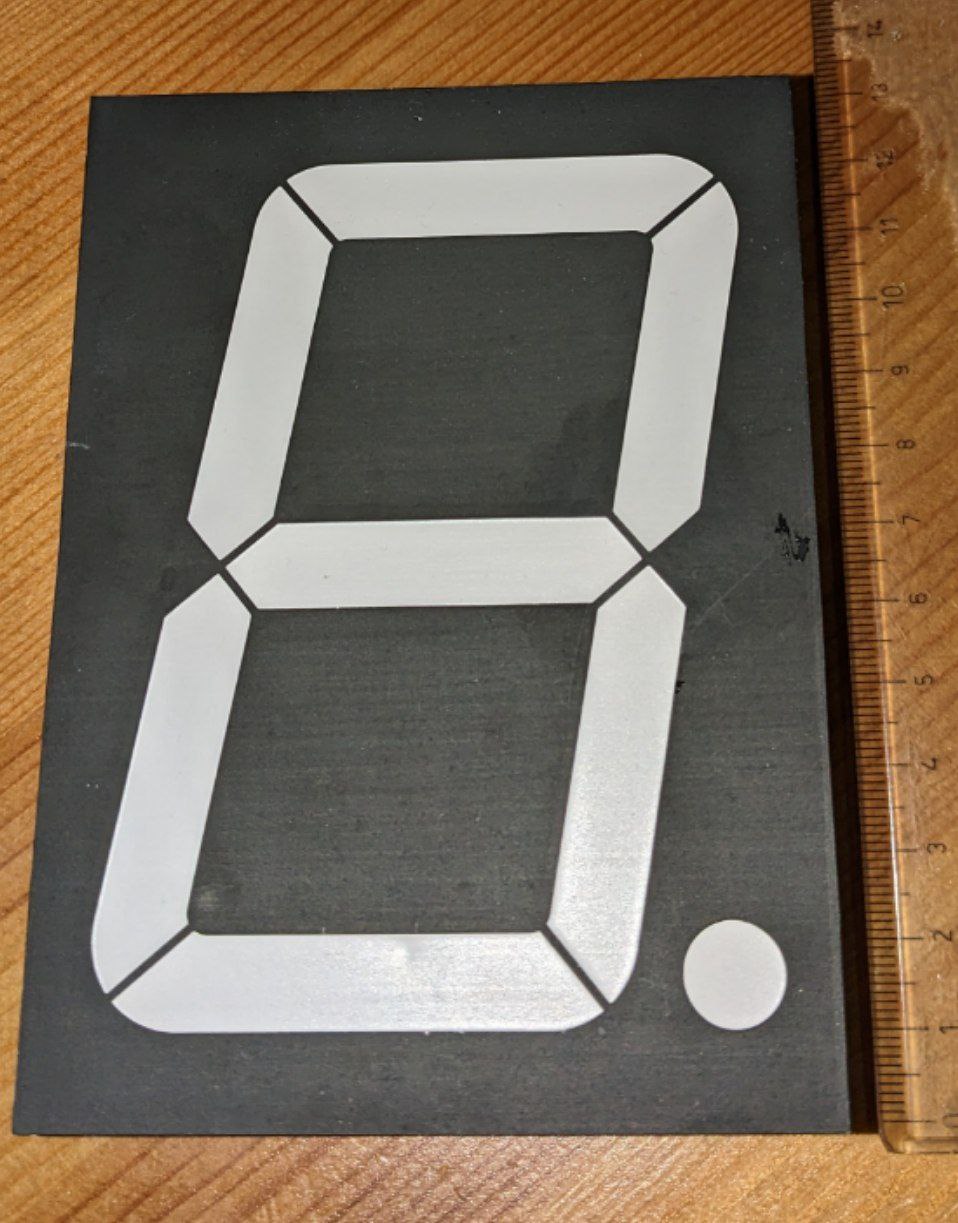
Hi everyone!
I bought some very large 7 segment displays, with following current specifications:
Forward Current Per Segment: 30mA
Peak Forward Current Per Segment (Duty 1/10, 1KHZ): 150mA
I would like to connect 5 of them to an Arduino board, to display numbers from 00000 to 99999. I don't have an Arduino for that yet.
My question is: How do you suggest I connect it? Using a specific driver? Do I find anything that already supports that current?
I also have to choose my arduino, and I will need it to connect to the internet to curl a web page where I store the number to be shown on the display. So every suggestion about what board I should buy is very welcome, considering it will also have to connect to a wifi board (or have native wifi).
I suggest to use a ESP32 board as controller; it's easy to program with the Arduino IDE, provides Wifi and a lot of RAM and is not very expensive. And you will find a lot of examples/projects that may already deal with your requirements ... like e.g. Use of Lib CURL with ESP32
5 x 7 segment need 35 IO. ESP don't have that. Then you must going multiplexing.
5 IO display control + 7 IO A-G segment = 12 IO.
7 x 30mA = 210mA/display. That is to much for the controller. The ULN2003 (7 IO) or ULN2008 (8 IO) as (sinking) driver for CA display's is OK but then you need a source driver like MIC2981 too.
Contra, you must do the multiplexing in software. A little hookup in the code you can see the brightness difference.
The MAX7219 do the multiplexing for the user. Every digit is even bright. Only 3 IO to use.
I agree that the MAX7219 is easier to use (have some in my stock ).
As the TO has already bought some displays, it might be a solution to use the ULN2003 ...
But I also fully agree with you that multiplexing has an issue with brightness! Your code has to be non-blocking and that makes things sometimes more difficult. With an ESP32 it might be interesting to use FreeRTOS ... ?!?
It still way complicate than led matrices
LED panels not needs any additional chips, has very easy connections and can be very large (up to few meters high) for quite moderate prices.
Of course not.
One LED matrix contains at least 512 pixels. How much would it take 7219 for it? There are more smart drivers have been known for a long time.
But the main thing is that they are already built into the matrix, you don’t need to solder or wire anything
I would like to use 5 of this elements, that I already have, instead of other types of displays. I also add a detail I forgot: I will need a free digital out pin for another use, so I should consider that wen I choose the board.
The voltage needed to drive this display is too high for most above solutions.
The common way to drive these is with a shift register chip from the TPIC family. Read this.
Beware of using an ESP.
These are 5-volt logic only chips.
Leo..