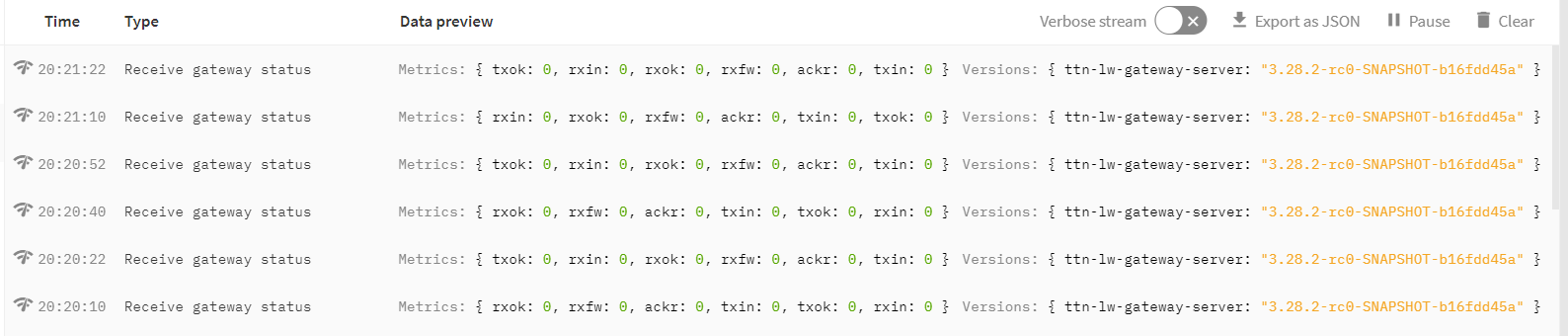
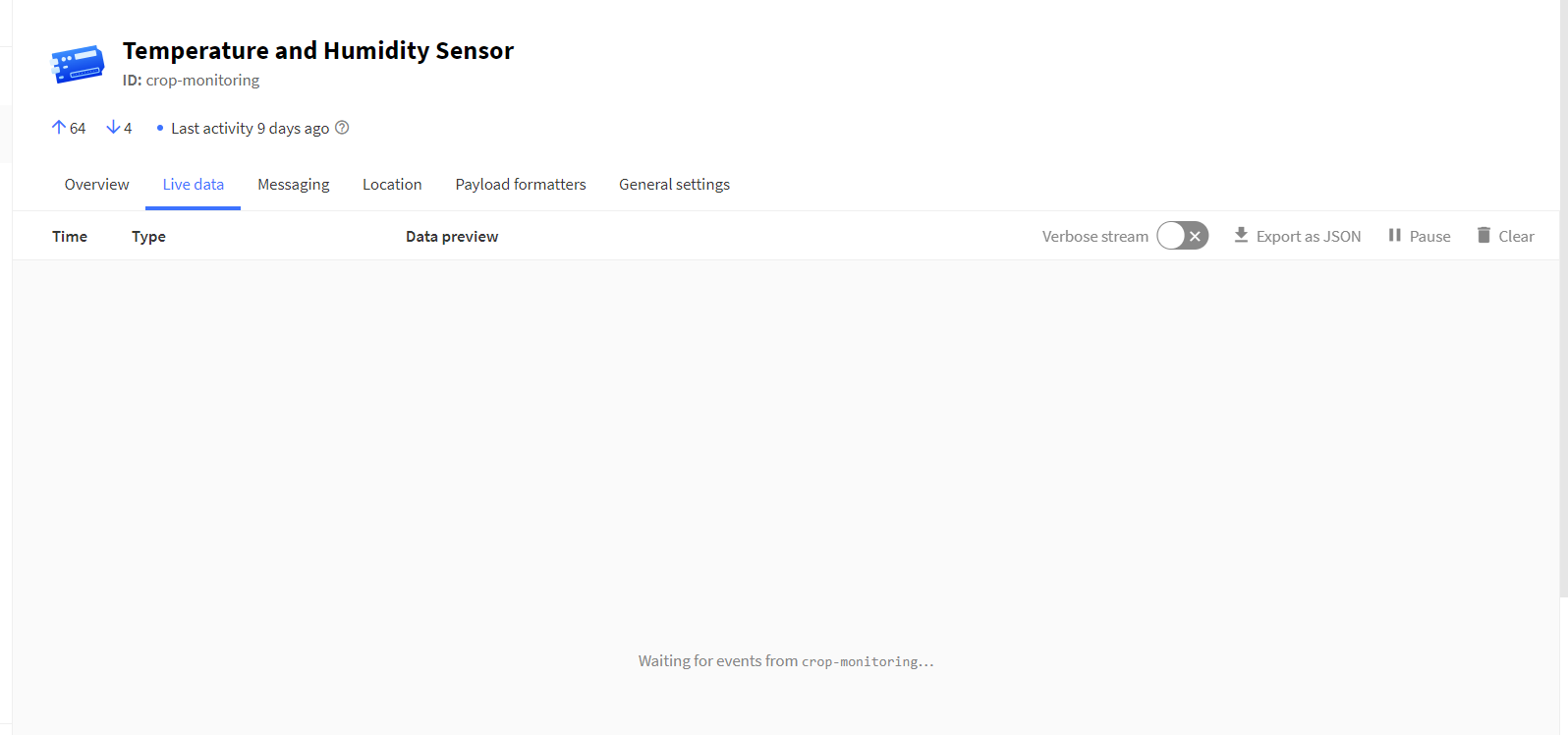
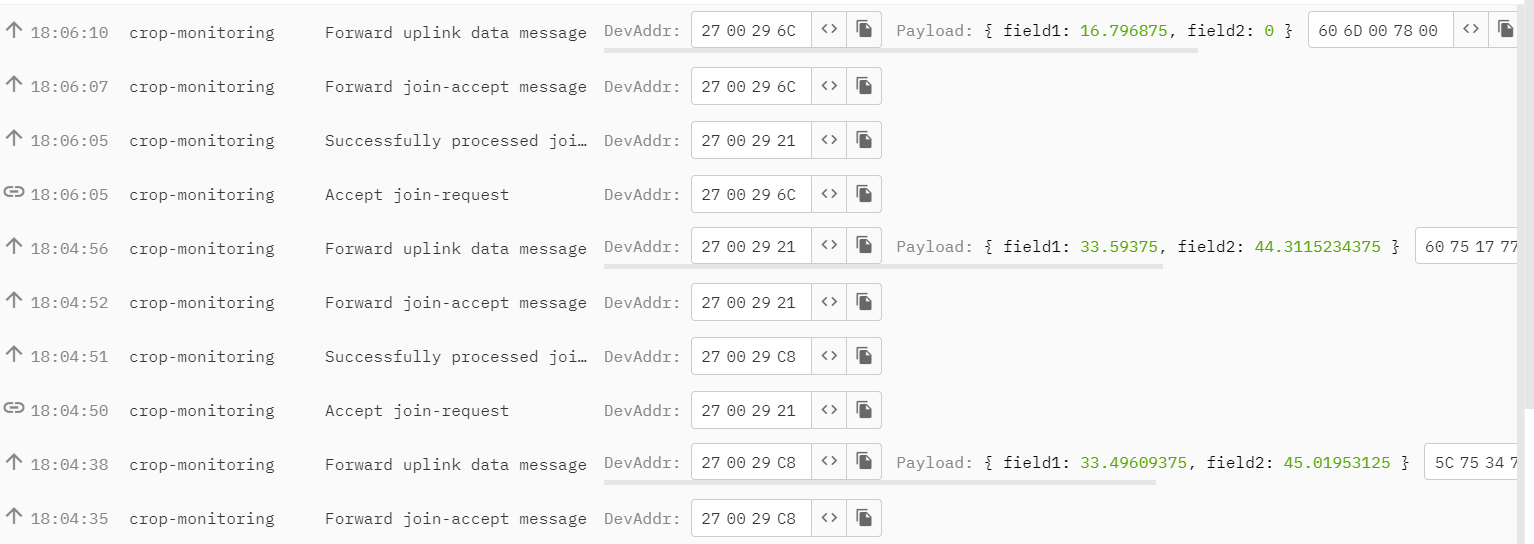
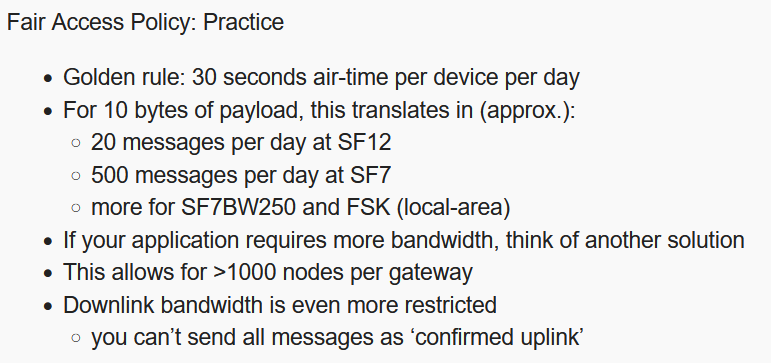
Hi! I'm trying to send a packet with DHT22 temperature and humidity data to The Things Network using LoRa. Here's the code I'm using:
/*******************************************************************************
 * The Things Network - Sensor Data Example
 *
 * Example of sending a valid LoRaWAN packet with DHT22 temperature and
 * humidity data to The Things Networ using a Feather M0 LoRa.
 *
 * Learn Guide: https://learn.adafruit.com/the-things-network-for-feather
 *
 * Copyright (c) 2015 Thomas Telkamp and Matthijs Kooijman
 * Copyright (c) 2018 Terry Moore, MCCI
 * Copyright (c) 2018 Brent Rubell, Adafruit Industries
 *
 * Permission is hereby granted, free of charge, to anyone
 * obtaining a copy of this document and accompanying files,
 * to do whatever they want with them without any restriction,
 * including, but not limited to, copying, modification and redistribution.
 * NO WARRANTY OF ANY KIND IS PROVIDED.
 *******************************************************************************/
#include <lmic.h>
#include <hal/hal.h>
#include <SPI.h>

// include the DHT22 Sensor Library
#include "DHT.h"

// DHT digital pin and sensor type
#define DHTPIN 7
#define DHTTYPE DHT22

//
// For normal use, we require that you edit the sketch to replace FILLMEIN
// with values assigned by the TTN console. However, for regression tests,
// we want to be able to compile these scripts. The regression tests define
// COMPILE_REGRESSION_TEST, and in that case we define FILLMEIN to a non-
// working but innocuous value.
//
#ifdef COMPILE_REGRESSION_TEST
#define FILLMEIN 0
#else
#warning "You must replace the values marked FILLMEIN with real values from the TTN control panel!"
#define FILLMEIN (#dont edit this, edit the lines that use FILLMEIN)
#endif

// This EUI must be in little-endian format, so least-significant-byte
// first. When copying an EUI from ttnctl output, this means to reverse
// the bytes. For TTN issued EUIs the last bytes should be 0xD5, 0xB3,
// 0x70.
static const u1_t PROGMEM APPEUI[8] = { 0x34, 0x34, 0x34, 0x12, 0x12, 0x12, 0x12, 0x12 };
void os_getArtEui (u1_t* buf) { memcpy_P(buf, APPEUI, 8);}

// This should also be in little endian format, see above.
static const u1_t PROGMEM DEVEUI[8] = { 0xF0, 0x21, 0x00, 0xD8, 0x7E, 0xD5, 0xB3, 0x70 };
void os_getDevEui (u1_t* buf) { memcpy_P(buf, DEVEUI, 8);}

// This key should be in big endian format (or, since it is not really a
// number but a block of memory, endianness does not really apply). In
// practice, a key taken from the TTN console can be copied as-is.
static const u1_t PROGMEM APPKEY[16] = { 0x01, 0x7F, 0x12, 0x8B, 0xC8, 0x32, 0x73, 0x2D, 0x0F, 0xFC, 0x38, 0x0C, 0x98, 0x8B, 0xD4, 0x0D };
void os_getDevKey (u1_t* buf) {  memcpy_P(buf, APPKEY, 16);}

// payload to send to TTN gateway
static uint8_t payload[5];
static osjob_t sendjob;

// Schedule TX every this many seconds (might become longer due to duty
// cycle limitations).
const unsigned TX_INTERVAL = 10;

// Pin mapping for Adafruit Feather M0 LoRa
const lmic_pinmap lmic_pins = {
    .nss = 10,
    .rxtx = LMIC_UNUSED_PIN,
    .rst = 9,
    .dio = {3,4,5},
    .rxtx_rx_active = 0,
    .rssi_cal = 0,              // LBT cal for the Adafruit Feather M0 LoRa, in dB
    .spi_freq = 1000000,
};

// init. DHT
DHT dht(DHTPIN, DHTTYPE);

void onEvent (ev_t ev) {
    Serial.print(os_getTime());
    Serial.print(": ");
    switch(ev) {
        case EV_SCAN_TIMEOUT:
            Serial.println(F("EV_SCAN_TIMEOUT"));
            break;
        case EV_BEACON_FOUND:
            Serial.println(F("EV_BEACON_FOUND"));
            break;
        case EV_BEACON_MISSED:
            Serial.println(F("EV_BEACON_MISSED"));
            break;
        case EV_BEACON_TRACKED:
            Serial.println(F("EV_BEACON_TRACKED"));
            break;
        case EV_JOINING:
            Serial.println(F("EV_JOINING"));
            break;
        case EV_JOINED:
            Serial.println(F("EV_JOINED"));
            {
              u4_t netid = 0;
              devaddr_t devaddr = 0;
              u1_t nwkKey[16];
              u1_t artKey[16];
              LMIC_getSessionKeys(&netid, &devaddr, nwkKey, artKey);
              Serial.print("netid: ");
              Serial.println(netid, DEC);
              Serial.print("devaddr: ");
              Serial.println(devaddr, HEX);
              Serial.print("artKey: ");
              for (int i=0; i<sizeof(artKey); ++i) {
                if (i != 0)
                  Serial.print("-");
                Serial.print(artKey[i], HEX);
              }
              Serial.println("");
              Serial.print("nwkKey: ");
              for (int i=0; i<sizeof(nwkKey); ++i) {
                      if (i != 0)
                              Serial.print("-");
                      Serial.print(nwkKey[i], HEX);
              }
              Serial.println("");
            }
            // Disable link check validation (automatically enabled
            // during join, but because slow data rates change max TX
      // size, we don't use it in this example.
            LMIC_setLinkCheckMode(0);
            break;
        /*
        || This event is defined but not used in the code. No
        || point in wasting codespace on it.
        ||
        || case EV_RFU1:
        ||     Serial.println(F("EV_RFU1"));
        ||     break;
        */
        case EV_JOIN_FAILED:
            Serial.println(F("EV_JOIN_FAILED"));
            break;
        case EV_REJOIN_FAILED:
            Serial.println(F("EV_REJOIN_FAILED"));
            break;
            break;
        case EV_TXCOMPLETE:
            Serial.println(F("EV_TXCOMPLETE (includes waiting for RX windows)"));
            if (LMIC.txrxFlags & TXRX_ACK)
              Serial.println(F("Received ack"));
            if (LMIC.dataLen) {
              Serial.println(F("Received "));
              Serial.println(LMIC.dataLen);
              Serial.println(F(" bytes of payload"));
            }
            // Schedule next transmission
            os_setTimedCallback(&sendjob, os_getTime()+sec2osticks(TX_INTERVAL), do_send);
            break;
        case EV_LOST_TSYNC:
            Serial.println(F("EV_LOST_TSYNC"));
            break;
        case EV_RESET:
            Serial.println(F("EV_RESET"));
            break;
        case EV_RXCOMPLETE:
            // data received in ping slot
            Serial.println(F("EV_RXCOMPLETE"));
            break;
        case EV_LINK_DEAD:
            Serial.println(F("EV_LINK_DEAD"));
            break;
        case EV_LINK_ALIVE:
            Serial.println(F("EV_LINK_ALIVE"));
            break;
        /*
        || This event is defined but not used in the code. No
        || point in wasting codespace on it.
        ||
        || case EV_SCAN_FOUND:
        ||    Serial.println(F("EV_SCAN_FOUND"));
        ||    break;
        */
        case EV_TXSTART:
            Serial.println(F("EV_TXSTART"));
            break;
        default:
            Serial.print(F("Unknown event: "));
            Serial.println((unsigned) ev);
            break;
    }
}

void do_send(osjob_t* j){
    // Check if there is not a current TX/RX job running
    if (LMIC.opmode & OP_TXRXPEND) {
        Serial.println(F("OP_TXRXPEND, not sending"));
    } else {
        // read the temperature from the DHT22
        float temperature = dht.readTemperature();
        Serial.print("Temperature: "); Serial.print(temperature);
        Serial.println(" *C");
        // adjust for the f2sflt16 range (-1 to 1)
        temperature = temperature / 100;

        // read the humidity from the DHT22
        float rHumidity = dht.readHumidity();
        Serial.print("%RH ");
        Serial.println(rHumidity);
        // adjust for the f2sflt16 range (-1 to 1)
        rHumidity = (0.8899*rHumidity) - 9;

        // float -> int
        // note: this uses the sflt16 datum (https://github.com/mcci-catena/arduino-lmic#sflt16)
        uint16_t payloadTemp = LMIC_f2sflt16(temperature);
        // int -> bytes
        byte tempLow = lowByte(payloadTemp);
        byte tempHigh = highByte(payloadTemp);
        // place the bytes into the payload
        payload[0] = tempLow;
        payload[1] = tempHigh;

        // float -> int
        uint16_t payloadHumid = LMIC_f2sflt16(rHumidity);
        // int -> bytes
        byte humidLow = lowByte(payloadHumid);
        byte humidHigh = highByte(payloadHumid);
        payload[2] = humidLow;
        payload[3] = humidHigh;

        // prepare upstream data transmission at the next possible time.
        // transmit on port 1 (the first parameter); you can use any value from 1 to 223 (others are reserved).
        // don't request an ack (the last parameter, if not zero, requests an ack from the network).
        // Remember, acks consume a lot of network resources; don't ask for an ack unless you really need it.
        LMIC_setTxData2(3, (xref2u1_t)(payload), sizeof(payload), 0);
    }
    // Next TX is scheduled after TX_COMPLETE event.
}

void setup() {
    delay(5000);
    while (! Serial);
    Serial.begin(9600);
    Serial.println(F("Starting"));

    dht.begin();

    // LMIC init
    os_init();
    // Reset the MAC state. Session and pending data transfers will be discarded.
    LMIC_reset();
    LMIC_setClockError(MAX_CLOCK_ERROR * 1 / 100);
    // Disable link-check mode and ADR, because ADR tends to complicate testing.
    LMIC_setLinkCheckMode(0);
    // Set the data rate to Spreading Factor 7.  This is the fastest supported rate for 125 kHz channels, and it
    // minimizes air time and battery power. Set the transmission power to 14 dBi (25 mW).
    LMIC_setDrTxpow(DR_SF7,14);


    // Start job (sending automatically starts OTAA too)
    do_send(&sendjob);
}

void loop() {
  // we call the LMIC's runloop processor. This will cause things to happen based on events and time. One
  // of the things that will happen is callbacks for transmission complete or received messages. We also
  // use this loop to queue periodic data transmissions.  You can put other things here in the `loop()` routine,
  // but beware that LoRaWAN timing is pretty tight, so if you do more than a few milliseconds of work, you
  // will want to call `os_runloop_once()` every so often, to keep the radio running.
  os_runloop_once();
}
However, the output in the serial monitor shows a join and start loop and the sensor can't connect to TTN.