Can you share the link where you've ordered your servos?
How many GPIO's you've used for each servo? 
I bought the metal geared servos from Amazon, Amazon.com : metal geared servo
1 Like
Very interesting...
For the project of my group it wouldnt be necessary to include machine learning...
It would be ( because we are just "newbies" ) very hard to deal with such a problem 
Thank you very much! 
1 Like
Plastic geared servos do not have an accurate movement repeatability as do metal geared servos. Also the plastic wears out after 100 or so hours of continuous operations. I got some metal geared hobby grade servos in continuous operation for over 3 years.
sounds plausible... 
An esp32 has two processor cores, each of which is 10 times faster than Mega's, and they are 32-bit compared to Mega's 8-bit. There is far more ram memory and flash memory. The only thing the esp has less of is pins. The number of pins can be extended using I/o extender chips/modules of various kinds.
Depending on the type of driver module you use for stepper motors, they can require up to 4 Arduino pins per motor. Better driver modules use less pins, possibly sharing the same 2 pins between several driver modules (those with i²c bus).
Servo motors usually have drivers built in and require only a single Arduino pin, although it must be a PWM capable pin. Some i/o extender modules can be used to increase the number of pwm capable pins (such as pca9685).
That sounds quit good...
Thank you very much!
Controlling 32 Servo motors with PCA9685 and ESP32 - V4 - YouTube
How in the video above I am going to do a similiar thing with the roboter arm 
Would an MG996R be recommendable?
Like:
Amazon.com: [4-Pack] MG996R 55g Metal Gear Torque Digital Servo Motor for Futaba JR RC Helicopter Car Boat Robot : Toys & Games
Quite. Quit means give up.
I didnt meant that, I meant something like... very good it wasnt ironic 
I watched

using this sensor
https://de.aliexpress.com/item/1005002969955647.html
I ordered one, but have not played with it yet.
This is how you can go using I2C Bus (Fig-1).
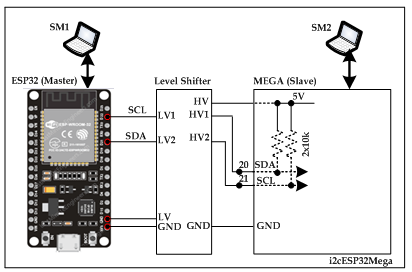
Figure-1:
Test Sketches:
Master:
#include <Wire.h>

void setup()
{
  Serial.begin(115200);
  Wire.begin(21, 22); //SDA, SCL

  //-------------------------
  Wire.beginTransmission(0b0010011);  //slave address
  byte busStatus = Wire.endTransmission();
  if (busStatus != 0)
  {
    Serial.print("Communication problem...!");
    while (1);
  }
  Serial.println("Slave found...!");
}

void loop()
{
  Wire.requestFrom(0x13, 1);
  Serial.println(Wire.read(), HEX);
  delay(1000);
}
Slave:
#include <Wire.h>

void setup()
{
  Serial.begin(115200);
  Wire.begin(0b0010011); //0x20
  Wire.onRequest(sendEvent);
}

void loop(){}

void sendEvent()
{
  Wire.write(0x31);
}
This topic was automatically closed 180 days after the last reply. New replies are no longer allowed.