/*#include <LiquidCrystal.h>

// LCD Pins: {RS, E, D4, D5, D6, D7};
LiquidCrystal lcd{10, 4, 8, 7, 6, 2};*/

// constants won't change. Used here to set a pin number:
const int ledPin =  3;// the Pin number of the LED
const int led2Pin = 5;// the Pin number of LED 2
const int led3Pin = 9;
const int led4Pin = 11;

// Flankenerkennungsvariablen

bool Aufsteigend1 = 0;
bool Fallend1 = 0;
bool Aufsteigend2 = 0;
bool Fallend2 = 0;
bool Aufsteigend3 = 0;
bool Fallend3 = 0;
bool Aufsteigend4 = 0;
bool Fallend4 = 0;
bool Aufsteigend[] = {NULL, Aufsteigend1, Aufsteigend2, Aufsteigend3, Aufsteigend4};
bool Fallend[] = {NULL, Fallend1, Fallend2, Fallend3, Fallend4};
//bool LED = 0;

// Flash() Variablen

bool halt1 = 0;
bool halt2 = 0;
bool halt3 = 0;
bool halt4 = 0;
bool halt[] = {NULL, halt1, halt2, halt3, halt4};

double flash = 0;
bool LED1 = 0;
bool LED2 = 0;
bool LED3 = 0;
bool LED4 = 0;
bool LED[] = {NULL, LED1, LED2, LED3, LED4};

// Variables will change:
bool ledState = LOW;             // ledState used to set the LED
bool ledState2 = LOW;            // ledState2 für die zweite LED
bool ledState3 = LOW;
bool ledState4 = LOW;

bool ledStates[] = {ledState, ledState2, ledState3, ledState4};

// constants won't change:
double x;                     // Die Frequenz die geblinkt werden soll

//Const für Blink1
long previousMillis;        // will store last time LED was updated

//Const für Blink2
long previousMillis2;

//Const für Blink3
long previousMillis3;
long previousMillis4;
long previousMillis5;

//Const Testprogramm
  int Stopp1;
  int Stopp2;
  int Stopp3;
  int Stopp4;
  int Stopp5;
  int Stopper;
  int Stopp[] = {Stopp1, Stopp2, Stopp3, Stopp4, Stopp5};
  int Stopperer;

  int Abschnitt;

// Frequenzabhängige Switch Case
int auswahl; //Je nach Frequenz wird hier die passende Blinkfunktion ausgewählt, damit keine LED durchgehend an ist
bool initial = 0;

// PROGRAMMSTART

void setup() {
  // set the digital pin as output:
  pinMode(ledPin, OUTPUT);
  pinMode(led2Pin, OUTPUT);
  Serial.begin(500000);

}


void loop() {

 x = 10;

 BlinkAuswahl();

}

void Blink1(){

   long currentMillis = millis();
   double Hertz = (1 / x) * 500;    // Hertz Intervall wird berechnet
   double interval = Hertz;           // interval at which to blink (milliseconds) in Hz

   while(initial != 1){
    previousMillis = currentMillis;
    initial = 1;
   }

if (currentMillis - previousMillis >= interval) {
    // save the last time you blinked the LED
      previousMillis = currentMillis;

      //Flankenerkennung innerhalb der if-Schleife, die hier als Clock Signal dient
      Flanke(1);
      }

      //Theoretisch jetzt ein Timer, in dem die ON/OFF Zeit für die LED rein soll
      Flash(1,1);

      ledState = LED[1];

  Serial.println("");
  Serial.print("CurrentTime: ");
  Serial.println(currentMillis);
  Serial.print("previousMillis: ");
  Serial.println(previousMillis);

    // set the LED with the ledState of the variable:
     digitalWrite(ledPin, ledState);
     digitalWrite(led2Pin, ledState);
     digitalWrite(led3Pin, ledState);
     digitalWrite(led4Pin, ledState);

   //Serial.println(previousMillis);
}

void Blink2(){

  double x_zwei = x / 2;             // Die Frequenz für den Timer nach dem ersten Split, damit kein durchflimmern vorliegt
  double Hertz2 = (1 / x_zwei) * 500;    // Hertz Intervall wird berechnet für Blink2
  double interval2 = Hertz2;
  long currentMillis = millis();

  while(initial != 1){
  previousMillis = currentMillis;
  previousMillis2 = currentMillis + Hertz2;
  initial = 1;
  }

  Serial.print("Interval: ");
  Serial.println(interval2);
  Serial.print("currentMillis: ");
  Serial.println(currentMillis);
  Serial.print("previousMillis: ");
  Serial.println(previousMillis);
  Serial.print("previousMillis2: ");
  Serial.println(previousMillis2);
  Serial.println("");

   if (currentMillis - previousMillis >= interval2) {
    // save the last time you blinked the LED
      previousMillis = currentMillis;

    Flanke(1);
   }

    Flash(1,2);

    ledState = LED[1];

    // set the LED with the ledState of the variable:
     digitalWrite(ledPin, ledState);
     digitalWrite(led3Pin, ledState);

     if (currentMillis - previousMillis2 >= interval2) {
    // save the last time you blinked the LED
      previousMillis2 = currentMillis;

      Flanke(2);
     }

     Flash(2,2);

     ledState2 = LED[2];

    // set the LED with the ledState of the variable:
     digitalWrite(led2Pin, ledState2);
     digitalWrite(led4Pin, ledState2);

}

void Blink3(){

  double x_drei = x / 4;                   // Die Frequenz für den ersten Timer im dritten Split
  double Hertz3 = (1 / x_drei) * 500;     // Hertz Intervall wird berechnet -> Das Intervall wird von der Insgesamtzahl auf 4 LEDs verteilt, da x_drei die Frequenz viertelt für Blink3
  double interval3 = Hertz3;
  long currentMillis = millis();

  while(initial != 1){
   previousMillis = currentMillis;
   previousMillis3 = currentMillis + (Hertz3 *2/ 4);      //Zweiter Timer für die zweite LED, die in den Pausen der ersten LED blinkt
   previousMillis4 = currentMillis + (Hertz3 *2/ 2);      //Zweiter Timer für die zweite LED, die in den Pausen der ersten LED blinkt
   previousMillis5 = currentMillis + (Hertz3 * 3 *2/ 4);  //Zweiter Timer für die zweite LED, die in den Pausen der ersten LED blinkt
   initial = 1;
  }

  Serial.println("");
  Serial.print("Intervall: ");
  Serial.println(interval3);
  Serial.print("CurrentTime: ");
  Serial.println(currentMillis);
  Serial.print("previousMillis: ");
  Serial.println(previousMillis);
  Serial.print("PreviousMillis3: ");
  Serial.println(previousMillis3);
  Serial.print("PreviousMillis4: ");
  Serial.println(previousMillis4);
  Serial.print("PreviousMillis5: ");
  Serial.println(previousMillis5);

if (currentMillis - previousMillis >= interval3) {
    // save the last time you blinked the LED
      previousMillis = currentMillis;
      Flanke(1);
   }

    Flash(1,3);
    ledState = LED[1];

    // set the LED with the ledState of the variable:
     digitalWrite(ledPin, ledState);

if (currentMillis - previousMillis3 >= interval3) {
    // save the last time you blinked the LED
      previousMillis3 = currentMillis;
      Flanke(2);
    }

    Flash(2,3);
    ledState2 = LED[2];

    // set the LED with the ledState of the variable:
     digitalWrite(led2Pin, ledState2);

 if (currentMillis - previousMillis4 >= interval3) {
    // save the last time you blinked the LED
      previousMillis4 = currentMillis;
      Flanke(3);
    }

    Flash(3,3);
    ledState3 = LED[3];
    // set the LED with the ledState of the variable:
     digitalWrite(led3Pin, ledState3);

 if (currentMillis - previousMillis5 >= interval3) {
    // save the last time you blinked the LED
      previousMillis5 = currentMillis;
      Flanke(4);
    }

    Flash(4,3);
    ledState4 = LED[4];
    // set the LED with the ledState of the variable:
     digitalWrite(led4Pin, ledState4);

}

void Flanke(int Speicher){
  if(Aufsteigend[Speicher] == 0){
    Aufsteigend[Speicher] = 1;
    Fallend[Speicher] = 0;
  }
  else{
   Aufsteigend[Speicher] = 0;
   Fallend[Speicher] = 1;
  }
}

void Flash(int Speicher, int Blink){      // Speicher ist die Vraiable, in der bei mehreren Flash-Zugriffen auf verschiedene Speicherbereiche zugegriffen werden soll, Blink ist dazu da um die Einschaltzeit für die LEDs zu berechnen
  long currentMillis = millis();
  double x_zwei = x / 2;
  double x_drei = x / 4;
  double Frequenz1 = (1 / x) * 500;
  double Frequenz2 = (1 / x_zwei) * 500;
  double Frequenz3 = (1 / x_drei) * 500;
  double Frequenz[] = {0, Frequenz1, Frequenz2, Frequenz3};
  double flashtime = Frequenz[Blink] / 10; //Zweite Variable wegen der Blink Funktion und entsprechender Frequenz zum blinken
  /*Serial.print("flashtime : ");
  Serial.println(flashtime);*/
  if(Aufsteigend[Speicher] == 1 && Fallend[Speicher] == 0){
        LED[Speicher] = 1;
        while(halt[Speicher] != 1){
          flash = currentMillis;
          halt[Speicher] = 1;
        }
        }

      if(currentMillis - flash >= flashtime){
        LED[Speicher] = 0;
      }

      if(Aufsteigend[Speicher] == 0 && Fallend[Speicher] == 1){
        halt[Speicher] = 0;
      }
}

//Vor jedem Programmwechsel bzw vor jedem Frequenzwechsel im Programm müssen alle Speicher und Werte zurückgesetzt werden.
void Reset(){

  // Initial muss für die nächsten Zeitabgriffe anderer Frequenzen zurückgesetzt werden.
  initial = 0;
  ledState = 0;
  ledState2 = 0;
  ledState3 = 0;
  ledState4 = 0;

  // Alle Flanken, halte-Variablen und LED States müssen zurückgesetzt werden. Sie werden im Programm in Form von Arrays gespeichert.
  for(int i = 0; i < 5; i++){  // Die Arrays haben alle 5 Einträge, da 4 Zustände und die 0 an erster Stelle
    Aufsteigend[i] = 0;
    Fallend[i] = 0;
    LED[i] = 0;
    halt[i] = 0;
    }

  // Die LEDs sollen bei x = 0 aus sein. Das geht nur, indem sie mit dem LED Wert überschrieben werden.
  digitalWrite(ledPin, LED[1]);
  digitalWrite(led2Pin, LED[2]);
  digitalWrite(led3Pin, LED[3]);
  digitalWrite(led4Pin, LED[4]);

}

void BlinkAuswahl(){
  if(x == 0)
  auswahl = 0;
  if(x>0 && x<10)
  auswahl = 1;
  if(x>=6&&x<14)
  auswahl = 2;
  if(x>=14)
  auswahl = 3;

  switch(auswahl){
    case 1:
      Blink1();
    break;
    case 2:
      Blink2();
    break;
    case 3:
      Blink3();
    break;
    case 0:
      Reset();
    break;
  }
}
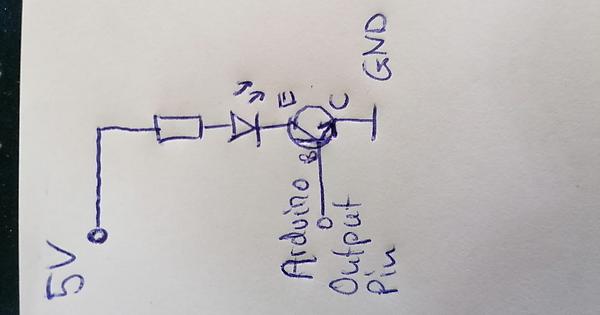
The sketch alone should be enough to see the shift. If you want to set up my build, it's just 4 LEDs with a resistor going from 5V to GND with a NPN Transistor C and E inbetween. The PIN Output connects to the base.