Hi, I want to ask you how to move a lever using arduino? I'm working on a project where I want to switch some kind of lever to activate pipes of a church organ. I have tried using some servos for this purpose but I'm not sure whether it is the right choice. The levers are a bit stiff and I was kind of in doubt whether the servos can survive this. Thank you in advance.
How much force is required to move the levers and over what distance ?
There are some very powerful servos available if required
The force required could be something around 6N to 8N and the range could be 1cm.
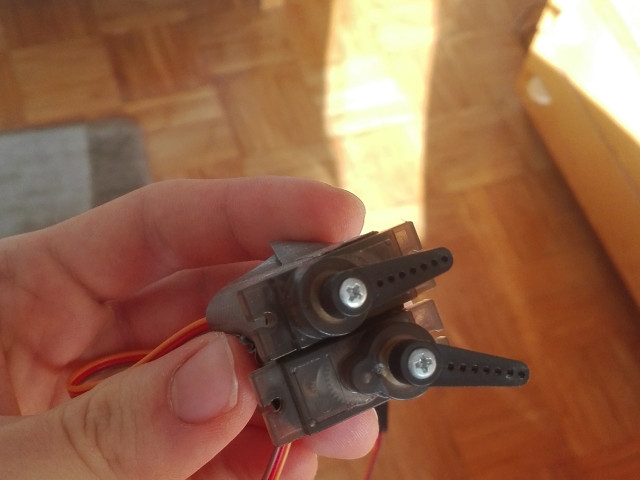
I have attached two pictures. In the first picture there are the levers i want to move and in the second one are two servos one on another, that are supposed to push the lever upwards or downwards. However, I can't make them stay in one place effectively, because the organ is a cultural monument and I mustn't drill any holes or put glue in it and I still haven't found the optimal mechanism of pushing the lever.
A linear actuator might be more suited. Attach a ring/loop to the actuator and place that around the pedal. You'd have positive control in both directions.
.02
With such short strokes, look at solenoids moving leather pads.
How fast does it have to move?
Do you need position control beyond the two extremes?
I'm also thinking of a solenoid.
If it doesn't have to be fast then a stepper turning a bolt in a frame (with leather pad on the moving end) could hold the pedal without using power. Metric coarse thread M 24 bolt advances 3mm per turn.
It doesn't have to be precise, it's just on or off. It has to be quite fast to respond, I guess 50ms max. It has to be manually operatable by the organist, because there are also levers for manual switching, so the servo or whatever I will be using mustn't be attached to the lever mechanism (or it can be attached, but it mustn't cause any resistance if the organist wants to switch it manually.)
I hope you can understand my explanation, I have a photo of the lever mechanism attached to the post. The black levers are operated directly by the organist and I want to place my system inside.
Is the solenoid powerful enough to move the lever? I saw them pushing some objects on Youtube but they couldn't push a tube of toothpaste, so I'm not sure whether it can push the mechanism. The linear actuator seems a bit expensive and I'm not sure it can move the lever without being attached to it.

wondrush:
It doesn't have to be precise, it's just on or off. It has to be quite fast to respond, I guess 50ms max.
A solenoid definitely qualifies for this. Solenoids come in many sizes and shapes; get one that's strong enough for your application.
It has to be manually operatable by the organist, because there are also levers for manual switching, so the servo or whatever I will be using mustn't be attached to the lever mechanism (or it can be attached, but it mustn't cause any resistance if the organist wants to switch it manually.)
That's an interesting requirement.
I assume the lever does not need any force to stay in place, its normal mechanism (friction?) taking care of that.
A reversible solenoid may be the solution for you. It has two coils - one for push, the other for pull. It seems they can move freely when not powered (can't get this confirmed on my searches), so that would allow the organist to move the valve freely. Power it for half a second or so to move it the way you want, then power down the solenoid for free movement. Of course if you want to know where the valve is at any time you need to add a separate position sensor, as the organist can move it without your project knowing.
These things are available in many sizes and stroke lengths.
wondrush:
It has to be manually operatable by the organist, because there are also levers for manual switching, so the servo or whatever I will be using mustn't be attached to the lever mechanism (or it can be attached, but it mustn't cause any resistance if the organist wants to switch it manually.)
So, two spring-return solenoids per pedal. One pushes to ON, the other to OFF. When not powered the next one to activate rests very lightly against the pedal.
OK, here are your images:

So, this is a standard mechanical organ stop mechanism. I can't say I am familiar with the amount of force needed to operate these as the organ which I maintain has a full electronic actuation and the stops are simple lever switches with solenoid up/ down action which the electronics multiplexes into the signal sent to the loft to operate the solenoids to the pipes.
I would have to visit the local Anglican church to get an idea of a full mechanical organ and that may not be similar to yours in any case.
wondrush:
The force required could be something around 6N to 8N and the range could be 1cm.
Of the order of 1 kg force. Need a fairly substantial servo for this - not sure whether your examples are "up" to this.
wondrush:
However, I can't make them stay in one place effectively, because the organ is a cultural monument and I mustn't drill any holes or put glue in it and I still haven't found the optimal mechanism of pushing the lever.
It will be a servo, as you need the gearing.
50 ms is overly optimistic and inappropriate, if the action completes in 250 ms that would be just fine. I trust your organist does not whack the stops but treats them with respect. Clearly you will have to construct a (wooden) "bridge" that mounts the servos over the area you show and simply locates itself to the present battens.
For each stop, you need one servo and an arm (3D printed) with two "fingers" which push the dowel I see projecting from each slider in alternate directions at each end of their travel, then return to the centre default position where neither finger obstructs the action.
I would appreciate some better pictures. I gather from further inspection that these stops appear to operate pneumatic valves which themselves presumably servo control larger valve sliders in the ranks, so their action is indeed quite light. You could apparently drop a (wooden/ plastic) elongated loop over the aforementioned pegs projecting form the slides, and have it moved back and forth by the servo lever. The slot in the loop would correspond to the length of the free travel when the servo is centred and the servo needs the leverage to move it just that distance in each direction.
There is - not surprisingly - a fair bit of engineering and craftsmanship involved. 
I think you may have to "take a punt" on your servos and start by building the "bridge" I describe to fit over the action with enough clearance to mount servos, and then work on one one action as a test case.
I will remember to get some better photos next Sunday. Well, the two servos could move it, so I guess less force is required to move those things than I previously thought.
I find the idea of the two fingers and a bridge pretty good since it would only need one servo to make it switch on and off and it would stay in place. I have some plywood left in the garage so the only thing I need to do is to measure the lenght of the bridge and get to work.
Do you think the 3D printed fingers wouldn't break? Is the 3D printed plastic durable enough to sustain this?
There are "jumbo" metal gear servos available @ 30Kg /cm with a quoted speed of 130ms for 60 degrees @6V supply.
If you could hack those cables and do it all with sensors and outputs it would be a LOT easier.
Perhaps with a pass-through with plug and socket if the cables have jacks, you wouldn't need to modify the cables as well.
You have the option of using ABS for 3D printing.
It doesn't break easily. Could be easiest to make a part which mounts over the current servo arm.
If you're afraid of breaking, make your 3D printed part thicker. ABS is quite strong but 3D printed it's not nearly as strong as moulded. Whether it's strong enough for your application we can't tell, you'd best try that out.
Keep in mind that servos are quite noisy. That may be a concern. Solenoids are more quiet.
The noise of the servos is not a big problem given fact that the organ makes louder noises when switching the levers.
I will take a look at the solenoids. Already ordered some but I haven't yet found out how to mount them properly.
The levers activate something that sends electric power or signal up to what drives the pipes?
GoForSmoke:
The levers activate something that sends electric power or signal up to what drives the pipes?
See my #10.
I did and then wrote #13 but I think more info needs to get dragged out and the OP to realize that this doesn't need to be a Rube Goldberg when you have Arduino.
Big point is that whatever is used can't interfere with the normal use of the stops. With mechanical or electro-mechanical solutions, that requirement adds complexity.
MCU's replace a lot of the old ways. Sometimes the old way may be simpler/cheaper but not so often.