i was looking at my project and involves 2 buttons and a passive speaker.. now with that said.. each item has 3 pins..
button 1 = gnd, vcc and takes up 1 pin on the arduino
button 2 = gnd, vcc and takes up a pin on the arduino
speaker = gnd, vcc and takes up 1 pin on the arduino
so, my question is: how can i connect the 3 vcc's and make it 1 and do the same for gnds.. considering the arduino only has 1 vcc yet 2 gnd's...
i was looking for a dupont splitter kinda thing.. but all i find is the same amt of pins and holes on each side

like i wanted 1 side as you see.. multiple females but the other side i only want 1 male
i mean i "could" solder them.. but rather find a connector like i'm describing.. if one even exists
1 Like
Have a look to the electric connectors in a store. I saw one-to-many connectors of various formats. They are not suitable for breadboards but could be added to jumpers to achieve one-to-many format. Have a look to my thread about wire managment in general electronics for pictures and more.
Or you could use the natural skills of the breadboard:
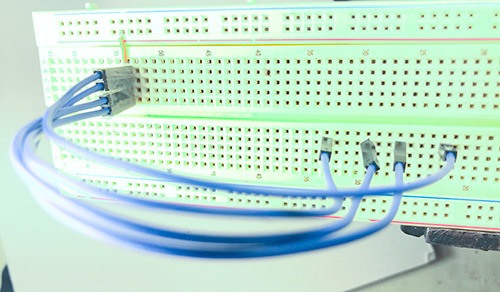
ps, Larry - that piece looks great! I'm gonna make some - thanks! (+1 Karma to larryd.)
that's exactly what i'm trying to avoid.. my project wouldn't require a breadboard for 3 little things 
Soldering is another long-standing method for joining wires.
...R
Mini-boards are also very good on this sort of connections. I use one to multiply one entry (GND).
But really depends on what connectors are available locally. I struggle to find wire nuts without much success by now :-((.
Jumpers are not a good idea for anything but prototyping - that's also where breadboards come in.
So when you know it works, get out that soldering iron to make proper, lasting connections, indeed soldering multiple wires to the pins, and then put it all in a nice little case.
I am thinking to soldering wires to perf to compromise clear view and durability. But in my case is about educational purposes, so it may not apply to other uses.
wvmarle:
Jumpers are not a good idea for anything but prototyping - that's also where breadboards come in.
So when you know it works, get out that soldering iron to make proper, lasting connections, indeed soldering multiple wires to the pins, and then put it all in a nice little case.
trust me, i have a few things that i would like to do that to but i'm not gonna use an arduino for each, when i get better (if, i get better) at this stuff i'll look into minis.. battery voltages will be a struggle for me as i do no know how much juice is required for each to last a long time to use one of my projects.
T_Ramen:
... battery voltages will be a struggle for me as i do no know how much juice is required for each to last a long time to use one of my projects.
It depends on what you are doing, of course. My three rules of thumb for battery life are: less voltage, less megahertz, and less peripherals. Oops, four: plenty of sleep.
ChrisTenone:
Oops, four: plenty of sleep.
Looking at your avatar it seems like this is not the only time you forget about that fourth rule 
wvmarle:
Looking at your avatar it seems like this is not the only time you forget about that fourth rule
I suspect Chris will tell you that his Avatar is actually a mirror.
...R
I just laughed, looked at it again, and no change
That is an actual picture of me waking up!

