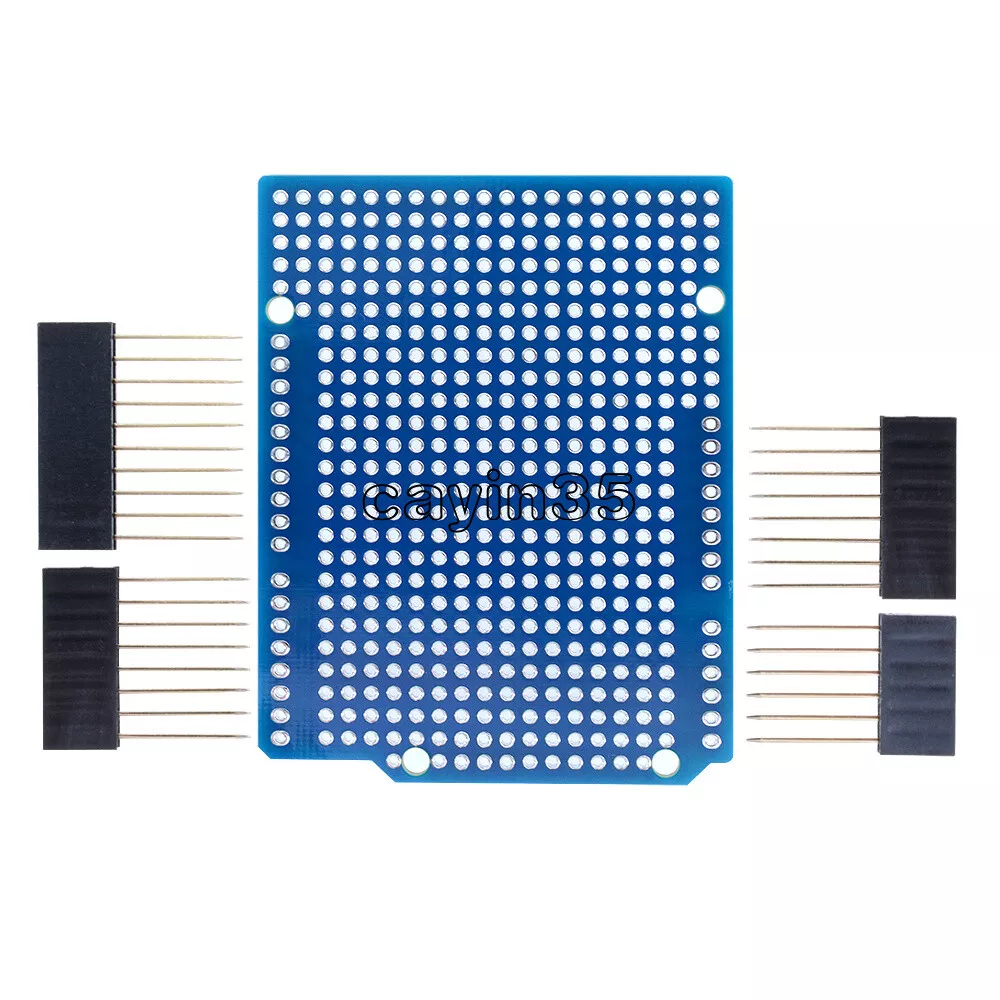
I'm trying to combine all the jumper wire connections to my Arduino into a single plug/socket, so that everything can be plugged or unplugged at once — neatly and without the risk of mixing up which wire goes where.
This feels especially important because the Arduino is used for a job, and it may need maintenance when I'm no longer around.
What’s the best method to turn multiple Arduino pin connections (whether from jumper wires or other cables) into a unified connector system, like a proper plug or socket?
Would love suggestions on what parts, headers, or techniques people here use for this.
What you do is solder male pins to the Arduino then solder female hdrs to a perf board. Now the Arduino can be removed without touching the wires. Sooder the wires to the bottom of the female hdrs. Or buy a screw base. Here is Amazon.CA link and a screen grab.
If all of the connections are to Dupont pins or sockets on the board and all of them are on the same section of pins/sockets then you can remove the connections from the single Dupont housings on the cables and put them into a multiple Dupont connector housing at the appropriate positions. This turns all of the connections into a single plug
@UKHeliBob is the method I use and I also color code them and mark the orientation. I also orient the notch on the side of the connector pointing away from the board, that makes it accessible with a test probe.
However, it needs to be soldered onto a piece of perfboard, to which the necessary wires should then be soldered. This is the recommended approach if you want a reliable and trouble-free electrical connection over the long term.
Other connectors, including jumper wires and even Dupont connectors, do not have the same cross-section and do not guarantee proper contact.
For professional use, in my opinion, there's no other choice. You can also create a perfboard or a PCB with male headers and plug the Arduino onto it upside down.
But in reality, for a final circuit, I wouldn't use an Arduino Uno—I would use a Nano instead.
You remove the plastic housings from the current single pins that plug into the Uno. They come out very easily by lifting the small plastic tag that holds them in place. The you insert the same pins into a multi pin housing as illustrated by @oldcurmudgeon
For this one, I tried that and it feels that the black part melts quickly when I tried soldering wires there, and the soldering result seems to snap easily as well. Dunno if there'd be a solution for that.
I guess I'd want to use this, but I wonder if there can be a way to prevent the Dupont connector being plugged in the wrong way, like how some sockets have built-in keying or notches to prevent incorrect orientation. I'm afraid that there can be people from a different division (or if i'm no longer there) trying to perform maintenance on said machine and plug the Dupont connector the wrong way.