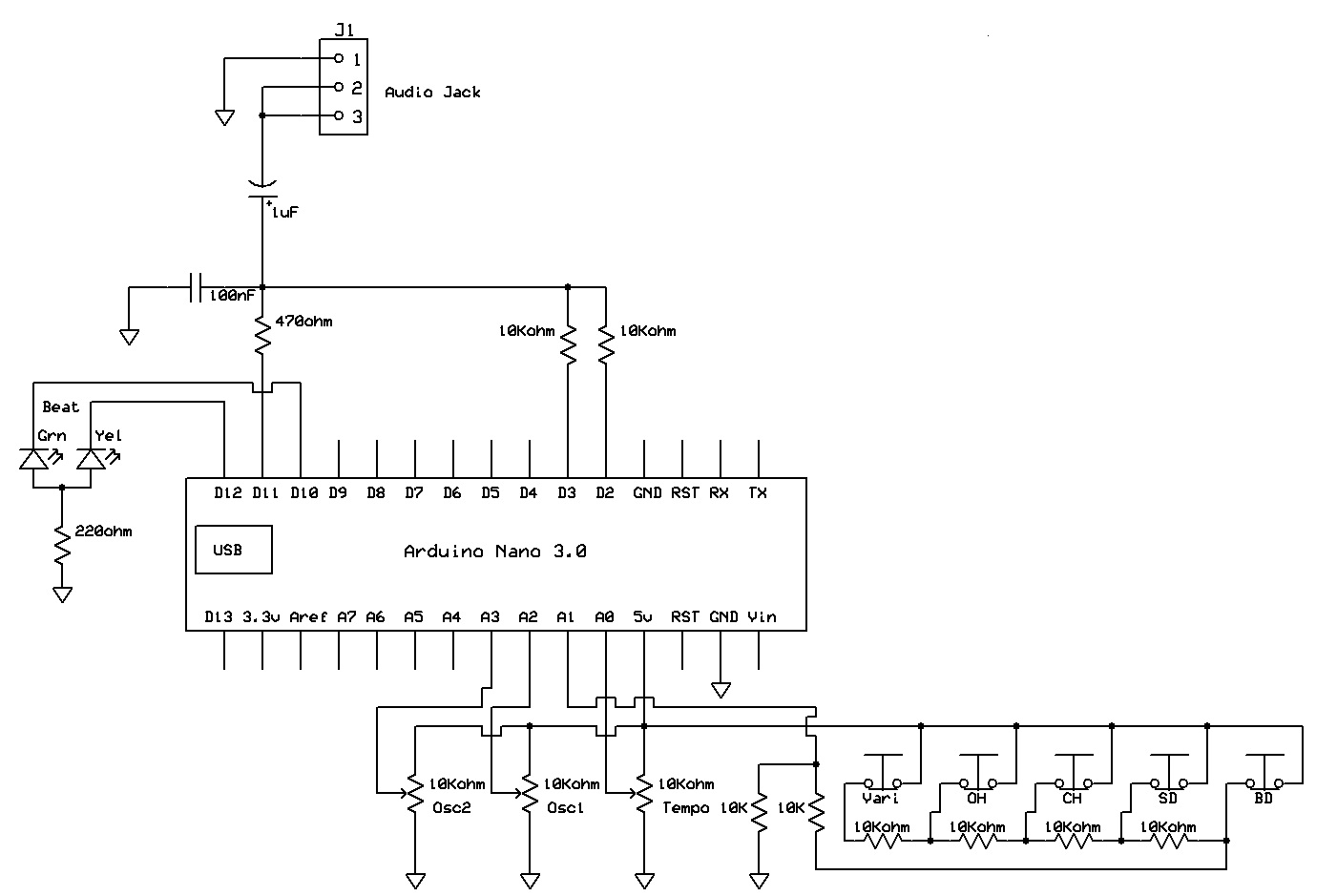
Here is the code as it is now.
It has only one single pattern but will compile and perform as in the video.
/*
 * Arduino Nano Groove, The smallest groovebox in the world.
 *
 * Plays 8-bit PCM Drums on pin 11 using pulse-width modulation (PWM).
 * For Arduino with Atmega328 at 16 MHz.
 *
 * Uses two timers. The first changes the sample value 8000 times a second.
 * The second holds pin 11 high for 0-255 ticks out of a 256-tick cycle,
 * depending on sample value. The second timer repeats 62500 times per second
 * (16000000 / 256), much faster than the playback rate (8000 Hz).
 * Based on code from Michael Smith.
 *
 * The The bassline synth is a true analog SAW synthesizer with its own audio output
 * The waveform is built on digitalpin2 and digitalpin3 mixed with a 10K resistor on each pin.
 * Two freerunning phaseaccumulators are used creating a phaseincrement.
 * The result is a real SAW-wave that is mixed with the PCM drumpart.
 * Hardware for this comes from Roland synthesizers, mainly the Juno 106 and ideas from Duane B, rcarduino.blogspot.com
 * Thanks for the inspiration.
 */

#include <stdint.h>
#include <avr/interrupt.h>
#include <avr/io.h>
#include <avr/pgmspace.h>

#define SAMPLE_RATE 8000

// Define various ADC prescaler
const unsigned char PS_16 = (1 << ADPS2);
const unsigned char PS_32 = (1 << ADPS2) | (1 << ADPS0);
const unsigned char PS_64 = (1 << ADPS2) | (1 << ADPS1);
const unsigned char PS_128 = (1 << ADPS2) | (1 << ADPS1) | (1 << ADPS0);

#include "sounddata.h"

int ledPin = 13;
int GRNledPin = 10;
int YELledPin = 12;
int speakerPin = 11; // Can be either 3 or 11, two PWM outputs connected to Timer 2
volatile uint16_t sample;
byte lastSample;
int sound_stop;
int BPM;
int BEAT;
int Tick;
int sixteen;
byte pat;
int mute;
int nextmute;
int bassgate;
int button;
int variation;

//float chromatic = 1.059463094359;

//float scale[] = { 1 , 1.059463094359 , 1.122462048308747 , 1.189207115001727 , 1.259921049893469 , 1.334839854168174 , 1.41421356237073 , 1.498307076873759 , 1.58740105196466 , 1.681792830503211 , 1.781797436275713 , 1.8877486253576 };
long scale[] = { 10000 , 10594 , 11224 , 11892 , 12599 , 13348 , 14142 , 14983 , 15874 , 16817 , 17817 , 18877 };

int pattern[] = { 1 , 0 , 4 , 0 , 3 , 0 , 4 , 0 , 1 , 0 , 4 , 0 , 3 , 0 , 4 , 8 , 1 , 0 , 4 , 4 , 1 , 0 , 5 , 4 , 1 , 0 , 5 , 5 , 3 , 0 , 3 , 6 };


int basspattern[] = { 0 , 0 , 2 , 1 , 0 , 0 , 1 , 0 , 0 , 0 , 1 , 0 , 0 , 0 , 3 , 4 };


//SAW Synth
long phacc1;
long phacc2;
int pitch1;
int pitch2;
int osc1;
int osc2;

void stopPlayback()
{
    // Disable playback per-sample interrupt.
    TIMSK1 &= ~_BV(OCIE1A);

    // Disable the per-sample timer completely.
    TCCR1B &= ~_BV(CS10);

    // Disable the PWM timer.
    TCCR2B &= ~_BV(CS10);

    digitalWrite(speakerPin, LOW);

  }


// This is called at 8000 Hz to load the next sample.
ISR(TIMER1_COMPA_vect) {
    if (sample >= sound_stop) {
      sample = sound_stop;
    }
    else {
        OCR2A = pgm_read_byte(&sounddata_data[sample]);
    }

    //The BassSynth
    phacc1 = phacc1 + pitch1;
    phacc2 = phacc2 + pitch2;
    osc1 = (phacc1 ) / 8192;
    osc2 = (phacc2 ) / 4096;

    // Output the SAW-wave to D2 and D3 without using digitalwrite because its to slow in a ISR.

    if (bassgate==1) {
    PORTD = PORTD & B11110011 | (osc1 | osc2 & 12); //Outputs the SAW Wave
    }

    ++sample;
    ++Tick;


}

void startPlayback()
{
    pinMode(speakerPin, OUTPUT);

    // Set up Timer 2 to do pulse width modulation on the speaker
    // pin.

    // Use internal clock (datasheet p.160)
    ASSR &= ~(_BV(EXCLK) | _BV(AS2));

    // Set fast PWM mode  (p.157)
    TCCR2A |= _BV(WGM21) | _BV(WGM20);
    TCCR2B &= ~_BV(WGM22);


        // Do non-inverting PWM on pin OC2A (p.155)
        // On the Arduino this is pin 11.
        TCCR2A = (TCCR2A | _BV(COM2A1)) & ~_BV(COM2A0);
        TCCR2A &= ~(_BV(COM2B1) | _BV(COM2B0));
        // No prescaler (p.158)
        TCCR2B = (TCCR2B & ~(_BV(CS12) | _BV(CS11))) | _BV(CS10);

        // Set initial pulse width to the first sample.
        OCR2A = pgm_read_byte(&sounddata_data[0]);


    // Set up Timer 1 to send a sample every interrupt.

    cli();

    // Set CTC mode (Clear Timer on Compare Match) (p.133)
    // Have to set OCR1A *after*, otherwise it gets reset to 0!
    TCCR1B = (TCCR1B & ~_BV(WGM13)) | _BV(WGM12);
    TCCR1A = TCCR1A & ~(_BV(WGM11) | _BV(WGM10));

    // No prescaler (p.134)
    TCCR1B = (TCCR1B & ~(_BV(CS12) | _BV(CS11))) | _BV(CS10);

    // Set the compare register (OCR1A).
    // OCR1A is a 16-bit register, so we have to do this with
    // interrupts disabled to be safe.
    OCR1A = F_CPU / SAMPLE_RATE;    // 16e6 / 8000 = 2000

    // Enable interrupt when TCNT1 == OCR1A (p.136)
    TIMSK1 |= _BV(OCIE1A);

    lastSample = pgm_read_byte(&sounddata_data[sounddata_length-1]);
    sample = 0;
    sei();
    digitalWrite(GRNledPin, LOW);
    digitalWrite(YELledPin, HIGH);
    Tick = 0;
    sixteen = 0;
    BEAT = 0;
}


void setup()
{
    pinMode(ledPin, OUTPUT);
    pinMode(GRNledPin, OUTPUT);
    pinMode(YELledPin, OUTPUT);
    digitalWrite(ledPin, HIGH);
    digitalWrite(GRNledPin, LOW);
    digitalWrite(YELledPin, LOW);
    pinMode(2, OUTPUT);
    pinMode(3, OUTPUT);
    startPlayback();

      // set up the ADC
  ADCSRA &= ~PS_128;  // remove bits set by Arduino library

  // you can choose a prescaler from above.
  // PS_16, PS_32, PS_64 or PS_128
  ADCSRA |= PS_32;    // set our own prescaler to 32

}

void loop()
{

    // calculate the tempo

    BPM = (analogRead(0) / 10) + 60;
    sixteen = 2000 - (BPM * 7);
    if (Tick >= sixteen) {


            Tick = 0;

 //Button 1 511
 //Button 2 339
 //Button 3 245
 //Button 4 203
 //Button 5 168

    button = analogRead(1);

    if (button > 150 and button <180) {
      variation = 1;

    }
    if (button > 195) {
      nextmute = 8;

    }
    if (button > 215) {
      nextmute = 4;

    }
    if (button > 260) {
      nextmute = 2;

    }
    if (button > 415) {
      nextmute = 1;

    }


            ++BEAT;

            // Calculate the next bass sound

            pitch1 = int(analogRead(2) * scale[basspattern[BEAT] - 1] / 10000);
            pitch2 = int(analogRead(3) * scale[basspattern[BEAT] - 1] / 10000);

            bassgate = 0;
            if (basspattern[BEAT] > 0) {
              bassgate = 1;
            }

            if (BEAT >= 16) {
              BEAT = 0;
              mute = mute ^ nextmute;
              nextmute = 0;
              variation = 0;

            }


            // Calculate the next drumsound

            sample = (pattern[BEAT + (variation * 16)] & mute) * 1024;
            sound_stop = sample + 1023;


            // Turn on the BPM flash LED

              switch (BEAT) {
              case 0:
              digitalWrite(YELledPin, HIGH);
              break;
              case 4:
              digitalWrite(GRNledPin, HIGH);
              break;
              case 8:
              digitalWrite(GRNledPin, HIGH);
              break;
              case 12:
              digitalWrite(GRNledPin, HIGH);
              break;


            }


        }

      // Turn off the BPM flash LED

      if (Tick >= 10) {
         digitalWrite(GRNledPin, LOW);
      }
      if (Tick >= 750) {
         digitalWrite(YELledPin, LOW);
      }


}
And the sounddata.h required. It's not complete because it contains 16384 samples and would not fit here.
// sounddata sound made by wav2c
// (wav2c modified to use unsigned samples)

/* const int sounddata_sampleRate=8000; */
const int sounddata_length=1024;

const unsigned char sounddata_data[] PROGMEM = { 128 , 128 ..... };
So I have attached it.
sounddata.h (95.5 KB)