Freetronics makes a version of the Uno with SD and Ethernet built-in, but a standard W5100 Ethernet shield for a standard Uno makes for a cheaper combination. That shield also has an SD slot.
You could use one of the ESP devices that have WiFi capability. If the readings are critical you can use a FRAM memory device as intermediate storage. Then if a scheduled upload is missed you will have enough for more data and it will remain even if the power fails.
I am not sure what the temperature range is but there are solid state sensors that that the Arduinos can talk to without an additional module.
If the time is not critical you can get it from the internet and use the internals mills as a time base. It will not be very accurate but that can be compensated with each time update from the internet.
Temperature range is 400F-450F
WiFi may be an option.
Time is not super critical, a few seconds of drift over the course of a day wouldn't hurt. Sending the log doesn't have to be 12:00a.m. on the dot.
does the area have local WiFi? if so an ESP32 with onboard WiFi capability would be a good choice
consider a ESP32-Cheap-Yellow-Display - it has an ESP32, a TFT screen for data display and an SD card
I use one with a [ds18b20 waterproof temperature sensor for monitoring heat pump output over several days
That's the trouble with Arduinos..
Projects grow as the not bad ideas accumulate. While I mentioned Uno before, I took your "that is all it will do" at face value. A Uno, or those of its ilk, are actually not the best choice for data logging as you might run out of programme memory. A Mega takes the same shields as a Uno and has much more memory available.
the main limitation with this display is access to GPIO pins - see section on Extended IO ESP32 Cheap Yellow Display (CYD) Pinout
e.g. GPIO 35, GPIO 22, GPIO 21, and GPIO 27 which gives access to I2C and ADC (the ds18b20 used a one wire interface so no problem)
I have seen a larger display with access to SPI but have never used it
however, if it does meet the project IO requirements having much of the complexity on a single PCB (ESP32, TFT, SD) minimizes wire interconnections which are a source of poor connections and intermittent problems
While the display would be a nice add-on, it is not required. The low price makes the CYD interesting, but I'm not sure it has I/O capacity. The thermocouple amp takes 4 DI/O pins for SPI.
What I do need is the thermocouple amp, a way of storing readings, and Ethernet (or possibly WiFi). I probably don't really need the RTC module as the timing doesn't need to be that accurate.
I'm thinking I'll go with an ESP-WROOM-32 board with FRAM and thermocouple modules.
if you do need Ethernet the wt32-eth01 (ESP32 with Ethernet on board) module referenced in post 16 does support SPI
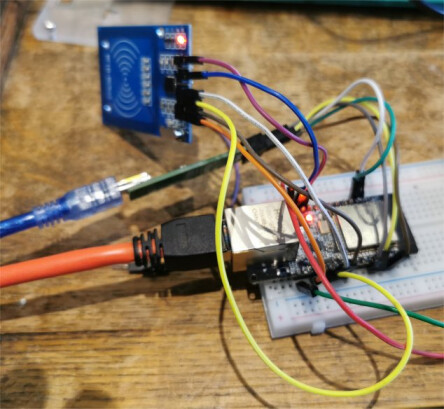
I connected a MFRC522 RFID reader to pins
//  HSPI pins used by MFRC522 RFID reader
#define HSPI_SCK 15
#define HSPI_MISO 14
#define HSPI_MOSI 12
#define HSPI_CS 4