HELP!!!
I have a radio transmitter sending out radio waves to a light bulb receiver. It uses an Arduino. I know my problem is not in the transmitter. This is the link for the reciever. Seeing radio waves with a light bulb - Make:.
I was on 1000mhz but I am now on 137mhz. Why is the light not lighting on the reciever? I am using a Christmas light. PLEASE HELP!!!
I know my problem is not in the transmitter
A statement belied by the thread title.
1000mHz?
Yes 1000megahertz
I didn't write 1000MHz.
What has this got to do with Arduino?
Did you adjust the dipole length?
I used an Arduino to choose what frequency I was on but the recieving light is getting voltage but not lighting. I will upload schematic in a minute.
First of all , your setup is obviosly not something we would be expected to know about.
Second, you have not provided schematic OR code. How do you expect us to help you ?
Oh sorry. I will upload it soon. Sorry.
This type of experiment needs a substantial amount of transmitter power, at least 5-10 watts, and both the
transmitting and receiving antennas must be resonant with the transmitters frequency.
I am powering it with 9volts. The schematics are almost done. Is that enough power on the transmitter?
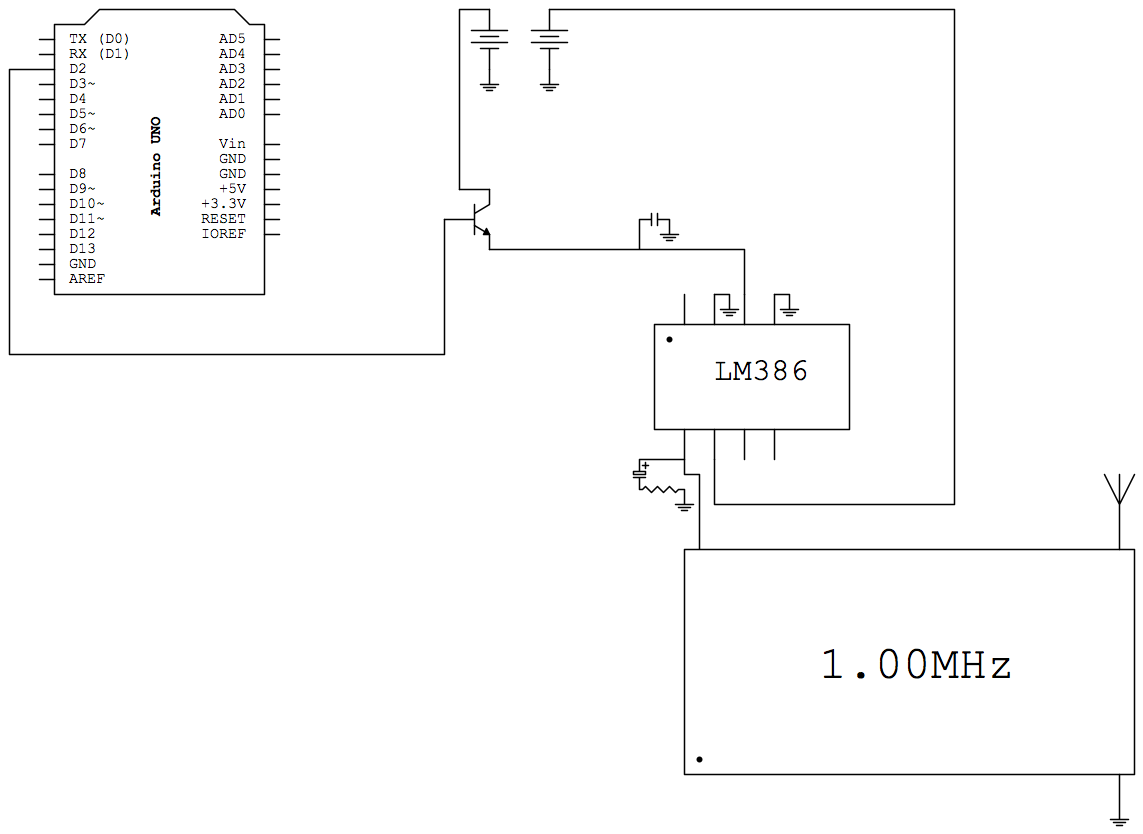
No wonder it doesn't work.
What kind of answer is that?
It is obvious from the schematic why the circuit doesn't work. Isn't it obvious to you?
Or, perhaps the schematic diagram does not correspond to the circuit you actually built, in which case it should be corrected.
Hi, first off, what you have built is a very elementary reciever, it picks up RF from a very close TX and the resultant current lights the GLOBE.
The problem is, in this case you need at least 5W of RF power.
Also the length of the two wires tunes the system to the frequency you are detecting. Each wire is 1/4 wavelength of the frequency.
Your mission, if you choose to learn, find out how you convert freq to wavelength, calculate what 1/4 of it is.
You did not say how much power your TX was, if less than a couple of watts, then its not very probable that you will get a glow.
Tom,... here to help you, help yourself.... 
PS. All you are doing with the arduino is supplying a modulation signal to the TX, NOT setting its output frequency. What is your TX frequency in MHz that is MegaHertz....?
What you have built isnt a transmitter.
To generate 136 Mhz at sufficient power to light the globe, you need a stable frequency source, usually a crystal oscillator.
You then need a series of frequency multiplier stages to multiply the crystal frequency up to 136 Mhz, and then an RF power amplifier to raise the power level sufficiently to light the globe.
None of this is easy stuff for a first project.
If you really want to learn how to build transmitters, then this book is a good place to start.
Be warned though, its a steep learning curve.
int freq = 136000000;//Hz
int del = (1000/freq)/2;
Just two lines of code; so many wrong things.
Is that enough power on the transmitter?
How could we possibly tell?
First off, thanks for all the responses I got. Second, I have also tried using my handheld ham radio to light the bulb and still nothing. The girl in the video used a slightly larger ham radio. The end result of this is for the transmitter to be able to change frequencies as it likes. Originally is did not have a transistor and a 9v because I had the Arduino connected to the lm386 input. I can change the frequency be changing how fast the Arduino let's power through the transistor. The crystal oscillator I have oscillates at 1MHz. So if the Arduino is sending in 136meg, being amped by the lm386 circuitry, and then oscillated again at 1meg, then the output is a more powerful 137meg. Am I correct? Also, if I need enormous amounts of power to light the bulb, How did the girl in the video get it to light with a simple dipole? Thanks!!!
So if the Arduino is sending in 136meg
That's an enormous "if"
See reply #15.
How do you imagine a 16MHz processor is going to produce 137MHz, except perhaps as some crazy harmonic?
Arduino is a 16MHz micro controller? If so how can I get it to go all the way up to 2000MHz. I am sure there is no crystal oscillator for it but WiFi can get that high. How can I?
If so how can I get it to go all the way up to 2000MHz
Cool to near 0K and massively over-clock it.
Seriously, you can't.
Did you read and understand reply #15?