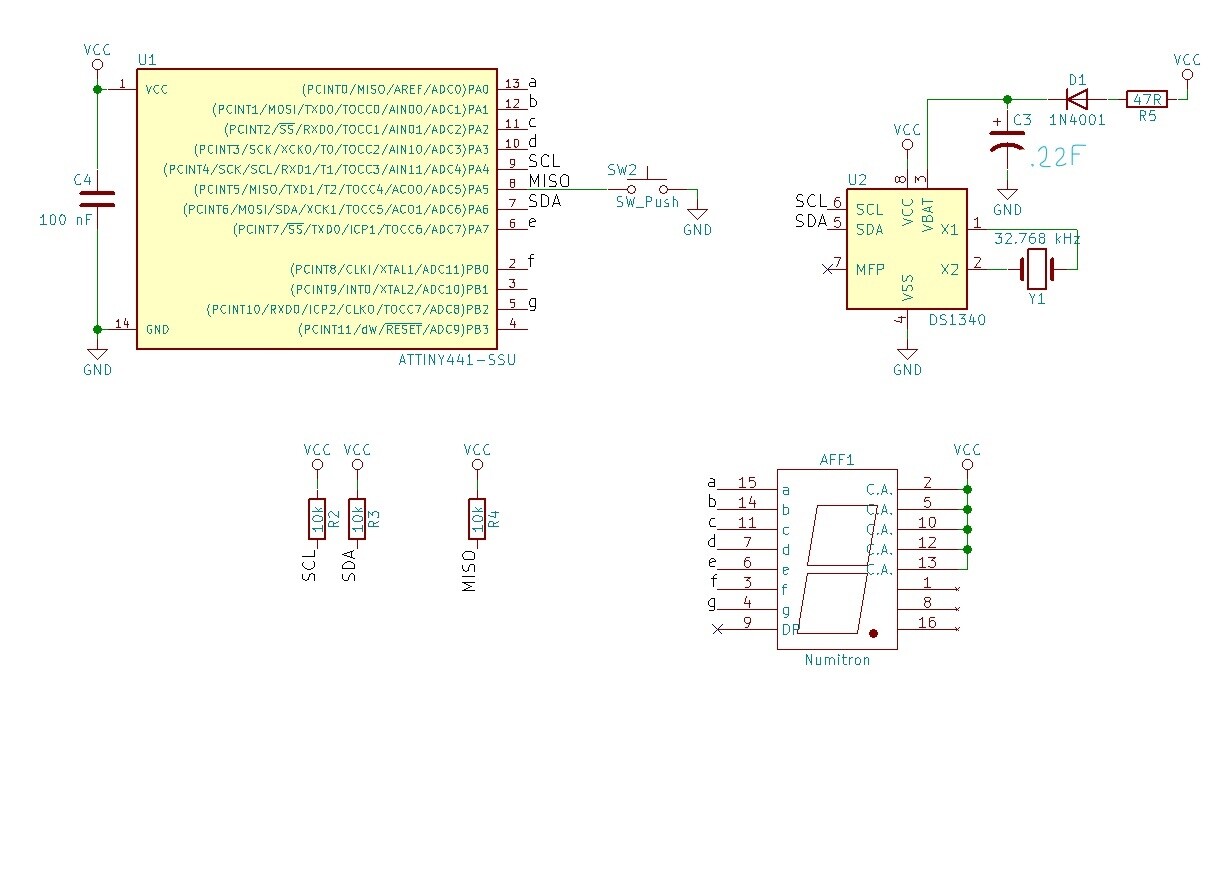
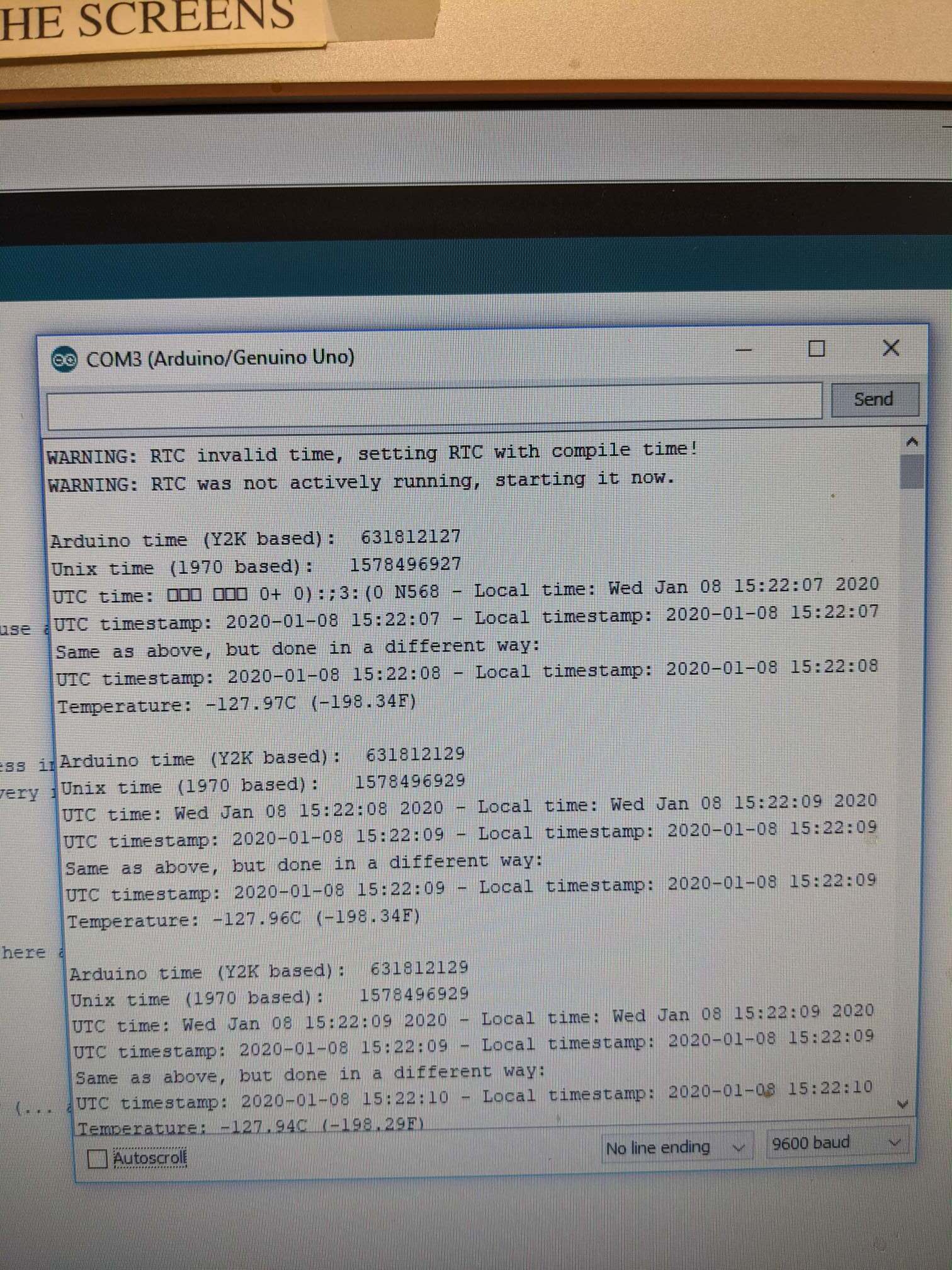
Hello all, first off you must know that I am a complete noob to this stuff. I have been trying to learn a little bit at a time. I am trying to make a single digit seven segment clock and I have the prototype almost working. Today I decided to see if I could switch from USB power( I am using the Arduino Uno as power) to battery power to run my Attiny. When I switched the time reset to 12:00. So I hooked up my Uno to the RTC and set the correct time again. The time was correct again. I proceeded to switch from USB power to battery power. Again it resets to 12:00.
I have done this about 10 times now with the same results. I am using a supercap for RTC backup power and it is charged when power is off. I am pretty sure all my wiring is correct. In fact it used to work, I could unplug the UNO over a weekend and come back and plug the Uno back in and the time would show up correct. I am at a loss, I don't know if I did something to the code or if it is the way I am setting the time. Any help would be greatly appreciated.
Here is my sketch
#include <Wire.h>

// I2C address
#define DS1307 B1101000

// pinout for the 7 segment display
// Starts top center, clock-wise, then
// center line, then dot
byte segment[] = {10, 9, 8, 7, 3, 2, 1};

byte second=0, minute=0, hour=0;
const int buttonPin = 0;     // the number of the pushbutton pin
int buttonState = 0;         // variable for reading the pushbutton status
bool showTime = false;

void updatetime();
void printtime();
void print7digit(byte number);
byte DECTOBCD(byte val);
byte BCDTODEC(byte val);
void clearDisplay();
void checkButton();

void setup() {
  byte i;
  Wire.begin();

  for (i=0; i<8; i++) {
    pinMode(segment[i], OUTPUT);
  }
  clearDisplay();
  // initialize the pushbutton pin as an input:
  pinMode(buttonPin, INPUT);
}

void checkButton() {
  // read the state of the pushbutton value:
  buttonState = digitalRead(buttonPin);

  // check if the pushbutton is pressed.
  // if it is, the buttonState is HIGH:
  if (buttonState == HIGH) {
    showTime = true;
  }
}

void loop() {
  checkButton();
  if(showTime) {
    updatetime();
    printtime();
    showTime = false;
  }
}

// Pull current time off the DS1307
void updatetime() {
  Wire.beginTransmission(DS1307);
  Wire.write(0x00);
  Wire.endTransmission();
  Wire.requestFrom(DS1307, 3);
  // Don't actually use seconds value. Feel free to.
  second = BCDTODEC(Wire.read() & 0x7f);
  minute = BCDTODEC(Wire.read());
  hour   = BCDTODEC(Wire.read() & 0x3f);
}

// Flash each digit of the time in turn on the 7 segment
void printtime() {
  byte j;
  // Convert from 24 hour to 12 hour mode
  // Should be done on the DS1307. I'm sorry.
  byte temphour = hour % 12;
  if (temphour == 0) {
    // Not zero based, not one based, but 12 based.
    temphour = 12;
  }

  int betweenSegmentDelay = 500;
  int clearDelay = 200;

// Hour
  // Only display highest digit if it's nonzero
  if (temphour > 9) {
    print7digit(temphour/10);
    delay(betweenSegmentDelay); // Repeated magic values in my code? Never!
    clearDisplay();
    delay(clearDelay);
  } else {
    print7digit(0);
    delay(betweenSegmentDelay); // Repeated magic values in my code? Never!
    clearDisplay();
    delay(clearDelay);
  }

  print7digit(temphour % 10);
  delay(betweenSegmentDelay);
  clearDisplay();
  delay(clearDelay);

// Minute
  print7digit(minute/10);
  delay(betweenSegmentDelay);
  clearDisplay();
  delay(clearDelay);

  print7digit(minute%10);
  delay(betweenSegmentDelay);
  clearDisplay();
  delay(clearDelay);
/*
// Seconds
  print7digit(second/10);
  delay(betweenSegmentDelay);
  clearDisplay();
  delay(clearDelay);

  print7digit(second%10);
  delay(betweenSegmentDelay);
  clearDisplay();
  delay(clearDelay);
*/

  delay(2000);
}

// Display a single digit on the 7 segment
void print7digit(byte number) {
  // Bitfield for digits 0-9
  const byte numtable[] = {B01000000,   // Numeral 0.
                     B01111001,   // Numeral 1.
                     B00100100,   // Numeral 2.
                     B00110000,   // Numeral 3.
                     B00011001,   // Numeral 4.
                     B00010010,   // Numeral 5.
                     B00000010,   // Numeral 6.
                     B01111000,   // Numeral 7.
                     B00000000,   // Numeral 8.
                     B00011000    // Numeral 9.
                    };
  byte litpins = numtable[number];
  byte i;
  for (i=0; i<7; i++) {
    digitalWrite(segment[i], (litpins>>i) & 1);
  }
}

void clearDisplay() {
  int j;
  for (j=0; j<8; j++) {
    digitalWrite(segment[j], HIGH);
  }
}

byte DECTOBCD(byte val) {
  return ((val/10)<<4) + (val%10);
}
byte BCDTODEC(byte val) {
  return (val>>4) * 10 + (val & 0xf);
}
Here is the sketch on how I am setting the time, it uses the Computer time and sets it automatically. there are three files in the sketch in the attachments.
Again I am a NOOB, most of this was pieced together with help from some of my friends and people on the forums. Thanks in advance
RTCtimeSet.ino (9.05 KB)
RTCtimeUtils.cpp (1.99 KB)
RTCtimeUtils.h (188 Bytes)