MaxG
August 10, 2023, 10:28pm
1
This seems to be the math behind the map() function:
long map(long x, long in_min, long in_max, long out_min, long out_max)
{
  return (x - in_min) * (out_max - out_min) / (in_max - in_min) + out_min;
}
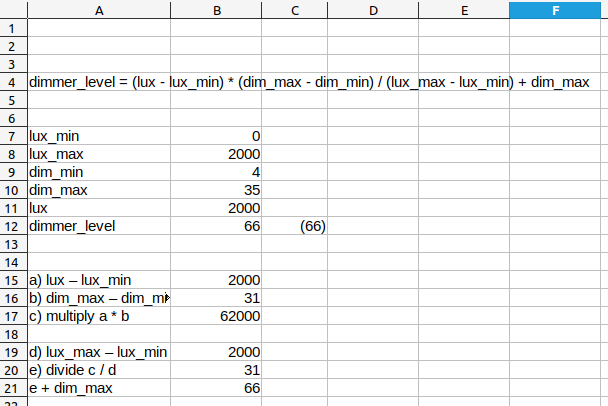
I have renamed the variables to calculate the dimmer level of a light in relation to a lux value.
dimmer_level = (lux - lux_min) * (dim_max - dim_min) / (lux_max - lux_min) + dim_max
Or as code:
int main (void)
{
    int lux_min	=    0;
    int lux_max	= 2000;
    int dim_min	=    4;
    int dim_max	=   35;

    int lux = 2000;

    int dimmer_level = (lux - lux_min) * (dim_max - dim_min) / (lux_max - lux_min) + dim_max;

    printf("dimmer value: %d\n", dimmer_level);

    return 0;
}
However, my result does not stay within out limits.
What did I get wrong?
MaxG
August 10, 2023, 10:52pm
2
Huh, found it!
The last value in my formula is dim_max; which should be dim_min.
The int data type will hold values from -32768 to 32767. Are any of the intermediate results of your calculations outside of that range?
See this thread >> Basic Calculation Results Wrong Value
Hi, @MaxG
The map function uses y = mx + c.
You may need to look at this function to use in conjunction with your values.https://www.arduino.cc/reference/en/language/functions/math/constrain/
Tom..
MaxG
August 10, 2023, 11:45pm
5
I actually constrain the in put between min and max.
The point of having a function is that you don't have to rename variables or use the wrong data types, thus avoiding the sorts of mistakes that you made in doing so.
system
February 7, 2024, 2:17am
7
This topic was automatically closed 180 days after the last reply. New replies are no longer allowed.


 Yes, I wanted to keep it simple and focus on the map function only.