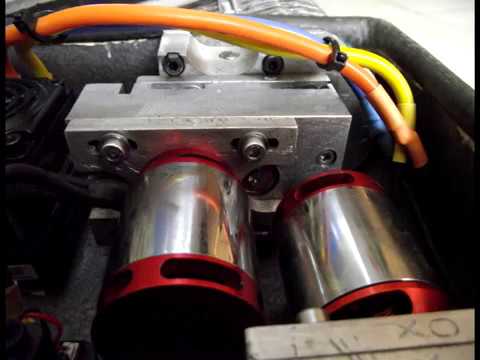
Ok - first off, shame on me for not watching the video first; my apologies - based on how the initial frame looked (showing chain-link treads) - I made the bad assumption that the machine was larger than it really was. Mea Culpa.
antisha:
I'm sorry if I confused you with my replies. All I want is to build toy scale (cca 35cm long, 20-30cm wide) RC tank with arduino as a brain, just like in video posted.
Do you insist on building it from the ground up? You mention it would be your first "amateur" project - perhaps your potential for success would be better realized by using an available R/C tank chassis? There are more than a few out there (airsoft and/or paintball combat tanks) that can be had for relatively low cost (around $100.00). Some have controllable turrets and firing mechanisms, too.
However, they tend to be made out of plastic - mostly...
antisha:
Tank made on video is made of steel, that's why I mentioned welding.
Looking at that video, more than a bit of machining was done to build it; do you have those skills (or do you know someone who does)? This project also probably wouldn't be inexpensive (neither time nor money, at that). Expect to spend at least a few hundred dollars or more, plus a lot of time machining, fitting, welding, etc. Then working out any bugs or other issues.
Using a pre-built chassis, as mentioned, especially for a "first project" - will likely yield results more quickly with less frustration (being overly ambitious on first projects without having had success in smaller but similar ones can be a recipe for disaster).
Also - does it have to be made of steel? As the link I posted before shows, several people have managed to construct R/C tanks from plywood and other easier-to-work materials; you might also consider using aluminium extrusions (either the common stuff you can find at a big-box home improvement store, or more advanced stuff like t-slot - makerbeam, 80/20, etc). Aluminium is much easier to work with than steel, though it isn't as inexpensive. Combine it, though, with stuff like PVC or ABS sheeting, as well as HDPE or similar (ie - plastic cutting board material) - all of which is also easy to machine and work with using fairly common hand tools, you might find your success rate higher (again, depending on your experience - or ability to find experience - in working with steel).
antisha:
My main problem is movement of tank, and that's why I need your help. Are there any low cost brushless motors on ebay that could move cca 16kg toy scale tank? And what kind of ESC and battery should be used?
Finally - is there a reason you seem to insist on using brushless motors? I only ask because the use of such motor almost always means you'll have to build a custom gear system to bring the torque up to acceptable levels. Even in that video, the person had to build a simple gearbox - and by the end had to redo it for some reason (either the tank moved too fast, or he was burning out the ESCs, or something?).
It's easier to find brushed motors with integrated gear boxes - they're all over the place; what can be difficult (and/or expensive) is finding motor controllers (or ESCs) that will work with such motors; but they also exist if you are willing to look.
An alternative would be to figure out how to mount a brushless motor to a separate gearbox (AC motors with integrated gearboxes tend to be cheaper - for instance, the gearboxes for rotisseries can make nice high-torque drives, though coupling a shaft to them can be problematic).