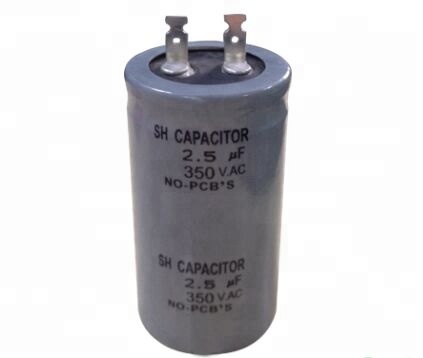
Right to the chase, induction heaters are awesome. But the capacitor selection is tedious. It seems that mkp capacitors are the best option. BUT,
What about these?
I dont see people mention these. Although electrolytic, they are quite big and seem capable enough to handle some current. I saw something about a low frequency /high frequency capacitor somewhere but google doesnt know anything about it..
kaseftamjid:
I don't see people mention these. Although electrolytic, they are quite big and seem capable enough to handle some current. I saw something about a low frequency /high frequency capacitor somewhere but google doesn't know anything about it..
To show an image, you have to insert the URL of an actual image, not a Web page.
These are not high frequency capacitors due to their method of construction. I very much doubt they would work and may explode.
MarkT:
Motor run capacitors are film capacitors, not electrolytic, as they are AC capacitors designed to last for decades,
that's why they are so large.
Sorry, again.
Does size=more current capability=lower than maximum load=longer lifespan?
Does size=more current capability=lower than maximum load=longer lifespan?
The answer to all the questions is: not necessarily.
Heat is the weak link in all electrical/electronic devices. The data sheet for capacitors will usually show a value range for the "effective series resistance" or ESR. All capacitors have a resistance to AC. That resistance produces heat. If the AC current through the capacitor it too great and is applied for too long, the internal components will be destroyed. Size of the capacitor has no bearing, it is the material used to build the capacitor.
Electrolytic capacitors used with DC will show a "leakage" current. This too, will cause heat and will destroy the capacitor with either a loud bang or a blown out spot designed for just such a case.
That is not an electrolytic capacitor. BTW there is a special kind of capacitors (MKPH) designed speciffically to be used in HF high current applications. Use those if possible. And read datasheets. They usually contain useful informations regarding the capacitor's ESR, ESL and dissipation factor.
Nice..
Is there any possibility of using mkph capacitor in ships?
You see, i live near somewhere they sell scrapped ship electronics.
Got a 60A omron ssr for 20 tk (1/4th of a dollar)
I don't know but you can get them on ebay or aliexpress I believe. It is aslo possible to use standard MKP caps, though. They may be less efficient but nothing terrible.
kaseftamjid:
I still dont get the high frequency bit
Each type of capacitor has a maximum frequency where it will still look like a capacitor. Over that frequency it will look like an inductor. This is called the resonant frequency of the capacitor and it depends on the value and the type.
The other related measure of this is the ESR or Effective Serial Resistance of the capacitor, which how much capacitance reactance it has rather than how much simple theory would say the capacitive reactance is. Low ESR capacitors are needed in things like power supplies, especially switch mode ones.
Google knows all about this, you must have been using the wrong words.
Grumpy_Mike:
Each type of capacitor has a maximum frequency where it will still look like a capacitor. Over that frequency it will look like an inductor. This is called the resonant frequency of the capacitor and it depends on the value and the type.
The other related measure of this is the ESR or Effective Serial Resistance of the capacitor, which how much capacitance reactance it has rather than how much simple theory would say the capacitive reactance is. Low ESR capacitors are needed in things like power supplies, especially switch mode ones.
Google knows all about this, you must have been using the wrong words.
 these?